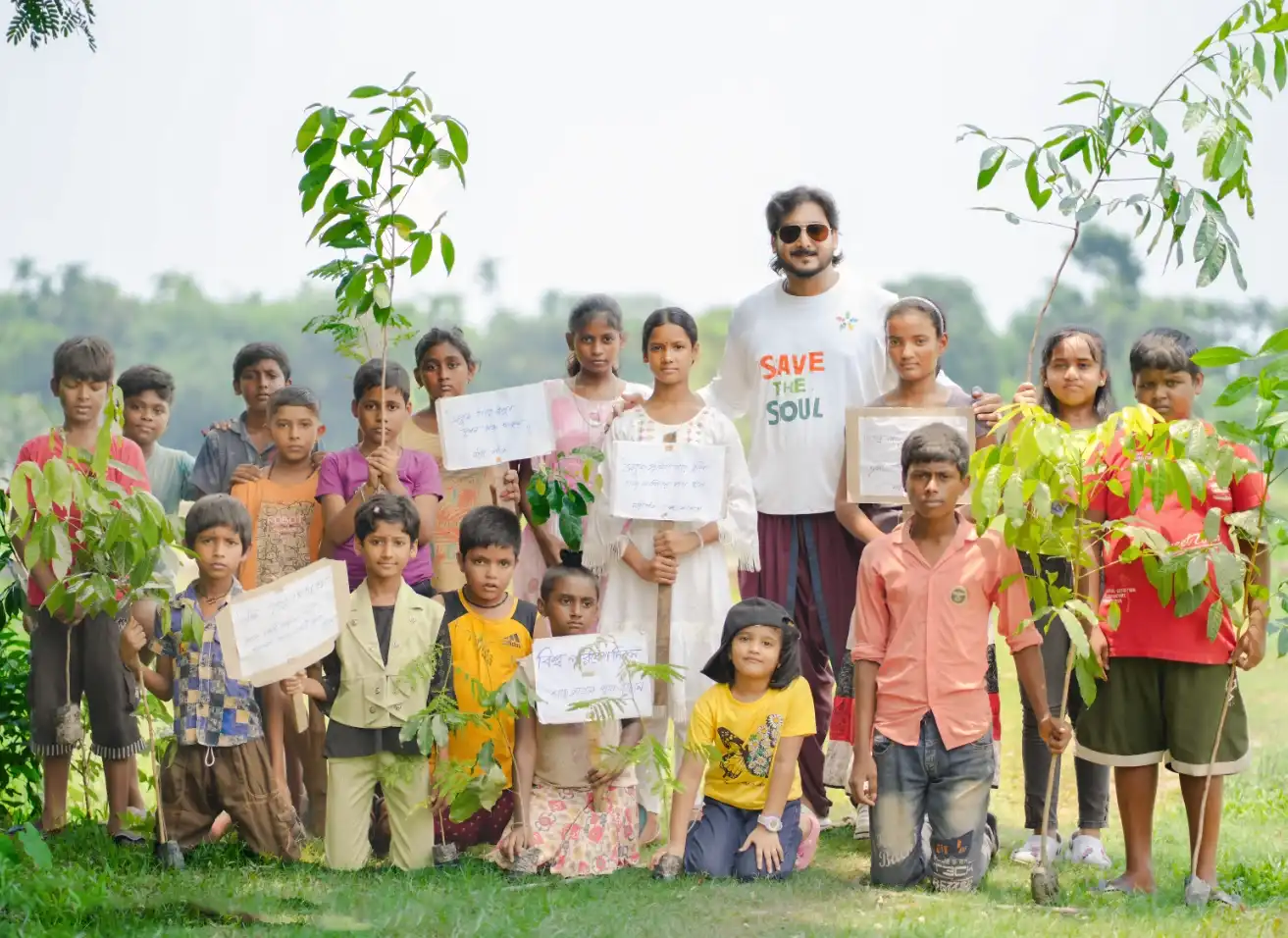
Growing Hope for a Greener Tomorrow
Organised by Nabatara Foundation, a registered non-profit organization working across India, the Tree Plantation Drive became a living embodiment of sustainable action. In an era where climate discussions often remain confined to conferences and policy debates, this initiative translated concern into soil, roots, and responsibility.
The event brought together celebrities, journalists, students, senior citizens, volunteers, and partner NGOs in a shared act of environmental stewardship. There was no performative urgency. There was collective intention. Every sapling planted symbolised a commitment not just to greenery, but to intergenerational responsibility.
In today’s India, where urbanization accelerates faster than ecological recovery, Tree Plantation Drives are no longer optional awareness campaigns. They are structural necessities.
The Environmental Reality of Modern India
India stands at a critical environmental crossroads. Rapid infrastructure development, expanding cities, and rising population density have placed significant pressure on natural ecosystems. Urban centers such as Kolkata are experiencing increased heat retention, declining green cover, deteriorating air quality, and water stress.
The urgency of a structured Tree Plantation Drive in India must be understood against this backdrop.
Environmental data consistently shows rising temperatures across multiple Indian states. Heatwaves are becoming longer and more intense. Monsoon patterns are increasingly erratic. Flooding alternates with drought conditions. Air pollution remains one of the most pressing public health challenges in major cities.
In such a scenario, community plantation drives serve as decentralized climate mitigation tools. Trees absorb carbon dioxide, filter particulate matter, release oxygen, reduce urban heat island effects, stabilize soil, and enhance biodiversity. They are one of the few natural interventions capable of addressing multiple environmental challenges simultaneously.
The Nabatara Tree Plantation Drive was conceptualized with this multi-dimensional environmental urgency in mind. It was not an isolated event; it was part of a broader sustainable living campaign rooted in ecological responsibility.
Nabatara Foundation: An Environment NGO in Kolkata with a Broader Vision
As an established Environment NGO in Kolkata, Nabatara Foundation has consistently integrated environmental responsibility into its wider social mission. While the organization is known for its healthcare and community development initiatives, its environmental programs reflect an understanding that human welfare and ecological balance are inseparable.
Under the guidance of Gaurav Tribedi, the foundation has emphasized that environmental degradation directly impacts public health, economic stability, and social equity. The Tree Plantation Drive of 2025 therefore represented a strategic expansion of the organization’s long-term community development framework.
Rather than positioning the event as a symbolic observance, Nabatara framed it as an ongoing green initiative in India. The intention was to create replicable models for community participation that could be scaled across cities such as Mumbai, Prayagraj, and other emerging urban hubs.
An effective Environment NGO in Kolkata must do more than organize events. It must build awareness ecosystems. The Nabatara Tree Plantation Drive achieved precisely that.
A Day That Transformed Soil into Symbolism
On the morning of 5th June 2025, participants gathered with a shared sense of purpose. The alignment with World Environment Day India gave the event symbolic significance, but the atmosphere remained grounded and sincere.
There were no extravagant stages. No performative speeches overshadowed the work. Instead, volunteers moved steadily from pit to pit, preparing the earth for saplings selected for their climate resilience and ecological suitability.
Students knelt beside senior citizens. Media professionals engaged in hands-on participation rather than passive coverage. Celebrities contributed quietly, understanding that influence is most powerful when expressed through action.
Each sapling planted during the Tree Plantation Drive carried personal meaning. Some were dedicated to future generations. Others were planted in memory of loved ones. Many represented individual commitments to adopt sustainable living practices.
The emotional undercurrent of the event transformed a standard community plantation drive into a reflective experience.
Tree Plantation Drive as a Sustainable Living Campaign
A Tree Plantation Drive becomes transformative when it is integrated into a broader sustainable living campaign. During the event, conversations naturally expanded beyond planting activities.
Participants discussed waste management challenges in Kolkata, the growing problem of plastic pollution, the need for rainwater harvesting, and the importance of conscious consumption. The initiative encouraged individuals to recognize that environmental responsibility is not confined to a single day.
Sustainable living in India requires behavioral shifts at scale. It involves reducing unnecessary consumption, conserving water, segregating waste, supporting local ecosystems, and making mindful lifestyle decisions.
The Nabatara Tree Plantation Drive served as a practical entry point into these deeper environmental dialogues.
The Science Behind Community Plantation Drives
From an environmental science perspective, Tree Plantation Drives contribute to urban ecological resilience in measurable ways.
Trees regulate microclimates by providing shade and releasing moisture through transpiration. This reduces surface and air temperatures in densely built environments. In cities like Kolkata, where summer heat can become extreme, increased tree cover significantly improves comfort levels and reduces energy consumption for cooling.
Trees also function as natural air filtration systems. Their leaves capture particulate matter, while their biological processes absorb pollutants such as carbon dioxide and nitrogen oxides. Over time, increased green cover leads to improved air quality.
Additionally, root systems stabilize soil, preventing erosion during heavy rainfall — a growing concern given changing monsoon patterns. Urban flooding can be mitigated when soil retains higher absorption capacity due to tree presence.
The Nabatara Tree Plantation Drive incorporated species chosen for long-term survival and ecological compatibility. This scientific approach differentiates a serious green initiative in India from superficial plantation activities.
Youth Participation and Environmental Identity
One of the most impactful aspects of the 2025 Tree Plantation Drive was the active engagement of students. Youth involvement in environmental programs is critical for long-term change.
When young individuals participate in a community plantation drive, environmental consciousness becomes experiential rather than theoretical. Planting a tree is not just a civic duty; it becomes a formative memory.
Students who attended the Nabatara Tree Plantation Drive asked informed questions about biodiversity, climate change, and urban sustainability. They demonstrated awareness that environmental challenges will shape their future.
By encouraging youth leadership in environmental programs, Nabatara Foundation is investing in a generation that views sustainability not as activism, but as normalcy.
Corporate Collaboration and Green Initiative India
Corporate Social Responsibility (CSR) frameworks in India increasingly prioritize sustainability metrics. Companies seek authentic partnerships that demonstrate measurable environmental impact rather than symbolic compliance.
The Nabatara Tree Plantation Drive provides structured opportunities for corporate collaboration. By partnering with an established Environment NGO in Kolkata, corporations can align their CSR efforts with tangible ecological outcomes.
CSR-based Tree Plantation Drives also enhance employee engagement. When employees physically participate in plantation activities, organizational sustainability goals gain emotional depth.
This alignment between NGOs and corporates strengthens the broader green initiative India ecosystem.
Ensuring Survival Beyond Plantation Day
A recurring challenge in many plantation campaigns across India is low survival rates of saplings. Without structured monitoring and maintenance, Tree Plantation Drives risk becoming performative.
Nabatara Foundation addressed this issue through post-plantation planning. Volunteers committed to regular follow-ups. Local community members were encouraged to adopt saplings. Monitoring schedules were established.
Environmental responsibility extends beyond planting. It requires nurturing.
The long-term success of the Nabatara Tree Plantation Drive depends not merely on the number of saplings planted, but on how many mature into thriving trees.
Expanding Environmental Impact Across Indian Cities
While the 2025 initiative focused on Kolkata, Nabatara Foundation has articulated a vision for multi-city expansion. Urban centers such as Mumbai and Prayagraj face their own environmental challenges, from air pollution to green space depletion.
Scaling community plantation drives across India requires local ecological adaptation. Native species selection, soil analysis, water availability, and community engagement must be customized to each region.
A scalable green initiative in India is not about replication without context. It is about structured adaptation with consistent environmental values.
Environmental Responsibility as a Cultural Value
India’s cultural heritage has long revered nature. Forests, rivers, mountains, and trees hold spiritual significance in various traditions.
Reintegrating this perspective into modern sustainability efforts strengthens environmental programs. When individuals perceive tree plantation as a sacred responsibility rather than a temporary campaign, participation becomes internalized.
The Nabatara Tree Plantation Drive subtly reinforced this philosophy. Protecting nature was framed not as activism, but as duty.
Climate Change in India and the Urgency of Grassroots Action
India’s environmental challenges are no longer projections confined to scientific reports. They are visible in everyday life. Summers are hotter. Monsoons are less predictable. Urban flooding alternates with water shortages. Air quality alerts have become common in multiple cities.
In this context, a Tree Plantation Drive becomes far more than a symbolic act of planting greenery. It becomes a frontline climate response.
Rising temperatures across eastern India, including West Bengal, are increasing heat stress in urban populations. Dense construction absorbs and retains heat, creating what environmental scientists refer to as the “urban heat island effect.†Areas with limited green cover can record temperatures several degrees higher than surrounding rural zones.
Trees are one of the most effective natural solutions to this problem. Through shade and evapotranspiration, they cool their surroundings. Large-scale community plantation drives can gradually transform microclimates, making neighborhoods more livable.
The Nabatara Tree Plantation Drive directly contributes to this climate resilience model. By increasing green cover in Kolkata, the initiative strengthens local ecological balance while contributing to national climate mitigation goals.
Air Pollution and the Need for Environmental NGOs in Kolkata
Kolkata, like many growing metropolitan cities in India, faces air quality challenges driven by vehicular emissions, construction dust, industrial activity, and seasonal climatic conditions. While policy frameworks and regulations are essential, community-driven environmental programs add an important layer of support.
An Environment NGO in Kolkata plays a crucial bridging role between policy and public participation.
The Nabatara Tree Plantation Drive illustrates how localized action can complement broader environmental strategies. Trees function as biological air filters. Their leaves trap particulate matter, while their metabolic processes absorb carbon dioxide and release oxygen.
Over time, increased tree density reduces ambient pollution levels and improves respiratory health outcomes. When environmental NGOs mobilize citizens to participate in plantation efforts, they convert passive awareness into active contribution.
This is the structural value of a well-organized Tree Plantation Drive.
Community Psychology and Environmental Participation
Environmental transformation is not driven by information alone. It is driven by belonging.
One of the most important outcomes of the Nabatara Tree Plantation Drive was the sense of collective ownership it created. When individuals plant trees together, environmental responsibility becomes shared identity rather than abstract obligation.
Research in community engagement consistently shows that participatory initiatives generate stronger long-term behavioral change than lecture-based awareness programs. Planting a sapling creates emotional investment. Watching it grow reinforces commitment.
The 5th June 2025 initiative fostered this sense of connection. Participants did not simply attend an event; they became contributors to a green initiative in India that extended beyond a single day.
This is how sustainable living campaigns evolve into movements.
Native Species Selection and Ecological Responsibility
A successful Tree Plantation Drive requires thoughtful planning. One of the most overlooked aspects of plantation campaigns in India is species selection.
Planting non-native or water-intensive trees can create ecological imbalance. In contrast, climate-resilient and native species support biodiversity, require less maintenance, and adapt better to local soil and weather conditions.
The Nabatara Tree Plantation Drive prioritized species suited to Kolkata’s climatic profile. This approach ensures higher survival rates and long-term ecological integration.
Native trees provide habitat for local birds, insects, and small animals. They contribute to restoring fragmented urban ecosystems. In this way, a community plantation drive becomes not just a carbon-offset initiative but a biodiversity restoration strategy.
Responsible plantation is science-backed plantation.
Sustainable Living in Urban India: Beyond Plantation
While Tree Plantation Drives are powerful catalysts, sustainable living in India requires a comprehensive framework. During the Nabatara initiative, discussions extended into broader environmental behaviors that influence daily life.
Urban sustainability includes responsible waste management. Segregating waste at the source reduces landfill burden and enables recycling systems to function efficiently. Composting organic waste transforms households into micro-contributors to soil health.
Water conservation is equally crucial. Rainwater harvesting, mindful consumption, and efficient plumbing systems reduce strain on municipal supply networks.
Energy use patterns also shape environmental outcomes. Choosing energy-efficient appliances, reducing unnecessary electricity consumption, and supporting renewable energy options collectively reduce carbon footprints.
The Nabatara Tree Plantation Drive positioned tree planting as an entry point into this broader sustainable living campaign. The message was clear: planting a tree is the beginning of environmental awareness, not the conclusion.
The Economic Value of Green Initiatives in India
Environmental sustainability is often perceived as a moral obligation, but it also carries economic value. Green spaces increase property value, enhance tourism appeal, reduce healthcare costs linked to pollution, and create employment opportunities in environmental management.
Cities that invest in green initiative India programs experience improved livability indices. Businesses prefer operating in environments with better air quality and infrastructure resilience. Urban greenery contributes to mental well-being, reducing stress and improving productivity.
The Nabatara Tree Plantation Drive indirectly supports this economic dimension. By contributing to ecological restoration, it enhances the long-term sustainability of urban development.
When environmental NGOs in Kolkata take proactive roles in green initiatives, they are strengthening both environmental and economic ecosystems.
Media Visibility and Environmental Narrative Building
The presence of media professionals at the Tree Plantation Drive amplified its reach beyond physical participants. Environmental campaigns gain momentum when stories are shared widely.
However, credibility is built through authenticity. Media coverage of the Nabatara Tree Plantation Drive highlighted hands-on participation rather than staged representation.
Narrative building plays a critical role in green initiative India campaigns. When citizens see recognizable public figures engaging sincerely in environmental efforts, skepticism decreases and participation increases.
A well-executed Tree Plantation Drive becomes a reference point for future environmental collaboration.
Monitoring Impact: Accountability in Environmental Programs
One of the challenges faced by plantation campaigns across India is lack of measurable follow-up. Saplings are planted in large numbers, but survival tracking is often absent.
The Nabatara Tree Plantation Drive incorporated structured accountability. Volunteers and community members committed to monitoring growth stages. Maintenance schedules were discussed. Local engagement was encouraged to prevent neglect.
Long-term impact measurement is essential for building trust and attracting CSR partnerships. Corporates supporting sustainable living campaigns seek data-driven accountability.
By prioritizing survival and monitoring, Nabatara Foundation strengthens its credibility as an Environment NGO in Kolkata committed to results rather than optics.
Intergenerational Responsibility and Environmental Ethics
Environmental protection is inherently intergenerational. Trees planted today will mature over decades, providing shade, oxygen, and ecological stability for future communities.
The emotional dimension of the Tree Plantation Drive became evident as participants reflected on this timeline. A sapling planted in 2025 may provide shelter in 2045 or 2055. This temporal extension encourages long-term thinking.
Modern consumer culture often prioritizes short-term convenience. Environmental initiatives counter this mindset by emphasizing continuity.
The Nabatara Tree Plantation Drive subtly reinforced the idea that environmental responsibility transcends individual lifespan. It is a gift to the future.
Policy Context: Aligning with National Environmental Goals
India has committed to multiple climate and sustainability targets at the national and international levels. Increasing forest and tree cover is a core component of national environmental strategies.
Community plantation drives complement governmental efforts by mobilizing civil society participation. Environmental NGOs act as execution partners at the grassroots level.
The Nabatara Tree Plantation Drive aligns with these broader goals by increasing localized green cover and promoting environmental awareness.
Such alignment enhances institutional credibility and opens avenues for larger-scale collaborations.
From Kolkata to a National Green Movement
While the 5th June 2025 Tree Plantation Drive was rooted in Kolkata, its framework is adaptable. Each city in India faces unique environmental challenges. Coastal cities confront rising sea levels and humidity. Inland cities face heat stress and water scarcity. Industrial hubs manage pollution burdens.
A scalable green initiative India strategy requires decentralized leadership. Nabatara Foundation’s model demonstrates how structured planning, community engagement, and long-term monitoring can be replicated across regions.
Expanding the Tree Plantation Drive model nationally would create a network of interconnected environmental communities, each contributing to broader climate resilience.
How Individuals and Institutions Can Collaborate
Participation in a Tree Plantation Drive should not be limited to annual events. Individuals can collaborate year-round through volunteering, awareness campaigns, educational partnerships, and CSR engagement.
Schools and colleges can integrate plantation programs into environmental education curricula. Corporate organizations can align sustainability goals with structured plantation initiatives. Local communities can adopt neighborhood green spaces.
Environmental responsibility becomes powerful when decentralized ownership replaces centralized management.
The Nabatara Tree Plantation Drive offers a framework for inclusive participation, inviting individuals and institutions to join a growing sustainability network.
Urban India at a Turning Point: Why Tree Plantation Drives Define the Future
India’s cities are expanding at an unprecedented pace. Infrastructure development, residential complexes, highways, and commercial zones are reshaping skylines across the country. While economic growth remains essential, ecological balance often struggles to keep pace with rapid urbanization.
In cities like Kolkata, green cover has steadily declined in certain zones due to construction density. As concrete replaces soil, the natural capacity of land to absorb heat and rainfall reduces significantly. This imbalance contributes to flooding during heavy rains and extreme heat during summer months.
A structured Tree Plantation Drive directly addresses this imbalance. By increasing the number of trees within urban landscapes, cities regain some of their natural buffering capacity. Trees slow down rainwater runoff, stabilize soil, reduce ambient temperature, and filter pollutants from the air.
The Nabatara Tree Plantation Drive represents a localized yet scalable solution to these broader urban challenges. Rather than waiting for systemic reforms alone, this green initiative in India demonstrates how community participation can produce measurable environmental recovery.
Environmental Awareness in India: From Information to Implementation
Environmental awareness in India has grown significantly over the past decade. Climate change is no longer an abstract global topic. School textbooks, media debates, and digital platforms frequently discuss sustainability.
However, awareness without implementation remains incomplete.
The power of a Tree Plantation Drive lies in converting awareness into action. When individuals physically engage in planting and nurturing saplings, environmental education becomes experiential. The shift from “knowing†to “doing†strengthens long-term commitment.
The 5th June 2025 initiative organized by Nabatara Foundation reflected this transition. It was not a seminar about climate change. It was climate action grounded in soil.
This is where an Environment NGO in Kolkata can make a decisive impact — by transforming environmental consciousness into structured community programs.
The Role of Civil Society in Climate Responsibility
Governments establish environmental policies, and corporations invest in sustainability frameworks. Yet civil society remains the connective tissue between regulation and daily practice.
Environmental NGOs serve as facilitators of grassroots change. They create platforms where citizens can contribute directly to ecological restoration.
The Nabatara Tree Plantation Drive demonstrates the importance of civil society leadership. By bringing together diverse stakeholders — students, media professionals, celebrities, elders, volunteers — the initiative blurred traditional boundaries between institutions and individuals.
Climate responsibility becomes stronger when distributed across society rather than centralized within institutions.
Community plantation drives foster this distribution of responsibility.
Measuring Environmental Impact: Beyond Plantation Numbers
In India, plantation campaigns often emphasize the number of saplings planted. While numbers are important, impact must be evaluated through survival rates, canopy growth, biodiversity support, and long-term maintenance.
The Nabatara Tree Plantation Drive adopted a more holistic perspective. The focus extended to monitoring, community adoption, and species suitability.
A sapling that survives five years contributes significantly more ecological value than multiple saplings that fail within months.
Environmental credibility depends on measurable continuity.
By integrating follow-up care into its sustainable living campaign, Nabatara Foundation strengthened the long-term ecological potential of the initiative.
Climate Resilience and Urban Heat Mitigation
Heatwaves across India are becoming longer and more severe. Urban environments intensify this problem due to asphalt, glass, and concrete surfaces that absorb and retain heat.
Trees counteract this phenomenon naturally. Shaded streets can be several degrees cooler than exposed ones. Neighborhoods with higher tree density experience improved microclimates.
The Nabatara Tree Plantation Drive contributes directly to this urban cooling mechanism. Over time, the planted saplings will form canopies that provide shade, reduce surface temperature, and improve pedestrian comfort.
Urban heat mitigation is not an abstract concept. It is a daily quality-of-life factor. Tree Plantation Drives therefore function as long-term public health investments.
Biodiversity Restoration in Urban Landscapes
Urban expansion often fragments natural habitats. Birds, insects, and small mammals lose nesting and feeding grounds. Biodiversity decline affects ecological balance and pollination systems.
Community plantation drives that prioritize native species help reverse this fragmentation.
The Nabatara Tree Plantation Drive incorporated biodiversity considerations into its planning. Native trees support local ecosystems by providing appropriate habitat conditions.
Restoring biodiversity is essential for maintaining ecological stability. Pollinators, for example, play critical roles in food production systems. By supporting biodiversity through tree plantation, environmental NGOs indirectly strengthen agricultural resilience.
This interconnected perspective distinguishes strategic green initiative India programs from surface-level environmental events.
The Cultural Significance of Trees in Indian Tradition
India’s cultural history deeply reveres trees. Sacred groves, ancient banyan trees, and ritualistic plantings reflect an enduring respect for nature.
Modern environmental campaigns can draw strength from this heritage.
The Nabatara Tree Plantation Drive subtly aligned with this cultural narrative. Planting a tree was framed not merely as environmental activism but as a reaffirmation of responsibility embedded within Indian values.
When environmental action resonates culturally, participation becomes organic rather than forced.
A successful sustainable living campaign must integrate ecological science with cultural understanding.
Education, Youth Leadership, and Environmental Continuity
Educational institutions play a central role in shaping environmental attitudes. The participation of students in the 2025 Tree Plantation Drive demonstrated how experiential learning strengthens environmental commitment.
Young participants witnessed firsthand the effort required to prepare soil, position roots, and water saplings. This tactile experience fosters deeper respect for nature.
Environmental education in India is evolving. Beyond textbooks, practical engagement through community plantation drives creates future leaders who understand sustainability from lived experience.
An Environment NGO in Kolkata that actively collaborates with schools contributes to generational environmental literacy.
Corporate ESG Goals and Structured Plantation Programs
Environmental, Social, and Governance (ESG) metrics are increasingly important for corporate accountability in India. Companies are expected to demonstrate measurable sustainability impact.
Tree Plantation Drives offer tangible environmental contribution. However, corporates seek structured programs with long-term monitoring and transparent reporting.
The Nabatara Tree Plantation Drive provides a model that aligns with CSR and ESG objectives. By ensuring sapling survival and community engagement, the initiative creates credible environmental value.
Corporate collaboration amplifies scale while NGOs ensure integrity.
This synergy strengthens India’s green initiative ecosystem.
Environmental Responsibility as a Daily Discipline
While large-scale Tree Plantation Drives create momentum, sustainable transformation depends on daily habits.
The 5th June initiative encouraged participants to reflect on personal environmental practices. Reducing plastic usage, conserving electricity, minimizing water waste, and supporting eco-friendly products contribute to collective sustainability.
A sustainable living campaign must emphasize continuity. Environmental responsibility cannot be outsourced to NGOs alone.
The Nabatara Tree Plantation Drive served as a reminder that systemic change begins with individual discipline multiplied across communities.
Expanding the Movement: From Local Drive to National Inspiration
The success of the 2025 Tree Plantation Drive has opened conversations about expansion into other cities.
Each region in India presents distinct ecological challenges. Coastal cities address humidity and sea-level rise. Inland urban centers manage heatwaves and dust pollution. Industrial hubs combat emissions.
A scalable model must adapt to regional realities while maintaining consistent environmental principles.
The Nabatara Tree Plantation Drive provides a framework adaptable across Indian contexts. Its emphasis on community involvement, native species selection, monitoring, and awareness ensures sustainability beyond symbolic action.
A localized initiative thus becomes a template for national environmental participation.
Long-Term Vision: Building Environmental Communities
The ultimate success of a Tree Plantation Drive lies in its ability to build environmental communities rather than isolated events.
Environmental communities share knowledge, monitor green spaces, mentor youth volunteers, and collaborate across sectors.
Nabatara Foundation’s approach reflects this long-term vision. By encouraging follow-up engagement and cross-institution collaboration, the organization is building a network of environmentally conscious citizens.
Such networks amplify impact over time.
Green initiative India campaigns succeed when continuity replaces episodic action.
Conclusion: Planting Trees, Cultivating Responsibility
The Tree Plantation Drive organized by Nabatara Foundation on 5th June 2025 stands as a powerful example of community-driven environmental leadership in India.
In a time marked by climate uncertainty and ecological strain, grassroots initiatives restore hope. Each sapling planted during the Nabatara Tree Plantation Drive represents a living commitment to balance development with preservation.
Environmental responsibility is not an annual observance. It is an ongoing discipline.
As the planted trees grow in Kolkata’s soil, they will offer shade, oxygen, biodiversity, and symbolic reassurance that collective action matters.
A greener tomorrow is not achieved through intention alone. It is achieved through participation.
And on World Environment Day India 2025, participation transformed into action — action that continues to grow.