A Sacred Beginning in the Spiritual Landscape of Sundarban
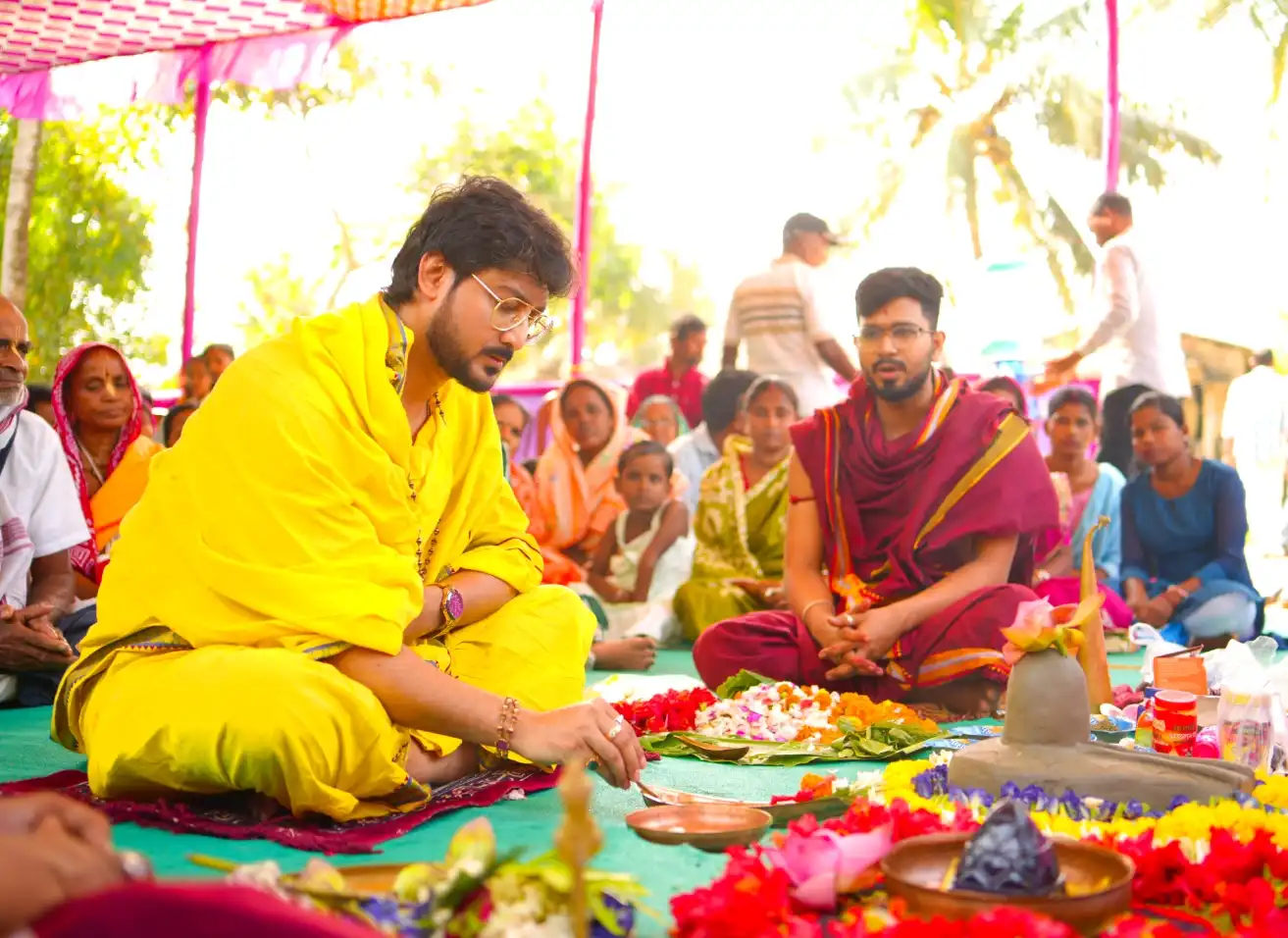
On 20th November 2025, in the serene yet powerful terrain of the Sundarban, a spiritually historic moment unfolded. The Nabatara Foundation conducted a deeply transformative Rudrabhishek for Purifying Land, marking the sacred beginning of a long-term humanitarian mission in one of West Bengal’s most ecologically and socially sensitive regions.
This was not merely a ceremonial observance. It was a foundational act of spiritual alignment. Before classrooms rise, before free medical camps begin service, before women empowerment programs initiate skill development, and before the construction of a Shiva and Goddess Tara temple, the land itself was consecrated through Vedic ritual.
The ceremony was performed under the spiritual guidance of Gaurav Tribedi, whose presence infused the atmosphere with devotion, discipline, and sacred intention.
The Rudrabhishek for Purifying Land in Sundarban symbolized more than ritual purification. It represented the merging of spirituality with structured social responsibility.
Understanding Rudrabhishek for Purifying Land in Vedic Tradition
The Deeper Meaning of Rudrabhishek
Rudrabhishek is one of the most powerful Vedic rituals dedicated to Lord Shiva in His Rudra form. The term combines “Rudra,†the transformative aspect of Shiva, and “Abhishek,†meaning sacred bathing.
In Vedic philosophy, Rudra is not only the destroyer of negativity but the force of renewal. When a Rudrabhishek for Purifying Land is performed, it is believed that dormant energies are awakened, negative vibrations are dissolved, and divine grace is invoked upon the soil.
Land, in Vedic understanding, is not inert matter. It is conscious. It absorbs actions, emotions, and history. Therefore, before beginning any charitable project in Sundarban or elsewhere in India, spiritual purification becomes essential.
This is why the Rudrabhishek in Sundarban was conducted before launching Nabatara Foundation’s education centre, healthcare programs, women empowerment initiatives, yoga and meditation hub, and temple project.
Why Land Purification Is Essential Before Starting an NGO Project
Spiritual Responsibility Before Social Construction
In Indian culture, it is customary to perform rituals such as Bhoomi Puja or Punyaham before constructing homes or commercial buildings. However, when the land is dedicated to humanitarian service, the responsibility becomes deeper.
A Spiritual purification ritual for NGO land ensures that the space intended for education, healing, and empowerment is aligned with higher energies.
The philosophy behind Rudrabhishek for Purifying Land rests on three spiritual principles:
First, purification removes unseen obstacles.Second, invocation invites divine protection.Third, intention anchors long-term success.
For a charitable project in Sundarban—where environmental vulnerability and socio-economic challenges coexist—this spiritual foundation is particularly meaningful.
The Sacred Day: 20th November 2025
As dawn emerged over the mangrove forests, the ritual preparations began with meticulous Vedic precision. Sacred vessels filled with Ganga jal were arranged alongside bilva leaves, sandalwood paste, clarified butter, honey, milk, and fresh flowers.
When Gaurav Tribedi began chanting the Rudra mantras, the atmosphere shifted palpably. The rhythmic recitation resonated through the open land. Volunteers, trustees, and local supporters stood in quiet reverence as the Rudrabhishek for Purifying Land at Nabatara Sundarban Project Site unfolded.
The ceremony lasted several hours. Each mantra carried sankalp—an intention for collective upliftment. Each offering symbolized surrender and alignment.
The purified soil was no longer merely terrain. It became consecrated ground dedicated to education, empowerment, healthcare, and spiritual awakening.
Why Sundarban Was Chosen for This Charitable Initiative
The Socio-Economic Reality of Sundarban
The Sundarban region of West Bengal is globally known for its unique mangrove ecosystem and biodiversity. Yet beneath this ecological richness lies significant socio-economic hardship.
Limited access to quality education, inadequate healthcare infrastructure, and restricted employment opportunities have created generational challenges for many families.
By initiating a Charitable project in Sundarban, Nabatara Foundation has chosen to serve where impact is deeply needed.
But before implementing structured programs, the foundation ensured that the land was spiritually prepared through Rudrabhishek for Purifying Land.
The Vision Behind Nabatara Foundation’s Spiritual Initiative
The Nabatara Foundation operates with a philosophy that spirituality and social service are not separate paths.
Service without spiritual grounding can become mechanical.Spirituality without service can become self-centered.
By performing Rudrabhishek for Purifying Land in Sundarban, the foundation demonstrated that its humanitarian mission is rooted in Vedic ethics.
The initiative includes:
- A free education centre for underprivileged children.
- Women empowerment programs focused on skill development and financial independence.
- Free medical camps providing essential healthcare support.
- A yoga and meditation hub promoting emotional resilience.
- The establishment of a Shiva and Goddess Tara temple anchoring spiritual continuity.
Each of these components rests upon the sacred assurance established by the land purification ritual.
The Spiritual Significance of Shiva and Goddess Tara Temple Project
At the heart of this initiative lies the proposed Shiva and Goddess Tara temple.
Lord Shiva represents transformation, protection, and dissolution of negativity. Goddess Tara symbolizes compassion, guidance, and protective motherly energy.
The Shiva and Goddess Tara temple project is not merely architectural. It is symbolic.
By performing Rudrabhishek in Sundarban before temple construction, the foundation ensured that divine energies were invoked at the very beginning.
The temple will serve not only as a place of worship but as a spiritual anchor for the entire charitable ecosystem.
The Psychological and Energetic Impact of Rudrabhishek
Those present during the ceremony described a tangible shift in atmosphere. There was silence that felt protective. There was peace that felt anchored.
The Rudrabhishek for Purifying Land creates collective psychological alignment. Volunteers feel confident. Donors feel assured. Beneficiaries feel protected.
In regions like Sundarban, where natural forces can be unpredictable, invoking divine stability carries profound meaning.
This is not superstition. It is cultural continuity.
Blending Spirituality with Structured Humanitarian Action
Across India, many NGOs operate in education and healthcare. However, few integrate structured Vedic rituals into the foundation of their projects.
The Nabatara Foundation spiritual initiative distinguishes itself by ensuring that every humanitarian effort begins with spiritual sanctification.
This approach strengthens community trust, enhances cultural resonance, and establishes long-term credibility.
By aligning Rudrabhishek for Purifying Land with practical social programs, the foundation embodies the true spirit of Sanatan Dharma: inner purification must lead to outer service.
The Scriptural Foundations of Rudrabhishek for Purifying Land
To understand the deeper significance of Rudrabhishek for Purifying Land, one must return to the Vedic roots of Shiva worship. The worship of Rudra predates many later Puranic narratives and is deeply embedded in the Vedic corpus. In the ancient hymns of the Rigveda, Rudra is invoked as a powerful yet compassionate deity—both fierce and healing. He is described as the remover of suffering, the guardian of cosmic order, and the divine physician.
Over centuries, Rudra evolved into the more widely worshipped Shiva of the Shiva Purana, where his role expanded into that of Mahadeva—the supreme consciousness who dissolves ignorance and protects devotees.
The chanting of the Sri Rudram from the Yajurveda forms the heart of Rudrabhishek. This sacred recitation invokes the many aspects of Rudra, acknowledging his presence in every element of existence—wind, fire, earth, forest, river, and sky.
When performed as a Vedic land purification ceremony, Rudrabhishek becomes more than devotional worship. It becomes a ritual of cosmic alignment. It acknowledges that the land is not inert matter but part of the universal web of consciousness.
This is why the Rudrabhishek in Sundarban holds exceptional meaning. The mangrove forests, tidal rivers, and shifting soil of the region are living embodiments of natural power. Invoking Shiva in Rudra form before initiating a charitable project in Sundarban is both spiritually symbolic and culturally consistent.
Land as Conscious Entity in Vedic Philosophy
In Vedic thought, land is referred to as Bhumi Devi—Mother Earth. She is patient, nurturing, and sacred. Before building upon her surface, one seeks forgiveness and blessings.
The concept underlying Rudrabhishek for Purifying Land reflects three key philosophical ideas:
First, every place carries historical vibration. Actions performed on land leave subtle imprints.
Second, spiritual invocation harmonizes those vibrations with higher intention.
Third, consecration transforms physical space into sacred space.
When the Nabatara Foundation initiated its humanitarian mission in Sundarban, it chose to honor this ancient philosophy. The foundation recognized that education, healthcare, and empowerment must grow from spiritually aligned soil.
Detailed Step-by-Step Process of Rudrabhishek for Purifying Land
Sankalp: Declaring Sacred Intention
The ritual begins with sankalp—the formal declaration of purpose. In the case of Nabatara’s initiative, the sankalp was taken for:
- Establishing a free education centre
- Initiating women empowerment programs
- Conducting medical camps
- Building a yoga and meditation hub
- Constructing a Shiva and Goddess Tara temple
This sankalp anchors the ritual to tangible humanitarian goals.
Kalash Sthapana: Invocation of Divine Presence
Sacred vessels filled with Ganga jal are placed upon the altar. These kalash represent the presence of divine energy and cosmic elements.
Invocation of Lord Ganesha
Before beginning the Rudrabhishek, Lord Ganesha is invoked to remove obstacles. This step ensures that the Spiritual purification ritual for NGO land proceeds smoothly.
Chanting of Sri Rudram
Under the guidance of Gaurav Tribedi, the chanting of Sri Rudram resonated across the Sundarban project site. The rhythmic recitation creates vibrational purification.
Abhishekam: Ritual Bathing
The Shiva Linga is bathed with water, milk, curd, honey, ghee, and sacred herbs. Each substance symbolizes a spiritual quality:
Water represents purification.Milk represents nourishment.Honey symbolizes sweetness in outcomes.Ghee signifies clarity and illumination.Bilva leaves represent devotion and surrender.
When performed as a Rudrabhishek for Purifying Land, the abhishekam extends beyond the deity to the soil itself, invoking harmony for the entire project area.
Aarti and Collective Prayer
The ceremony concludes with aarti and collective prayer for the protection and success of the Nabatara Foundation spiritual initiative.
Why Rudrabhishek in Sundarban Is Uniquely Powerful
The Sundarban is not an ordinary landscape. It is one of the largest mangrove ecosystems in the world, shaped by tides, storms, and shifting river currents.
Such a dynamic environment carries immense natural energy. Performing Rudrabhishek for Purifying Land in Sundarban harmonizes human intention with these powerful natural forces.
Spiritually, it symbolizes balance between:
Nature and developmentTradition and progressDevotion and service
This balance is critical for any NGO project in Sundarban aiming for long-term sustainability.
The Education Centre Vision: Literacy as Liberation
One of the primary components of the charitable project in Sundarban is the establishment of a free education centre.
In many remote areas of West Bengal, access to structured quality education remains limited. Children often drop out due to financial constraints or lack of infrastructure.
The Nabatara Foundation education centre will focus on:
- Foundational literacy and numeracy
- Value-based education
- Digital awareness
- Environmental sensitivity
By performing Rudrabhishek for Purifying Land before launching the centre, the foundation ensured that learning begins in spiritually protected surroundings.
Education is not merely academic. It is transformational. And transformation is the essence of Rudra.
Women Empowerment in Sundarban: From Dependence to Dignity
The Sundarban region faces economic vulnerabilities that disproportionately affect women. Limited access to financial literacy and skill development often restricts independence.
The women empowerment programs planned under the Nabatara Foundation spiritual initiative aim to address this gap through:
- Vocational training
- Micro-enterprise development
- Self-help group formation
- Financial education
When such initiatives arise from land consecrated through Rudrabhishek for Purifying Land, they carry symbolic assurance of stability and protection.
Empowerment rooted in spiritual dignity becomes sustainable empowerment.
Healthcare Outreach: Medical Camps with Compassion
Access to healthcare in remote delta regions remains inconsistent. Seasonal flooding and infrastructural challenges create additional barriers.
The upcoming free medical camps under the Charitable project in Sundarban will focus on:
- Primary healthcare consultations
- Preventive screening
- Distribution of essential medicines
- Health awareness workshops
The land purification ritual symbolizes a prayer that healing extends beyond physical treatment to holistic well-being.
Yoga and Meditation Hub: Inner Strength for External Challenges
The yoga and meditation centre planned within the project area reflects the understanding that resilience begins within.
In regions facing environmental unpredictability, mental balance becomes as important as economic stability.
Through structured meditation sessions and yogic practices, the hub will promote:
- Stress reduction
- Emotional resilience
- Spiritual awareness
- Community bonding
The Rudrabhishek in Sundarban acts as the spiritual seed from which this inner transformation grows.
Shiva and Goddess Tara Temple Project: The Spiritual Anchor
The planned Shiva and Goddess Tara temple will stand at the heart of the initiative.
Lord Shiva symbolizes transformation and protection. Goddess Tara, deeply revered in Bengal, represents compassion and divine guidance.
By initiating the Shiva and Goddess Tara temple project with Rudrabhishek, Nabatara Foundation ensured that the temple rises from consecrated soil.
The temple will serve as:
- A centre for daily prayer
- A venue for community gatherings
- A space for spiritual education
- A symbol of cultural continuity
Spirituality and Social Development: A Unified Path
The integration of ritual and service reflects a larger Indian civilizational principle—Seva as Dharma.
The Spiritual NGO in Kolkata, Nabatara Foundation, exemplifies this philosophy. Rather than separating devotion from development, it unites them.
When spirituality guides social action:
Projects gain ethical grounding.Communities gain cultural trust.Volunteers gain inner motivation.Donors gain confidence.
The Rudrabhishek for Purifying Land becomes not only a ritual but a statement of long-term integrity.
A Foundation Anchored in Sacred Commitment
On 20th November 2025, under the guidance of Gaurav Tribedi, the land in Sundarban transitioned from physical space to consecrated mission ground.
The soil was purified.The intention was declared.The future was aligned.
This is how true humanitarian transformation begins in India—not merely with planning documents and architectural drawings, but with sacred invocation.
And from this purified land in Sundarban, hope continues to rise.
The Sacred Geography of the Sundarbans and Its Spiritual Significance
The sacred land of the Sundarbans carries a vibration that is both ancient and untamed. Located in the delta region formed by the confluence of the mighty rivers Ganga, Brahmaputra, and Meghna, the Sundarbans is not merely a geographical marvel but a deeply spiritual landscape. This vast mangrove forest, stretching across West Bengal and Bangladesh, is recognized as a UNESCO World Heritage Site and is home to rare biodiversity, powerful tidal rhythms, and intense elemental energy.
For centuries, sages, sadhaks, and Tantric practitioners have considered such powerful natural landscapes ideal for spiritual tapasya and sacred rituals. Water bodies, especially those connected to the holy Ganga, are believed to amplify mantra vibrations. The Sundarbans, nourished by the sacred currents of the Ganga, holds a unique spiritual frequency that makes it highly suitable for Vedic rituals like Rudrabhishek for purifying land.
In Vedic cosmology, land is not inert matter. It carries memory. It absorbs karma, emotion, and energy. The Sundarbans region has witnessed cyclones, floods, poverty, displacement, and struggle. When such land is purified through sacred Vedic rituals like Rudrabhishek, it is believed to undergo energetic healing. This is not superstition but a principle deeply rooted in Vedic land science known as Bhoomi Shuddhi.
Performing Rudrabhishek in Sundarban is therefore not just a ritual act; it is an act of spiritual ecology. It is a prayer for environmental harmony, protection from natural calamities, and upliftment of underprivileged communities living in remote delta regions of West Bengal.
Why Rudrabhishek is the Most Powerful Land Purification Ritual
Among all Vedic rituals dedicated to Lord Shiva, Rudrabhishek holds the highest spiritual potency. The chanting of the Sri Rudram from the Yajurveda, combined with abhishek (ritual bathing) of the Shiva Lingam, generates intense vibrational purification.
The Shiva Lingam symbolizes cosmic consciousness. When sacred substances like Ganga jal, milk, honey, curd, and bilva leaves are offered with mantra chanting, negative vibrations are believed to dissolve. Energetically disturbed land begins to stabilize.
In regions like the Sundarbans, where environmental instability and socio-economic struggles coexist, performing Rudrabhishek becomes deeply meaningful. It invokes divine protection, cosmic balance, and spiritual upliftment.
The ritual also aligns with the spiritual vision of organizations like Nabatara Foundation, which aim to combine Vedic knowledge with social welfare initiatives in Kolkata and across West Bengal.
The Vision of Establishing a Shiva and Goddess Tara Temple in Sundarban
The establishment of a Shiva and Goddess Tara temple in Sundarban is not just a religious project; it is a civilizational mission. Goddess Tara holds a special place in Bengal’s spiritual heritage, particularly in the Shakta tradition. Her worship has deep roots in the soil of West Bengal.
The energy of Lord Shiva and Goddess Tara together represents balance between destruction and compassion, power and protection, tapasya and grace. Establishing such a temple in the Sundarbans would create a spiritual anchor for thousands of local villagers who currently lack access to strong spiritual infrastructure.
In rural Bengal, temples often serve as social hubs. They become centers for education, food distribution, cultural preservation, and women empowerment. A temple in the Sundarban region can therefore function not only as a place of worship but also as a community upliftment centre.
The Rudrabhishek for purifying land in Sundarban marks the foundational step toward this long-term vision. Before any sacred structure is built, the land must be purified. Bhoomi Shuddhi through Vedic rituals ensures that the spiritual foundation is strong, stable, and energetically aligned.
Nabatara Foundation and the Integration of Spirituality with Social Service
In Kolkata, several spiritual organizations conduct rituals. However, very few combine Vedic rituals with structured social development programs. Nabatara Foundation represents a model where spirituality meets service.
The foundation envisions establishing educational programs, women empowerment initiatives, health support services, and spiritual awareness campaigns alongside temple construction. In regions like the Sundarbans, where access to infrastructure remains limited, such initiatives can transform lives.
When a spiritual NGO in Kolkata undertakes Rudrabhishek in Sundarban for land purification, it is not simply conducting a ritual for ceremonial purposes. It is setting the stage for holistic development. Spiritual stability becomes the root from which social progress grows.
Vedic Science Behind Bhoomi Shuddhi and Energy Transformation
According to Vastu Shastra and Vedic cosmology, land absorbs subtle vibrations over time. Every action performed on land leaves an energetic imprint. Natural disasters, violence, suffering, and prolonged negativity can disturb the vibrational field of a place.
Bhoomi Shuddhi rituals are therefore prescribed before temple construction, house building, or any major project. The chanting of Rudram, combined with sacred offerings, aligns the five elements—earth, water, fire, air, and ether.
In the context of the Sundarbans, which is a region constantly interacting with the elemental forces of water and wind, balancing these energies becomes spiritually significant. Rudrabhishek acts as an energetic stabilizer. It invokes the protective aspect of Lord Shiva, often referred to as Mahakaal, the lord beyond time.
When such rituals are performed collectively, the amplified intention of the community further strengthens the energetic outcome. This collective sankalpa for land purification in Sundarban becomes a powerful spiritual movement.
Socio-Economic Context of the Sundarbans and the Need for Spiritual Intervention
The Sundarbans region in West Bengal faces unique challenges. Frequent cyclones, limited healthcare facilities, migration, poverty, and lack of educational infrastructure create an environment of uncertainty.
In such areas, spirituality often becomes a source of psychological resilience. Rituals like Rudrabhishek not only purify land energetically but also restore hope among local communities. When villagers participate in sacred ceremonies, they feel connected to divine protection and collective strength.
A Shiva and Goddess Tara temple in Sundarban can serve as a center for spiritual counseling, moral education for children, and cultural preservation. It can also provide a platform for organizing health camps, food distribution drives, and women skill development workshops.
Thus, Rudrabhishek in Sundarban is both symbolic and practical. It represents purification of land and the beginning of sustainable social development in one of West Bengal’s most ecologically sensitive regions.
The Role of Devotees and Donors in Supporting the Mission
For large-scale spiritual and social projects to succeed, community participation is essential. Devotees from Kolkata and across India can contribute by sponsoring Rudrabhishek rituals, donating construction materials, or supporting educational programs.
In the Indian spiritual tradition, contributing to temple construction is considered highly meritorious. It is believed to generate positive karma not only for the individual but also for future generations. When the land is purified through Rudrabhishek and a temple foundation is laid, every contributor becomes spiritually connected to that sacred space.
Supporting land purification and temple construction in Sundarban also aligns with the broader goal of rural upliftment in West Bengal. It bridges the gap between urban spiritual seekers in Kolkata and rural communities in need.
Spiritual Tourism and Cultural Revival in West Bengal
West Bengal has a rich spiritual heritage. From Dakshineswar to Tarapith, from Kalighat to Mayapur, the state is home to powerful sacred sites. A Shiva and Goddess Tara temple in Sundarban can add a new dimension to spiritual tourism in the region.
Pilgrims visiting the Sundarbans for ecological tourism can also engage in spiritual experiences. This creates opportunities for local employment, small businesses, and cultural revival. Spiritual tourism in rural Bengal can generate sustainable income while preserving traditional practices.
Rudrabhishek for purifying land becomes the foundational spiritual event that initiates this long-term vision. It is the first step in transforming the Sundarban region into a place of both ecological and spiritual harmony.
Environmental Harmony Through Vedic Rituals
Modern environmental science increasingly recognizes the importance of collective intention, sound vibration, and community awareness in ecological conservation. While Vedic rituals operate on a spiritual framework, their ultimate intention aligns with environmental balance.
The chanting of Vedic mantras generates sound frequencies that resonate with natural elements. When performed with devotion, Rudrabhishek becomes a prayer for protection from cyclones, floods, and environmental instability.
In the Sundarbans, where communities live in close relationship with forests and rivers, spiritual ecology is not an abstract concept. It is lived reality. Land purification rituals reinforce respect for nature and strengthen collective responsibility toward environmental preservation.
A Long-Term Vision for West Bengal’s Spiritual and Social Renaissance
The Rudrabhishek for purifying land in Sundarban is not a one-day ritual. It is the beginning of a larger movement aimed at spiritual awakening and social upliftment.
Through systematic planning, temple establishment, educational outreach, women empowerment initiatives, healthcare support, and environmental awareness programs, the vision extends far beyond ritual practice.
In Kolkata and across West Bengal, there is a growing desire to reconnect with authentic Vedic traditions while addressing modern challenges. Projects that combine both dimensions hold immense potential.
As this mission unfolds, the purified land in the Sundarbans will stand as a symbol of faith, resilience, and collective intention. The Shiva and Goddess Tara temple envisioned for this sacred delta region can become a beacon of hope for thousands.
The journey that begins with Rudrabhishek will ultimately lead toward spiritual stability, social empowerment, and cultural revival in West Bengal.
The foundation has been laid energetically. The land has been invoked. The divine has been invited. What follows is the collective effort of devotees, donors, and visionaries who believe that spirituality and service must walk hand in hand.