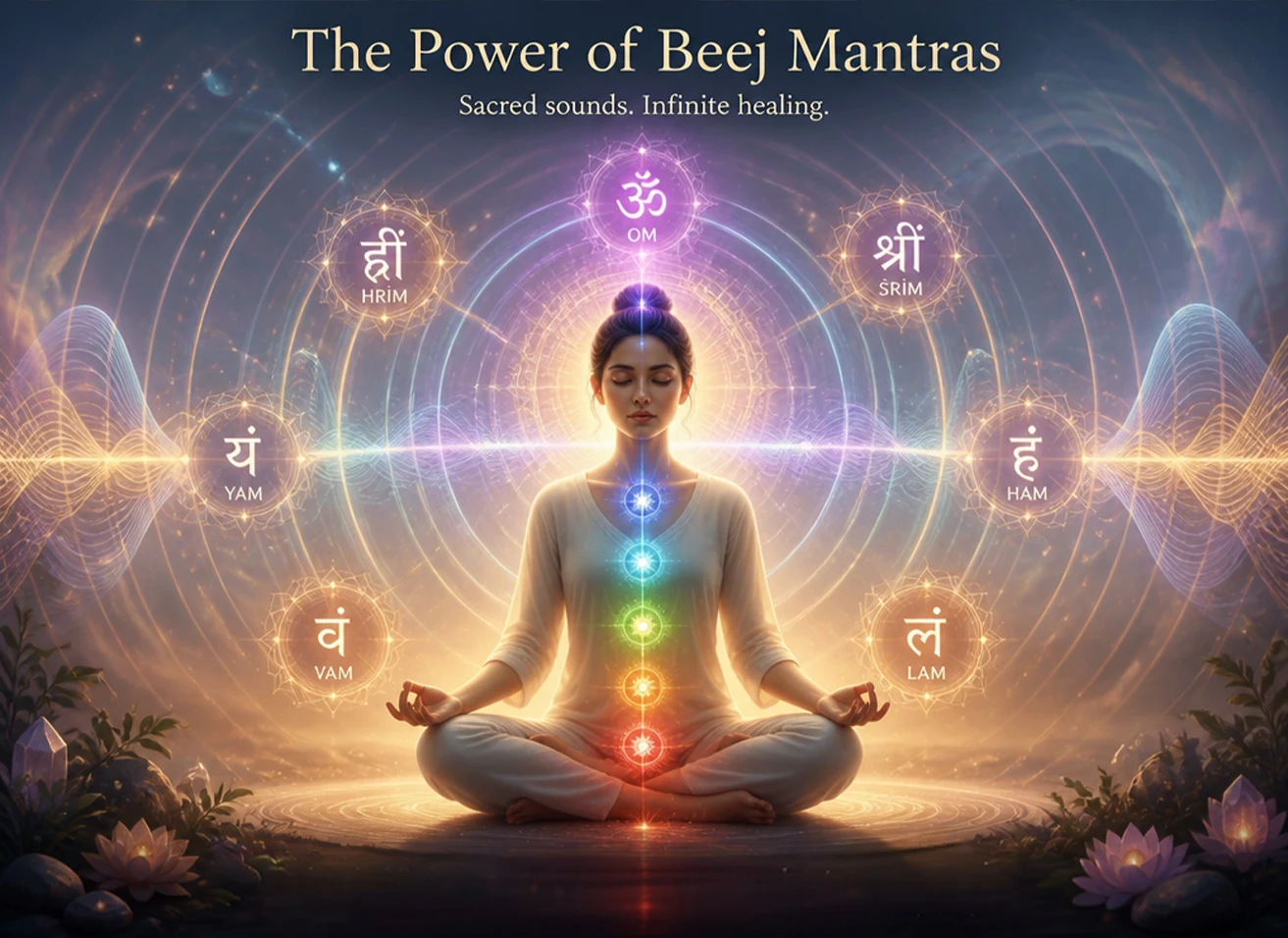
Overview: The Science of Mantra Chanting
In the silence between breaths, something extraordinary happens. When sacred sounds rise from your throat and ripple through your being, they don't just echo in the air—they rewrite the very architecture of your mind. For thousands of years, Vedic sages understood what modern neuroscience is only now confirming: mantra chanting is not mere ritual repetition but a precise technology of consciousness that alters brainwave patterns, harmonizes neural oscillations, and awakens dormant dimensions of awareness.
At Nabatara Institute of Astrology, under the guidance of Tantra Avishikta Gaurav Tribedi, we bridge this ancient wisdom with contemporary understanding. This isn't about blind faith or mystical claims. It's about recognizing that when you chant with proper Sanskrit pronunciation, focused intention, and disciplined regularity, you engage a profound psychophysiological process. Your breath slows. Your heart rate variability increases. Your brain shifts from chaotic beta waves to coherent alpha and theta states. The vibrations penetrate cellular memory, releasing stored trauma and creating space for clarity, emotional stability, and spiritual insight.
What follows is a comprehensive exploration of this transformative practice—rooted in unbroken Guru-shishya parampara, validated by scientific research, and made accessible for the sincere seeker ready to experience genuine inner transformation.
The Sacred Call—Introduction & Inner Context
The alarm rings at 4:47 AM. You silence it before it fully awakens the household, slipping out of bed while the world still sleeps. In the dim light of a single diya, you sit on your asana. spine straight, hands resting on your knees. The house is quiet. Your mind, however, is anything but. Thoughts of yesterday's argument with your colleague circle like vultures. Worry about your mother's health gnaws at your chest. The presentation due next week looms like a storm cloud. You close your eyes and take a breath, attempting to calm the tempest within.
This is where so many seekers find themselves—caught between the ancient call to spiritual practice and the relentless demands of modern existence. You've heard about mantra chanting. Perhaps your grandmother used to whisper the Gayatri Mantra at dawn, or maybe you've seen videos of monks in deep meditation, their voices creating waves of sound that seem to transcend ordinary human experience. Something in you recognizes that these sacred sounds hold power, but intellectual recognition alone doesn't quiet the anxiety that wakes you before sunrise.
The science of mantra chanting addresses precisely this dilemma—the gap between knowing and experiencing, between seeking peace and actually finding it. When we speak of mantra chanting in the Vedic tradition, we're not discussing wishful thinking or the placebo effect. We're engaging with a sophisticated understanding of consciousness, vibration, and neurophysiology that predates modern neuroscience by millennia yet aligns remarkably with what brain imaging studies now reveal about meditative practices and sound therapy.
At Nabatara Institute, we've witnessed countless seekers walk through our doors carrying this same restlessness, this same hunger for something that transcends the surface-level solutions offered by our stress-saturated culture. They come with varying backgrounds—some steeped in Hindu tradition from childhood, others complete newcomers to Sanatan Dharma, many caught somewhere in between, drawn by an inexplicable pull toward these ancient practices. What unites them is a recognition that their suffering isn't merely circumstantial; it's structural, rooted in the very way their nervous systems have been conditioned to respond to the world.
Mantra chanting works at this structural level. It doesn't simply distract you from anxiety or temporarily mask emotional pain. It fundamentally recalibrates your neurophysiological state through the precise application of sound frequencies, breath regulation, and focused awareness. When Gaurav Tribedi teaches mantra sadhana at Nabatara, he's not offering a quick fix or a spiritual band-aid. He's transmitting a time-tested methodology that reshapes the practitioner's entire relationship with their own mind.
Consider what happens in those early morning moments when you finally begin to chant. You choose a mantra—perhaps the Mahamrityunjaya Mantra for healing, or Om Namah Shivaya for inner transformation, or simply the primordial "Om" itself. You've learned the correct Sanskrit pronunciation from your guru, understanding that each syllable carries specific vibrational qualities. As you begin, something shifts. The first few repetitions feel mechanical, your mind still racing ahead to the day's concerns. But gradually, if you persist with sincerity, a subtle change occurs.
Your breathing slows without conscious effort. The chaotic beta waves that dominate your waking consciousness—associated with analytical thinking, stress, and scattered attention—begin to give way to alpha waves, the brainwave state linked with relaxed awareness and creative insight. With deeper practice, you may even touch theta states, those liminal zones between waking and sleeping where profound healing and spiritual experiences occur. This isn't mystical speculation; it's measurable neurophysiology, documented in studies of meditation practitioners and sound therapy participants worldwide.
But here's what separates authentic mantra chanting from generic meditation apps or wellness trends: the element of shakti, or spiritual power, transmitted through proper initiation and lineage. When you receive a mantra through diksha (initiation) from a qualified guru like Gaurav Tribedi, who carries the unbroken parampara (lineage) of the Sri Jagadguru Shankaracharya tradition, you're not simply learning a technique. You're being connected to a living current of spiritual energy that has flowed through realized masters for generations. This transmission activates the mantra's latent power in ways that self-study alone cannot achieve.
The science of mantra chanting also intersects profoundly with what we now understand about neuroplasticity—the brain's ability to reorganize itself by forming new neural connections throughout life. Each time you chant with focused awareness, you're literally rewiring your brain. The repetitive nature of mantra practice creates new neural pathways that gradually replace old patterns of reactivity, fear, and limitation. Where once your nervous system automatically responded to stress with fight-or-flight activation, consistent mantra sadhana builds alternative pathways that default to calm, clarity, and equanimity.
This transformation doesn't happen overnight, and this is where many seekers falter. We live in an era of instant gratification, where apps promise enlightenment in ten minutes a day and spiritual breakthroughs are marketed like consumer products. But the science of mantra chanting operates on different principles—those of disciplined practice, patient cultivation, and sincere surrender. At Nabatara Institute, we emphasize this reality from the first day of our courses. Mantra is not magic. It won't instantly erase your karmic patterns or dissolve years of accumulated samskaras (mental impressions) with a few weeks of casual practice.
What it will do, when approached with the right understanding and commitment, is create a stable foundation for genuine spiritual growth. It will give you a tool that works regardless of external circumstances—a portable sanctuary you can access whether you're sitting in formal meditation or navigating the chaos of daily life. The frequencies generated by sacred Sanskrit syllables don't require ideal conditions to be effective. They work in the subway during your commute, in the bathroom during a stressful workday, and in the hospital room beside a suffering loved one. This accessibility, combined with profound depth, makes mantra chanting one of the most practical and powerful technologies in the Vedic toolkit.
The emotional stability that emerges from consistent practice isn't a numb detachment or spiritual bypassing of life's challenges. Rather, it's a deepening capacity to remain centered amid turbulence, to respond rather than react, to maintain awareness of your true nature even when circumstances trigger old wounds. This stability arises because mantra chanting addresses the root level of your being—"your pranic energy, your subtle body, and your consciousness itself"—not just the surface symptoms of psychological distress.
As you continue reading this exploration of mantra chanting's science and spiritual dimensions, you'll discover how ancient wisdom and modern research converge to validate what the rishis knew intuitively: that sound is not merely a physical phenomenon but a creative force that shapes reality at every level. You'll learn about the specific mechanisms through which sacred vibrations alter brainwave patterns, regulate the autonomic nervous system, and facilitate states of consciousness that support healing, insight, and spiritual awakening.
More importantly, you'll understand why the guidance of an authentic guru and the support of a traditional learning environment like Nabatara Institute make the difference between superficial practice and transformative sadhana. Gaurav Tribedi's twenty-plus years of dedicated practice, his initiation into the Shankaracharya parampara, and his commitment to making these teachings accessible to sincere seekers worldwide represent a rare opportunity in our fragmented spiritual marketplace.
The call you're feeling—the restlessness that brings you to these words—isn't accidental. In the Vedic understanding, it's the result of purva samskara, impressions from past lives that ripen when the time is right for your spiritual evolution. The fact that you're reading about the science of mantra chanting, that these concepts resonate with something deep within you, suggests that you're standing at a threshold. What lies beyond isn't an escape from life's challenges but a fundamentally different way of meeting them—with awareness, with strength, with the unshakable knowing that your true nature is pure consciousness, untouched by the temporary storms of existence.
This is the promise of mantra chanting, not as theory but as lived experience. And it begins with a single syllable, a single breath, a single moment of sincere intention. The question isn't whether these ancient practices work—the evidence from both traditional sources and contemporary research is overwhelming. The question is whether you're ready to commit to the practice that will unlock their power in your own life. At Nabatara, we stand ready to guide those who answer this call with the authenticity and depth it deserves.
The Vedic Foundations—Ancient Knowledge for Today
The Vedas, those eternal sounds that reverberate through the corridors of time, didn't emerge from human imagination in the way we typically understand creative expression. They were heard—"shruti," the Sanskrit term reveals—by rishis in states of heightened consciousness, direct revelations of cosmic truth transmitted through the medium of sound itself. This understanding forms the bedrock of why mantra chanting occupies such a central position in Sanatan Dharma and why its practice carries implications far beyond psychological self-help or stress reduction.
When we examine the Brihat Parashara Hora Shastra, the foundational text of Vedic astrology attributed to Maharishi Parashara, we find sophisticated correlations between planetary influences, sound vibrations, and human consciousness. Parashara didn't view the Grahas (planets) as mere physical bodies moving through space but as conscious forces whose energies could be harmonized through specific mantras. Each planet governs particular frequencies, and when these frequencies fall out of alignment in an individual's birth chart, specific mantra practices can restore equilibrium. This isn't superstition; it's a precise science of energetic correspondence that modern physics, with its understanding of everything as vibration, is only beginning to appreciate.
The Tantraloka, Abhinavagupta's monumental synthesis of Kashmir Shaivism, takes this understanding even deeper. Here we find detailed explanations of how nada (primordial sound) gives rise to the entire manifest universe through a process of vibration and differentiation. Abhinavagupta describes how the supreme consciousness, Shiva, expresses itself through spanda (divine pulsation), creating the spectrum of existence from the most subtle to the most gross. Mantra chanting, in this framework, is the reverse process—a method of tracing vibration back to its source, dissolving the boundaries between individual awareness and universal consciousness.
At Nabatara Institute, Gaurav Tribedi teaches these principles not as abstract philosophy but as practical knowledge that informs every aspect of mantra sadhana. When students learn the proper pronunciation of Sanskrit mantras in our courses, they're not simply memorizing phonetic patterns. They're being initiated into an understanding of how specific sound combinations create specific energetic effects. The Sanskrit language itself is considered a vibrational technology, with each syllable (akshara) carrying precise frequencies that interact with the practitioner's subtle body in predictable ways.
Consider the structure of a typical Vedic mantra. Take the Gayatri Mantra, perhaps the most widely chanted mantra in Hindu tradition: "Om Bhur Bhuva Svah, Tat Savitur Varenyam, Bhargo Devasya Dheemahi, Dhiyo Yo Nah Prachodayat." Each word, each syllable, has been preserved with extraordinary precision for thousands of years through an oral tradition that prioritized exact pronunciation over written transmission. Why? Because the rishis understood that even slight variations in sound would alter the vibrational frequency and thus the effect on consciousness.
Modern acoustic science confirms what these ancient practitioners knew intuitively. Sound travels as waves, and these waves have measurable properties—frequency (pitch), amplitude (volume), timbre (quality), and duration. When you chant a mantra with correct Sanskrit pronunciation, you're generating specific frequencies that resonate with particular energy centers (chakras) in your subtle body. The nasal resonance required for certain Sanskrit sounds stimulates the vagus nerve, activating the parasympathetic nervous system and triggering the relaxation response. The rhythmic repetition creates coherent brainwave patterns that facilitate states of deep meditation and healing.
The Vastu Shastra, the ancient science of sacred architecture, provides another lens through which to understand mantras' power. Just as a temple is designed to amplify and harmonize spiritual energies through precise geometric proportions and directional alignments, the human body can be understood as a living temple where mantra creates similar effects. The vocal cords, the respiratory system, and the cranial cavity all function as resonating chambers that amplify the frequencies generated by sacred sounds. When you chant with proper technique, taught through the Guru-shishya parampara at Nabatara, you're essentially tuning your entire being like a musical instrument.
This tuning process addresses what Vedic psychology identifies as the three gunas—sattva (purity, harmony), rajas (activity, passion), and tamas (inertia, darkness). Every human being carries a unique proportion of these qualities, and imbalance among them creates the psychological and emotional disturbances that drive seekers to spiritual practice. Mantra chanting, particularly when practiced with the guidance of an experienced teacher like Gaurav Tribedi, systematically increases sattva while reducing rajas and tamas. This shift isn't merely subjective; it manifests in measurable changes in brain chemistry, hormone levels, and autonomic nervous system function.
The concept of bija (seed) mantras illustrates the precision of Vedic sound science. These single-syllable mantras—"Om, Hrim, Klim, Aim, Hum, and others"—are considered the most concentrated forms of spiritual energy, each corresponding to specific deities, elements, and consciousness states. When chanted with proper initiation and technique, bija mantras bypass the analytical mind and work directly on the subconscious and superconscious levels. They're like spiritual DNA, containing the complete blueprint of the divine principle they represent in compressed vibrational form.
In Nabatara's Advanced Tantra Shastra Courses, students learn how these bija mantras relate to the chakra system and the flow of kundalini energy. The sound "Lam" resonates with the muladhara (root) chakra, grounding and stabilizing. "Vam" activates the svadhisthana (sacral) chakra, enhancing creativity and emotional flow. "Ram" ignites the manipura (solar plexus), building confidence and personal power. Each chakra has its corresponding bija, and systematic practice creates a harmonious ascent of consciousness from the dense physical plane to the luminous realms of pure awareness.
The scientific validity of this chakra-mantra correlation finds support in contemporary research on the endocrine system. Each chakra corresponds to major nerve plexuses and endocrine glands that regulate hormonal balance throughout the body. When mantra vibrations stimulate these energy centers, they influence glandular function, which in turn affects mood, energy levels, immune function, and overall health. This explains why consistent mantra practitioners often report improvements in physical health alongside psychological and spiritual benefits—the practice works holistically, addressing the interconnectedness of body, mind, and spirit.
The role of prana (life force) in mantra chanting cannot be overstated. In Vedic physiology, prana flows through 72,000 nadis (energy channels), with three primary channels—"ida" (lunar), "pingala" (solar), and "sushumna" (central)—being most significant for spiritual practice. Mantra chanting, especially when synchronized with breath awareness, purifies these nadis and balances the flow of prana. This purification process, called nadi shodhana, is essential for awakening higher states of consciousness and preventing the psychological and physical disturbances that can arise from premature or improper spiritual practice.
Gaurav Tribedi emphasizes this point consistently in his teachings at Nabatara Institute. Without proper preparation and guidance, intense mantra practice can create imbalances—what traditional texts call "kundalini syndrome," where awakened energy has no clear pathway and creates psychological distress or physical symptoms. This is why the Guru-shishya relationship remains irreplaceable in authentic spiritual transmission. A qualified teacher assesses the student's readiness, prescribes appropriate practices, monitors progress, and provides course corrections when necessary.
The Vedic understanding of time also informs mantra practice in ways that modern practitioners often overlook. The concept of "muhurta," or "auspicious timing," recognizes that different periods of the day carry different energetic qualities. Brahma muhurta, the period approximately 90 minutes before sunrise, is considered optimal for mantra sadhana because the atmosphere is saturated with sattvic energy, the mind is naturally calm after sleep, and environmental distractions are minimal. This isn't arbitrary tradition; it aligns with what we now know about circadian rhythms and cortisol levels, which naturally support meditation and contemplative practice during these early morning hours.
Similarly, the lunar cycle influences mantra practice. The waxing moon (shukla paksha) supports practices aimed at growth, manifestation, and positive development, while the waning moon (krishna paksha) facilitates release, purification, and the dissolution of negative patterns. Advanced practitioners at Nabatara learn to align their sadhana with these cosmic rhythms, amplifying the effectiveness of their practice through conscious synchronization with natural cycles.
The concept of sankalpa (sacred intention) represents another crucial element that distinguishes Vedic mantra practice from casual repetition. Before beginning mantra chanting, the practitioner formally states their intention, often in Sanskrit, specifying the purpose of their practice and dedicating the merit to the welfare of all beings. This isn't mere ritual formalism; it's a psychological technique that focuses the mind and aligns conscious and subconscious motivations. Research on goal-setting and intention confirms that clear, emotionally charged intentions significantly enhance the effectiveness of any practice, and sankalpa applies this principle at the spiritual level.
The role of nyasa (ritual placement of mantras on the body) in advanced practice demonstrates the sophistication of Vedic methodology. Through specific hand gestures and mantras, the practitioner purifies and sanctifies different parts of the body, transforming the physical form into a temple of divine presence. This practice creates a powerful mind-body connection, reinforcing the understanding that spiritual practice isn't about escaping the body but consecrating it as an instrument of higher consciousness.
At Nabatara Institute, these traditional practices are taught with both fidelity to their ancient roots and sensitivity to the needs of modern practitioners. Gaurav Tribedi understands that most students can't retreat to a Himalayan cave for years of exclusive sadhana. They have jobs, families, and responsibilities. So the teachings are adapted—not diluted, but made accessible—so that a busy professional in Mumbai or a student in New York can integrate authentic mantra practice into their daily life and experience genuine transformation.
The Jyotish Foundation Program at Nabatara specifically addresses how mantra relates to astrological influences. Students learn to identify planetary weaknesses in their birth charts and prescribe appropriate mantra remedies. For example, someone with a weak or afflicted Saturn might practice the Shani mantra to strengthen that planet's positive qualities while mitigating its challenging effects. This personalized approach recognizes that spiritual practice isn't one-size-fits-all; it must be tailored to individual constitution, life circumstances, and karmic patterns.
The preservation of this knowledge through unbroken lineage is what separates Nabatara's approach from the fragmented, often distorted information available online or in popular spirituality books. When Gaurav Tribedi teaches mantra chanting, he's transmitting what he received from his guru, who received it from their guru, in a chain extending back to the original rishis who heard these truths in samadhi. This parampara ensures that the teachings remain pure, potent, and properly contextualized within the broader framework of Sanatan Dharma.
Modern neuroscience is only beginning to catch up with what these ancient traditions have known for millennia. Studies using fMRI and EEG technology show that mantra repetition activates specific brain regions, increases gray matter density in areas associated with emotional regulation, and creates coherent patterns of neural oscillation that support psychological well-being. But the Vedic tradition offers something that science alone cannot provide: a comprehensive map of consciousness, a time-tested methodology for spiritual evolution, and the living transmission of a guru who has walked the path and can guide others safely to the destination.
This is the foundation upon which Nabatara Institute builds all its teachings—not blind faith, but informed practice; not wishful thinking, but precise technology; not isolated technique, but integrated wisdom that addresses the whole human being in all dimensions of existence.
The Hidden Dimensions—Secrets Only the Sadhaka Knows
There exists a threshold in mantra practice that separates casual practitioners from serious sadhakas, a point where intellectual understanding gives way to direct experience, where the mantra ceases to be something you do and becomes something that does you. This transition, rarely discussed in books or weekend workshops, represents the hidden dimensions of mantra chanting—the esoteric realities that only reveal themselves through sustained, sincere practice under proper guidance.
At Nabatara Institute, Gaurav Tribedi speaks openly about these dimensions with students who have demonstrated readiness, not to create spiritual elitism but to prepare seekers for what actually lies ahead on the path. The first secret is this: the mantra chooses you as much as you choose the mantra. While it's true that certain mantras correspond to specific planetary positions or spiritual goals, there's a deeper level of resonance that transcends astrological calculation. A sincere seeker will feel drawn to a particular mantra with an intensity that can't be rationally explained. This attraction is the soul recognizing its own frequency, the atman responding to the vibration that will most effectively liberate it from bondage.
This phenomenon explains why two people with identical birth charts might receive different mantra prescriptions from Guruji. The external circumstances might be similar, but the inner karmic patterns, the samskaras carried from previous lives, and the specific lessons this incarnation must learn—all these factors influence which mantra will catalyze the deepest transformation. At Nabatara, this intuitive discernment is one of the most valuable gifts Gaurav Tribedi offers his shishyas, a wisdom that comes not from book learning but from decades of sadhana and the grace of his parampara.
The second hidden dimension involves what traditional texts call mantra chaitanya"—the awakening of consciousness within the mantra itself. Initially, when you begin chanting, you're the conscious agent repeating inert syllables. But with persistent practice, something extraordinary occurs: the mantra awakens. It begins to chant itself. You'll notice this shift when, in the middle of your daily activities, the mantra starts repeating spontaneously in your mind without any effort on your part. You're cooking dinner, and suddenly "Om Namah Shivaya" arises unbidden. You're walking to work, and the Gayatri Mantra flows through your awareness like an undercurrent.
This is the mantra becoming alive, developing its own momentum, asserting its presence in your consciousness. It's no longer a practice you perform but a living entity residing within you, a constant companion on the spiritual path. Advanced sadhakas at Nabatara describe this experience as having a guru within, an inner guide that provides protection, guidance, and gradual purification. The mantra becomes a yajna (sacred fire) that burns away impurities continuously, not just during formal meditation sessions but throughout every moment of existence.
The third secret concerns the relationship between mantra and prana. While beginners focus on correct pronunciation and counting repetitions, advanced practitioners understand that the real power lies in the synchronization of sound and breath. Each mantra has an optimal breathing pattern, a specific rhythm that maximizes its effect on the nervous system and subtle body. Gaurav Tribedi teaches these nuances in the Advanced Tantra Shastra Courses, showing students how to match mantra syllables with inhalation, retention, and exhalation to create specific physiological and energetic outcomes.
For instance, chanting with prolonged exhalation activates the parasympathetic nervous system, promoting deep relaxation and healing. Chanting with breath retention (kumbhaka) builds internal pressure that forces prana into the sushumna nadi, facilitating kundalini awakening. Chanting with rapid breath generates heat (tapas) that burns through karmic blockages. These techniques aren't arbitrary; they're precise applications of pranayama science that amplify the mantra's inherent power exponentially.
The fourth hidden dimension involves what's known as mantra drashta"—the seer or deity of the mantra. Every mantra has a presiding consciousness, a divine principle that embodies its essential nature. When you receive mantra diksha from an authentic guru, you're not just getting permission to chant syllables; you're being introduced to the deity who resides within that vibration. Through sustained practice, you develop a relationship with this consciousness, experiencing its presence, receiving its guidance, and gradually merging your awareness with its nature.
This isn't imagination or visualization; it's direct perception at the subtle level. Sadhakas report experiencing the deity's form in meditation, sensing their presence during chanting, and receiving intuitive insights and blessings. At Nabatara, Gaurav Tribedi emphasizes that this relationship develops naturally through sincere practice, not through forced visualization or wishful thinking. The deity reveals itself when the practitioner's consciousness has been sufficiently purified and prepared through consistent sadhana.
The fifth secret concerns the phenomenon of mantra siddhi—"the perfection or mastery of a mantra. Traditional texts specify that mantras require a certain number of repetitions (often lakhs, or hundreds of thousands) before they become fully activated and begin granting their promised fruits. This isn't about mechanical counting; it's about the cumulative effect of vibration on consciousness. Each repetition creates a subtle impression, and when these impressions reach a critical mass, they trigger a quantum shift in awareness.
However, Gaurav Tribedi teaches that the quality of repetition matters far more than quantity. One lakh repetitions chanted with full awareness, proper pronunciation, and devotional feeling are infinitely more powerful than ten lakhs chanted mechanically while the mind wanders. This is why Nabatara emphasizes focused practice over obsessive counting and presence over performance. The goal isn't to rack up numbers but to achieve such depth of absorption that each repetition becomes a complete offering, a total surrender.
The sixth hidden dimension involves the spontaneous emergence of inner sounds (nada) during advanced mantra practice. As the mind becomes increasingly refined through chanting, practitioners begin to hear subtle internal sounds that aren't produced by any physical source. These might manifest as the sound of a bell, a flute, ocean waves, or the primordial "Om." In Kashmir Shaivism and other tantric traditions, these nada experiences are considered signs of progress, indicators that consciousness is withdrawing from external objects and turning inward toward its source.
Gaurav Tribedi guides students through these experiences at Nabatara, helping them understand that these sounds aren't hallucinations but perceptions of subtle reality. They represent different stages of consciousness dissolution, leading ultimately to the experience of anahata nada—"the unstruck sound, the vibration that exists without any physical cause, the sonic form of pure consciousness itself. Following this inner sound becomes a meditation technique in itself, a way to trace vibration back to its origin and merge with the absolute.
The seventh secret concerns the relationship between mantra and dream states. Serious practitioners often notice changes in their dream content and quality as mantra practice deepens. Dreams may become more vivid, more meaningful, and sometimes even prophetic. Some sadhakas experience the mantra continuing in their dreams, or they might receive darshan (vision) of their mantra's deity during sleep. These dream experiences aren't merely psychological; they're evidence that the mantra is working at the subconscious level, restructuring deep mental patterns while the conscious mind rests.
At Nabatara, students learn to work with these dream experiences as part of their overall sadhana, understanding them as feedback from the subtle body about the progress and effects of their practice. Gaurav Tribedi teaches techniques for maintaining mantra awareness even during sleep, creating a continuous current of consciousness that bridges waking, dreaming, and deep sleep states.
The eighth hidden dimension involves the phenomenon of spontaneous mantra cessation. Paradoxically, there comes a point in advanced practice when the mantra simply stops. Not because you've abandoned it, but because it has completed its function. The vibration has done its work, the purification is complete, and consciousness no longer needs the support of sound to maintain its awakened state. This is the transition from saguna (with form) to nirguna (without form) meditation, from duality to non-duality.
This experience can be frightening for unprepared practitioners who might think they've lost their practice or fallen from grace. But Gaurav Tribedi reassures students at Nabatara that this is actually a sign of maturity, the natural evolution of spiritual practice. The mantra was a raft to cross the river; once you've reached the other shore, you don't continue carrying the raft on your head. The silence that follows a mantra's completion is infinitely more powerful than the sound that preceded it, for it's the silence of pure being, of consciousness resting in its own nature.
The ninth secret concerns the transmission of mantra shakti from guru to shishya. When a realized master like Gaurav Tribedi initiates a student into mantra practice, something ineffable occurs—a transfer of spiritual power that can't be measured or explained through conventional means. This shaktipat (descent of grace) activates the mantra's latent power within the student, jumpstarting their spiritual evolution in ways that self-initiation simply cannot achieve.
Students at Nabatara often report immediate experiences during diksha ceremonies—tingling sensations, waves of bliss, spontaneous tears, and overwhelming peace. These aren't emotional reactions; they're direct perceptions of energy transmission. The guru's consciousness, having merged with the mantra's deity, serves as a conduit for divine grace to flow into the student's system, awakening what was dormant and accelerating the purification process.
The tenth and perhaps most profound hidden dimension involves the realization that mantra and self are not separate. In the beginning, there's you chanting the mantra. Then there's the mantra chanting itself. Finally, there's the recognition that the consciousness witnessing the mantra is the same consciousness that the mantra expresses. The subject-object duality collapses. The chanter, the chanting, and that which is chanted merge into one undifferentiated awareness.
This is the ultimate secret that Gaurav Tribedi points toward in his teachings at Nabatara—not as a concept to be understood intellectually but as a reality to be directly experienced. The mantra was never a tool to get somewhere else; it was always a mirror reflecting your true nature. The peace you seek through chanting is the peace that you already are. The divine presence you invoke through sound is the divine presence that you've always been.
These hidden dimensions aren't meant to create spiritual ambition or become objects of craving. They're simply signposts along the path, descriptions of what sincere practitioners can expect when they commit to authentic sadhana under proper guidance. At Nabatara Institute, Gaurav Tribedi creates a container where these profound experiences can unfold safely, where students receive the support and correction they need to navigate the subtle territories of consciousness without getting lost or creating imbalance.
The science of mantra chanting, when practiced at this depth, ceases to be merely a stress-reduction technique or a means of planetary propitiation. It becomes a complete path of spiritual liberation, a direct method for realizing the ultimate truth of existence. And this path remains as accessible today as it was to the rishis in their forest ashrams, available to anyone willing to approach it with sincerity, humility, and the guidance of a qualified teacher who has walked the way before.
Explore our authentic Tantra and Sadhana courses to deepen your spiritual practice and unlock these hidden dimensions.
Gaurav Tribedi's Teachings & Nabatara's Global Mission
In the lineage of Sri Jagadguru Shankaracharya, where wisdom flows like an unbroken river from master to disciple across centuries, Gaurav Tribedi stands as a living bridge between ancient tradition and contemporary seeking. His journey—from a young seeker drawn to the mysteries of Tantra and Jyotish to becoming Tantra Avishikta, an initiated master transmitting these sacred sciences to students across the globe—embodies the timeless principle that authentic spiritual knowledge can never die as long as there are sincere seekers and qualified teachers to carry it forward.
Over twenty years of dedicated sadhana have shaped Gaurav Tribedi's understanding of mantra chanting not as an academic subject but as a lived reality, a transformative fire that has burned away his own limitations and awakened the divine consciousness within. This direct experience is what he brings to every class at Nabatara Institute, every initiation ceremony, and every personal consultation with a struggling seeker. When Guruji teaches the science of mantra chanting, he's not reciting from textbooks or repeating theories learned secondhand. He's sharing what he has seen, what he has experienced, and what has been revealed to him in the depths of meditation and the intensity of tantric practice.
The Shankaracharya parampara, one of the most prestigious and pure lineages in Sanatan Dharma, emphasizes jnana (knowledge) combined with bhakti (devotion) and disciplined practice. Gaurav Tribedi's initiation into this tradition wasn't a ceremonial formality but a profound transmission that reshaped his entire being. His guru recognized in him the qualities essential for a spiritual teacher—"humility, sincerity, compassion, and an insatiable thirst for truth. More importantly, they saw his capacity to hold the intense energies of tantric practice without being consumed by them, to navigate the subtle dimensions of consciousness without losing grounding in practical reality.
This balance between the transcendent and the immanent, between mystical experience and practical application, characterizes all of Gaurav Tribedi's teachings at Nabatara Institute. He understands that most seekers come to spiritual practice not to escape the world but to find a way to live in it with greater peace, purpose, and authenticity. They have careers to manage, relationships to nurture, and responsibilities to fulfill. They need spiritual tools that work in the real world, not just in isolated retreat conditions. This understanding informs every aspect of how he structures Nabatara's courses and guides his shishyas.
The Nabatara method, as it has come to be known among students, integrates multiple dimensions of Vedic science into a cohesive whole. Rather than teaching mantra chanting in isolation, Gaurav Tribedi shows how it relates to astrology, to tantra, to yoga, to Ayurveda, and to the entire ecosystem of Sanatan Dharma. A student learning a mantra for Graha Shanti (planetary peace) also learns to read their birth chart, understanding which planets need strengthening and which need pacifying. They learn how mantra affects the doshas (Ayurvedic constitutional types), how to adjust their practice based on their physical and mental constitution, and how to synchronize their sadhana with natural cycles and auspicious timings.
This holistic approach sets Nabatara apart from the fragmented spiritual marketplace, where you might learn meditation from one teacher, astrology from another, and mantra from a third, with no integration between these systems. At Nabatara, everything connects. The mantra you chant relates to your astrological chart, which reflects your karmic patterns, which determine the spiritual practices most suitable for your evolution. Gaurav Tribedi's deep knowledge across multiple Vedic sciences allows him to prescribe precisely tailored sadhana that addresses each student's unique needs and circumstances.
The global reach of Nabatara Institute testifies to the universal applicability of these ancient teachings. Students from over fifteen countries—India, the United States, Canada, the United Kingdom, Australia, Singapore, the UAE, and beyond—have found their way to Gaurav Tribedi's guidance, drawn by the authenticity of his transmission and the transformative power of his teachings. This international community of seekers, united by their commitment to spiritual growth, creates a vibrant energy that enriches the learning environment for everyone.
What strikes many international students is how Gaurav Tribedi makes these traditionally Indian teachings accessible without diluting their essence. He explains Sanskrit terms clearly, provides cultural context, addresses questions that arise from a Western educational background, and demonstrates how Vedic principles apply regardless of one's nationality or cultural heritage. Spirituality, he emphasizes, isn't about becoming Indian or adopting external trappings of Hindu culture. It's about realizing your true nature, which transcends all cultural and geographical boundaries.
The Section 8 nonprofit status of Nabatara Institute of Astrology reflects Gaurav Tribedi's commitment to keeping these teachings pure and accessible, free from commercial exploitation. This legal structure ensures that the institute's primary motive remains service (seva) rather than profit and that resources are reinvested into expanding educational offerings and supporting deserving students who might otherwise be unable to afford initiation and training. In an era where spirituality has become big business, with gurus charging exorbitant fees for basic teachings and initiation, this commitment to ethical practice stands as a beacon of authenticity.
The learning environment at Nabatara is carefully cultivated to support deep transformation. Gaurav Tribedi understands that spiritual growth doesn't happen in a vacuum; it requires the right conditions, the right company (satsang), and the right guidance. Classes are kept small enough to allow for personal attention, ensuring that each student's questions are addressed and their progress is monitored. The atmosphere is one of respect and devotion without servility, of seriousness without rigidity, of warmth without casualness.
Students describe the experience of learning from Gaurav Tribedi as both challenging and nurturing. He doesn't coddle seekers or feed spiritual egos with empty praise. He holds them to high standards, expecting regular practice, sincere effort, and honest self-reflection. But he also provides unwavering support, celebrating their breakthroughs, helping them navigate difficulties, and never abandoning them when they stumble. This balance of discipline and compassion creates the optimal conditions for growth.
The initiation process at Nabatara is treated with the gravity it deserves. Diksha isn't handed out casually or used as a marketing tool to attract students. Gaurav Tribedi assesses each seeker's readiness, ensuring they have the foundation, the commitment, and the sincerity necessary to handle the power of mantra practice. This selective approach, while it might seem exclusionary to some, actually protects students from the potential dangers of premature or inappropriate spiritual practice.
When initiation does occur, it's a profound event that students remember for the rest of their lives. The ceremony itself is steeped in traditional rituals that create a sacred container for the transmission of shakti. But beyond the external forms, something invisible yet palpable happens—a shift in consciousness, an opening of the heart, a deepening of connection to the divine. Students often report feeling lighter, clearer, and more centered immediately after diksha, as if a burden has been lifted or a door has been opened.
The ongoing relationship between Guruji and shishya extends far beyond the initial initiation. Gaurav Tribedi remains available to his students, providing guidance as they navigate the challenges and experiences that arise from their practice. He helps them interpret dreams, understand unusual experiences, adjust their practice as they evolve, and stay grounded when spiritual experiences become intense or confusing. This long-term mentorship is invaluable, preventing the isolation and confusion that often plague self-taught practitioners.
The Advanced Tantra Shastra Courses represent the pinnacle of Nabatara's educational offerings, designed for students who have demonstrated serious commitment and are ready to engage with the more powerful and potentially intense practices of the tantric tradition. Here, Gaurav Tribedi teaches advanced mantra techniques, kundalini awakening methods, yantra sadhana, and the esoteric dimensions of Vedic science that aren't appropriate for beginners. Admission to this course is by invitation only, based on Guruji's assessment of the student's readiness and stability.
The Jyotish Foundation Program, meanwhile, provides comprehensive training in Vedic astrology, teaching students to read birth charts, understand planetary influences, and prescribe appropriate remedial measures, including mantra, yantra, and ritual. This program attracts both those who want to become professional astrologers and those who simply want to understand their own charts more deeply and work more effectively with their karmic patterns.
What makes these courses truly transformative isn't just the information transmitted but the energy field created by Gaurav Tribedi's presence and the collective sadhana of the group. When students gather for classes or retreats, their combined focus and devotion create a powerful current that accelerates everyone's progress. This is the principle of sangha (spiritual community) in action—the recognition that we grow faster and more safely together than we do in isolation.
Gaurav Tribedi's teaching style combines traditional methods with modern pedagogical approaches. He uses clear explanations, practical examples, guided practices, and opportunities for questions and discussion. He incorporates technology where helpful, offering online classes and recorded sessions for students who can't attend in person, while maintaining that direct, in-person transmission carries a power that virtual learning cannot fully replicate.
The emphasis on proper Sanskrit pronunciation exemplifies his commitment to preserving traditional standards while making them accessible. Students learn the correct articulation of each sound through careful instruction, audio recordings, and individual correction. Gaurav Tribedi understands that in our globalized world, many students don't have Sanskrit as their native language, so he provides extra support and patience, never making students feel inadequate for struggling with unfamiliar phonetics.
The integration of scientific research into the teaching represents another distinctive feature of Nabatara's approach. Gaurav Tribedi stays informed about contemporary studies on meditation, sound therapy, neuroplasticity, and consciousness research, referencing this work when it validates traditional understanding. This doesn't mean he reduces Vedic science to what modern research can currently measure—far from it. But he recognizes that many sincere seekers come from scientific backgrounds and appreciate seeing where ancient wisdom and modern investigation converge.
The global mission of Nabatara Institute extends beyond individual transformation to cultural preservation and dissemination. In an age where traditional knowledge systems are rapidly disappearing, where young generations lose connection with their spiritual heritage, where authentic gurus become increasingly rare, Gaurav Tribedi sees himself as a custodian entrusted with protecting and transmitting this precious wisdom. Every student who receives initiation, every person whose life is transformed through mantra practice, represents a victory against the forces of spiritual amnesia and cultural erosion.
This mission carries particular urgency in the current historical moment. As humanity faces unprecedented challenges—environmental crisis, social fragmentation, psychological distress, and spiritual confusion—the need for authentic spiritual practice has never been greater. Mantra chanting, with its capacity to calm the mind, heal the nervous system, awaken higher consciousness, and connect individuals to universal intelligence, offers resources that our species desperately needs to navigate the turbulent waters ahead.
Gaurav Tribedi's vision for Nabatara includes expanding access to these teachings while maintaining quality and authenticity. Plans for establishing physical centers in different regions, training advanced students to become teachers themselves, developing online resources that preserve the integrity of traditional transmission, and creating scholarship programs for deserving students all reflect this commitment to growth without compromise.
The personal transformation that Gaurav Tribedi has undergone through his own practice serves as the ultimate validation of these teachings. Those who know him well speak of his equanimity in the face of challenges, his compassion toward all beings, his clarity of perception, and his freedom from ego-driven motivations. These aren't qualities he pretends to have; they're the natural expression of consciousness that has been purified and awakened through decades of dedicated sadhana.
When students ask about the timeline for spiritual progress, Gaurav Tribedi is honest: there are no shortcuts, no instant enlightenment, and no spiritual achievements without sustained effort. But he also reassures them that every moment of sincere practice bears fruit, that progress is happening even when it's not visible, that the mantra is working at levels beyond conscious awareness. This balanced perspective—neither promising impossible results nor discouraging seekers with excessive emphasis on difficulty—creates realistic expectations while maintaining inspiration.
The relationship between guru and shishya at Nabatara is rooted in mutual respect and shared commitment to truth. Gaurav Tribedi doesn't demand blind faith or unquestioning obedience. He encourages students to test the teachings through their own experience, to ask questions, and to think critically. But he also asks for trust in the process, for willingness to follow instructions even when their purpose isn't immediately clear, and for surrender to the wisdom of the lineage that extends far beyond any individual's limited understanding.
This balance between inquiry and surrender, between intellectual understanding and devotional practice, characterizes the entire approach at Nabatara Institute. Gaurav Tribedi embodies the integration of jnana and bhakti, showing that these aren't opposing paths but complementary aspects of a complete spiritual life. The science of mantra chanting, as he teaches it, engages the mind while transcending it, uses sound to reach silence, and employs technique to arrive at effortlessness.
For those who feel called to this path, who sense that their seeking has brought them to a threshold, Nabatara Institute and Gaurav Tribedi's guidance represent an opportunity that's both rare and precious. In a world full of spiritual options but short on authentic masters, in an age where information is abundant but wisdom is scarce, finding a qualified teacher and a genuine lineage is like discovering a spring of pure water in a desert of confusion.
The door stands open for those ready to walk through it. The mantra awaits those prepared to receive it. The transformation is possible for those willing to commit to the practice. And the guidance is available from a teacher who has traveled the path, who knows its dangers and its beauties, who can lead seekers safely from the darkness of ignorance to the light of self-realization.
Discover the complete spiritual journey and teachings of Gaurav Tribedi.
Integration, Real-Life Transformations & Your Next Step
The journey through the science of mantra chanting, from initial curiosity to profound transformation, isn't a linear progression marked by dramatic milestones and constant spiritual highs. It's more like the gradual deepening of twilight into night, where the shift happens so subtly that you barely notice it until you look back and realize how far you've come. This integration phase, where practice becomes natural, where wisdom becomes embodied, where the sacred and the ordinary cease to be separate, represents the true fruit of sustained sadhana under proper guidance.
At Nabatara Institute, Gaurav Tribedi often reminds students that the real test of spiritual practice isn't what happens during meditation but what happens in traffic jams, during difficult conversations, and in moments of loss or disappointment. Can you maintain your center when everything around you is chaotic? Can you access the peace you've cultivated in formal practice when life throws its inevitable curveballs? This is where the rubber meets the road, where the science of mantra chanting proves its worth not as an escape from reality but as a way of meeting reality with clarity, strength, and grace.
The transformations witnessed among Nabatara's students speak to the practical power of these ancient teachings. Consider the story of Priya, a software engineer from Bangalore who came to Gaurav Tribedi three years ago drowning in anxiety and burnout. Her mind raced constantly, she couldn't sleep without medication, and her relationships were suffering from her irritability and emotional unavailability. She'd tried therapy, medication, yoga classes, and meditation apps—nothing provided lasting relief.
Through the Jyotish Foundation Program, Priya learned that her chart showed an afflicted Moon and Mercury, creating mental restlessness and emotional instability. Gaurav Tribedi initiated her into the Chandra mantra and taught her specific practices to calm her mind. The transformation wasn't immediate. For the first few months, she struggled to maintain regular practice, her skeptical mind questioning whether ancient Sanskrit sounds could really help her modern problems.
But she persisted, attending classes, asking questions, trusting the process even when results seemed elusive. Then, gradually, things began to shift. She noticed she was sleeping better. Her colleagues commented that she seemed calmer in meetings. She found herself responding to her partner with patience instead of snapping. The anxiety didn't disappear overnight, but its grip loosened, giving her space to breathe, to think, and to choose her responses rather than being hijacked by fear.
Two years into her practice, Priya returned to Nabatara for advanced training. She described how the mantra had become her constant companion, how she could feel it working in her system even during her busiest days, and how she'd gone from needing medication to sleep to naturally drifting into deep, restorative rest. More importantly, she spoke of a fundamental shift in her relationship with herself—no longer at war with her own mind, but able to witness thoughts without being consumed by them, to feel emotions without being overwhelmed by them.
This is the kind of transformation that makes Gaurav Tribedi's work meaningful—not dramatic miracles that make headlines, but quiet revolutions in ordinary lives, the restoration of peace and purpose to people who'd lost hope of finding it. Priya's story isn't unique at Nabatara; it's representative of what happens when sincere seekers receive authentic teachings and commit to consistent practice.
Another student, Rajesh, a businessman from Kolkata, came to Nabatara struggling with anger issues that were destroying his family relationships and affecting his health. His blood pressure was dangerously high, and his doctor warned him about the risk of heart attack if he didn't manage his stress. Traditional anger management techniques hadn't worked; his rage felt like a force beyond his control.
Through astrological consultation, Gaurav Tribedi identified a severely afflicted Mars in Rajesh's chart, creating an explosive temper and aggressive tendencies. He prescribed the Mangal mantra along with specific tantric practices to pacify and redirect Mars's intense energy. The practice was challenging for Rajesh, whose restless nature resisted sitting still and chanting. But Guruji's firm guidance and the visible deterioration in his health provided enough motivation to keep going.
Over eighteen months, Rajesh's transformation was remarkable. His blood pressure normalized without medication. His family members noticed he was listening more and shouting less. At work, he became known for his calm decision-making rather than his temper. The Mars energy hadn't disappeared—it had been transmuted from destructive anger into constructive courage and leadership. Rajesh later joined the Advanced Tantra Shastra Courses, wanting to deepen his practice and eventually help others struggling with similar issues.
These real-life transformations demonstrate that the science of mantra chanting isn't theoretical or limited to ascetics living in caves. It works for busy professionals, for parents juggling multiple responsibilities, and for people living in the midst of modern chaos. The key is consistency, proper technique, and the guidance of a qualified teacher who can adjust the practice to individual needs and circumstances.
The integration of mantra practice into daily life becomes increasingly seamless as sadhana deepens. Advanced practitioners at Nabatara describe how the mantra runs like a subtle undercurrent beneath all their activities, providing a stable foundation of awareness regardless of external circumstances. They're not escaping from life but engaging with it more fully, bringing the peace and clarity of meditation into every interaction, every decision, every challenge.
This integration doesn't mean life becomes problem-free. Spiritual practice doesn't exempt you from karma or shield you from difficulties. What it does is change your relationship with whatever arises. Where once a setback would trigger days of depression, now it's met with equanimity and problem-solving clarity. Where once criticism would provoke defensive anger, now it's received with openness and the willingness to learn. The external circumstances might be the same, but your internal experience has fundamentally shifted.
Gaurav Tribedi emphasizes that this shift isn't about becoming emotionally numb or spiritually bypassing legitimate feelings. Authentic practice actually increases your capacity to feel deeply without being overwhelmed, to experience the full range of human emotion while maintaining awareness of your essential nature as pure consciousness. You cry when there's grief, you celebrate when there's joy, and you feel anger when there's injustice—but these emotions move through you like weather patterns through the sky, temporary and insubstantial, not defining who you are.
The question many seekers ask is, "How do I know if I'm ready to begin this journey?" The answer Gaurav Tribedi gives is both simple and profound: if you're asking the question, you're ready. The very fact that you're seeking, that conventional solutions haven't satisfied your deeper longing, and that you sense there's more to life than what you're currently experiencing—this is the calling of your soul, the ripening of your karma, and the universe conspiring to bring you home to yourself.
Readiness isn't about having perfect circumstances, complete understanding, or unwavering commitment from the start. It's about sincerity, about willingness to take the first step even when you can't see the entire path. The commitment deepens as you experience results; the understanding grows as you practice; the circumstances align as you demonstrate seriousness through action.
If you feel this calling, if the science of mantra chanting resonates with something deep within you, Nabatara Institute offers multiple pathways to begin. The Jyotish Foundation Program provides comprehensive training in Vedic astrology along with appropriate mantra practices for planetary harmony. The Advanced Tantra Shastra courses offer deeper initiation for those ready to engage with more powerful techniques. Individual consultations with Gaurav Tribedi allow for personalized guidance based on your specific chart, circumstances, and spiritual goals.
The process of beginning is straightforward but significant. You reach out to Nabatara through our contact page, expressing your interest and sharing a bit about your background and what draws you to this path. Gaurav Tribedi, or one of his senior students, responds, often scheduling a conversation to understand your situation better and answer any questions. If it seems like a good fit, you're invited to join an upcoming batch or schedule an individual initiation.
There's no pressure, no high-pressure sales tactics, and no urgency created through fear or manipulation. The decision is yours to make, and Gaurav Tribedi respects that each person has their own timeline and readiness level. What he does offer is clarity about what's involved, honesty about the commitment required, and confidence in the transformative power of these teachings when practiced sincerely.
For those concerned about balancing spiritual practice with modern life responsibilities, Nabatara's approach is specifically designed to be practical and sustainable. You don't need to quit your job, move to an ashram, or spend hours daily in meditation. Gaurav Tribedi teaches busy professionals, parents, students, and retirees how to integrate authentic sadhana into their existing routines, creating a practice that supports rather than conflicts with their responsibilities.
The investment in this journey isn't merely financial—though there are course fees that support the institute's work and ensure serious commitment. The real investment is in your time, your attention, your willingness to look honestly at yourself and make necessary changes. It's the courage to face your limitations, the humility to accept guidance, and the patience to trust a process whose full results might not be visible for months or years.
But the returns on this investment are immeasurable. Peace that doesn't depend on external circumstances. Clarity that cuts through confusion and doubt. Strength that remains steady in the face of challenges. Joy that arises from within rather than requiring constant external stimulation. Purpose that gives meaning to your actions. Connection to something vast and eternal that puts your individual struggles in perspective.
These aren't promises of perfection or permanent bliss. Life will still have difficulties. You'll still experience loss, disappointment, and pain. But you'll face these realities from a fundamentally different place—a place of inner stability, spiritual perspective, and trust in the larger intelligence that guides all existence.
The science of mantra chanting, as transmitted through Gaurav Tribedi and the Nabatara Institute, represents a rare opportunity in our fragmented spiritual age. Here is authentic knowledge, uncorrupted by commercialism or diluted for mass consumption. Here is a qualified teacher, tested by decades of practice and authorized by an unbroken lineage. Here is a supportive community of fellow seekers, walking the path together and encouraging each other's growth.
The question isn't whether these teachings work—the evidence from thousands of years of tradition and countless transformed lives is overwhelming. The question is whether you're ready to claim what's available to you, to answer the call that has brought you to these words, and to take the step that your soul has been preparing you to take.
The door is open. The path is clear. The guidance is available. All that remains is your decision to begin.
Apply online for admission at Nabatara Institute today to explore course offerings, read more about Gaurav Tribedi's teachings, and take the first step toward transforming your life through the ancient science of mantra chanting. Your future self, the one who has walked this path and discovered the peace and power that await, is already thanking you for the courage to begin.
What is the scientific basis for mantra chanting affecting brainwaves and consciousness?
Modern neuroscience has documented that mantra chanting creates measurable changes in brain activity, shifting neural oscillations from high-frequency beta waves associated with stress and scattered thinking to coherent alpha and theta waves linked with relaxation, creativity, and deep meditation. Functional MRI studies show that repetitive sacred sound activates the prefrontal cortex while calming the amygdala, the brain's fear center, creating physiological conditions that support emotional regulation and mental clarity. The rhythmic nature of mantra practice, especially when synchronized with breath, stimulates the vagus nerve and activates the parasympathetic nervous system, triggering what researchers call the relaxation response. Additionally, the specific frequencies generated by Sanskrit syllables create resonance in the cranial cavity and vocal chambers, producing vibrational effects that influence the entire nervous system. This isn't speculation but a documented phenomenon observed in laboratories studying meditation and sound therapy, validating what Vedic tradition has claimed for millennia about the transformative power of sacred sound.
How long does it take to experience results from regular mantra practice?
The timeline for experiencing benefits from mantra chanting varies based on individual factors, including consistency of practice, quality of attention, proper pronunciation, and the specific mantra being used. Some practitioners report feeling calmer and more centered within the first few weeks of daily practice, noticing improved sleep, reduced anxiety, and greater emotional stability. These initial effects come from the immediate impact of rhythmic breathing and sound vibration on the nervous system. Deeper transformations involving fundamental shifts in consciousness, karmic pattern dissolution, and sustained spiritual awakening typically require months or years of dedicated practice. Traditional texts suggest that mantras need a certain number of repetitions (often counted in lakhs or hundreds of thousands) to reach full activation, though quality matters far more than quantity. Gaurav Tribedi emphasizes that progress isn't always linear or dramatic—subtle shifts accumulate gradually until one day you realize how much has changed. The key is consistent daily practice under proper guidance rather than obsessive focus on results or timeline expectations.
Can I learn mantra chanting from books or online videos without a guru?
While you can certainly learn the mechanical aspects of mantra pronunciation from books, recordings, or online resources, authentic mantra sadhana traditionally requires initiation (diksha) from a qualified guru for several important reasons. First, a guru assesses your readiness and prescribes the specific mantra most suitable for your constitution, karma, and spiritual goals—something you cannot determine for yourself. Second, the initiation process involves shaktipat, a transmission of spiritual energy that activates the mantra's latent power within your system in ways that self-initiation cannot achieve. Third, a qualified teacher provides ongoing guidance, helping you navigate experiences that arise, correct mistakes in practice, and avoid potential pitfalls like spiritual ego or energetic imbalance. Fourth, the guru-shishya relationship creates accountability and support that sustains practice through difficult periods. While reading about mantra chanting can provide valuable intellectual understanding, the transformative power of these practices is fully unlocked only through proper initiation and guidance from someone who has mastered the practice themselves, like Gaurav Tribedi at Nabatara Institute.
Is mantra chanting compatible with other religious or spiritual practices?
The science of mantra chanting is fundamentally a technology of consciousness rather than a dogmatic religious system, making it compatible with sincere practice in most spiritual traditions. Mantra works through universal principles of sound vibration, breath regulation, and focused awareness that transcend specific religious beliefs. Many practitioners at Nabatara Institute maintain their existing religious identities while incorporating mantra sadhana into their spiritual life, finding that these practices deepen rather than conflict with their faith. However, there are important considerations. Mantra chanting requires sincere commitment and regular practice to be effective, so it shouldn't be approached casually or as mere experimentation. The practices should complement rather than replace your existing spiritual foundation. If you have concerns about compatibility with your tradition, discuss them openly with Gaurav Tribedi during consultation—he can address specific questions and help you understand how mantra practice might integrate with your path. Ultimately, authentic spirituality seeks truth and liberation, and mantra chanting serves these universal goals regardless of religious labels or cultural backgrounds.
What should I do if I experience difficult emotions or unusual sensations during mantra practice?
Experiencing intense emotions, physical sensations, or unusual psychological states during mantra practice is actually quite common and often indicates that the practice is working to release stored trauma, balance energy, and purify subconscious patterns. As mantra vibration penetrates deep layers of your being, it can bring suppressed material to the surface for healing and integration. You might experience waves of sadness, sudden anger, physical tingling, heat or cold sensations, spontaneous movements, vivid dreams, or temporary increases in anxiety before finding greater peace. The key is not to panic or assume something is wrong but to maintain steady practice while staying grounded. This is precisely why guidance from an experienced teacher like Gaurav Tribedi is invaluable—he can help you understand what you're experiencing, adjust your practice if needed, and provide reassurance that these are normal phases of the purification process. Never push through severe discomfort or psychological distress without guidance. Maintain regular sleep, eat nourishing food, spend time in nature, and don't hesitate to contact Nabatara Institute if experiences become overwhelming. With proper support, these challenging phases pass, leaving you clearer, lighter, and more balanced than before.
How do I know if I'm chanting the mantra correctly and getting the full benefits?
Correct mantra practice involves multiple dimensions beyond just pronouncing syllables accurately, though proper Sanskrit pronunciation is important for generating the right vibrational frequencies. You're chanting correctly when you maintain focused awareness on the sound rather than letting the mind wander, when you synchronize the mantra with natural breath rhythm, when you chant with sincere devotion and intention rather than mechanical repetition, and when you practice consistently at the same time each day. Signs that you're receiving benefits include progressive mental calm, improved emotional stability, better sleep quality, increased clarity of perception, spontaneous joy or peace arising during or after practice, and the mantra beginning to repeat itself in your mind without effort. However, don't become obsessed with monitoring results or comparing your experience to others—this very monitoring creates mental agitation that interferes with practice. Trust the process, maintain regular sadhana under Gaurav Tribedi's guidance at Nabatara, and allow transformation to unfold naturally. If you have doubts about your practice, bring them to your teacher rather than trying to figure everything out yourself. The relationship with a qualified guru is your best assurance that you're practicing correctly and receiving the full benefits of this sacred science.