The Curiosity That Begins Every Spiritual Journey
Anyone who steps into the world of Rudraksha eventually faces the same question: "Should you choose Indonesian Rudraksha or Nepal Rudraksha?" It sounds like a simple comparison at first, almost like choosing between two varieties of the same fruit. But the deeper you go, the more confusing it becomes. Some say Nepal Rudraksha is more powerful. Others claim Indonesian beads are equally effective. A few insist that origin changes everything, while traditional practitioners quietly suggest something entirely different.
This confusion is not accidental. The Rudraksha market today is filled with half-truths, exaggerated claims, and commercial narratives designed to influence buyers rather than guide seekers. What gets lost in all this noise is the real essence of Rudraksha—its spiritual significance, its vibrational quality, and its connection with consciousness.
At Nabatara, where ancient wisdom is not just taught but lived, the approach has always been different. The focus is not on selling belief but on helping individuals understand truth through authentic knowledge. And when it comes to Rudraksha, truth is often simpler than what the market makes it appear.
Before comparing Indonesian and Nepalese Rudraksha, it is important to understand what Rudraksha truly represents.
Understanding Rudraksha Beyond the Surface
Rudraksha is not merely a bead. It is a sacred seed traditionally associated with Lord Shiva, revered for its ability to influence the mind, body, and subtle energy systems. In classical texts and spiritual traditions, Rudraksha is considered a bridge between the physical and the spiritual, helping the wearer align with higher states of awareness.
What makes Rudraksha unique is not just its appearance but also its internal structure. Each bead contains natural compartments known as "mukhis," which define its type and energetic properties. These mukhis are not man-made divisions; they are formed naturally within the seed, making each Rudraksha inherently unique.
At Nabatara Institute, students are taught to look beyond external appearance and understand the energetic blueprint of Rudraksha. Because ultimately, spirituality is not about what looks powerful—it is about what resonates with your inner system.
Why the Indonesian vs. Nepalese Debate Exists
The debate between Indonesian and Nepalese Rudraksha largely comes from visible differences. When people see the beads side by side, they immediately notice variations in size, texture, and surface detailing. These physical distinctions create assumptions about strength, purity, and effectiveness.
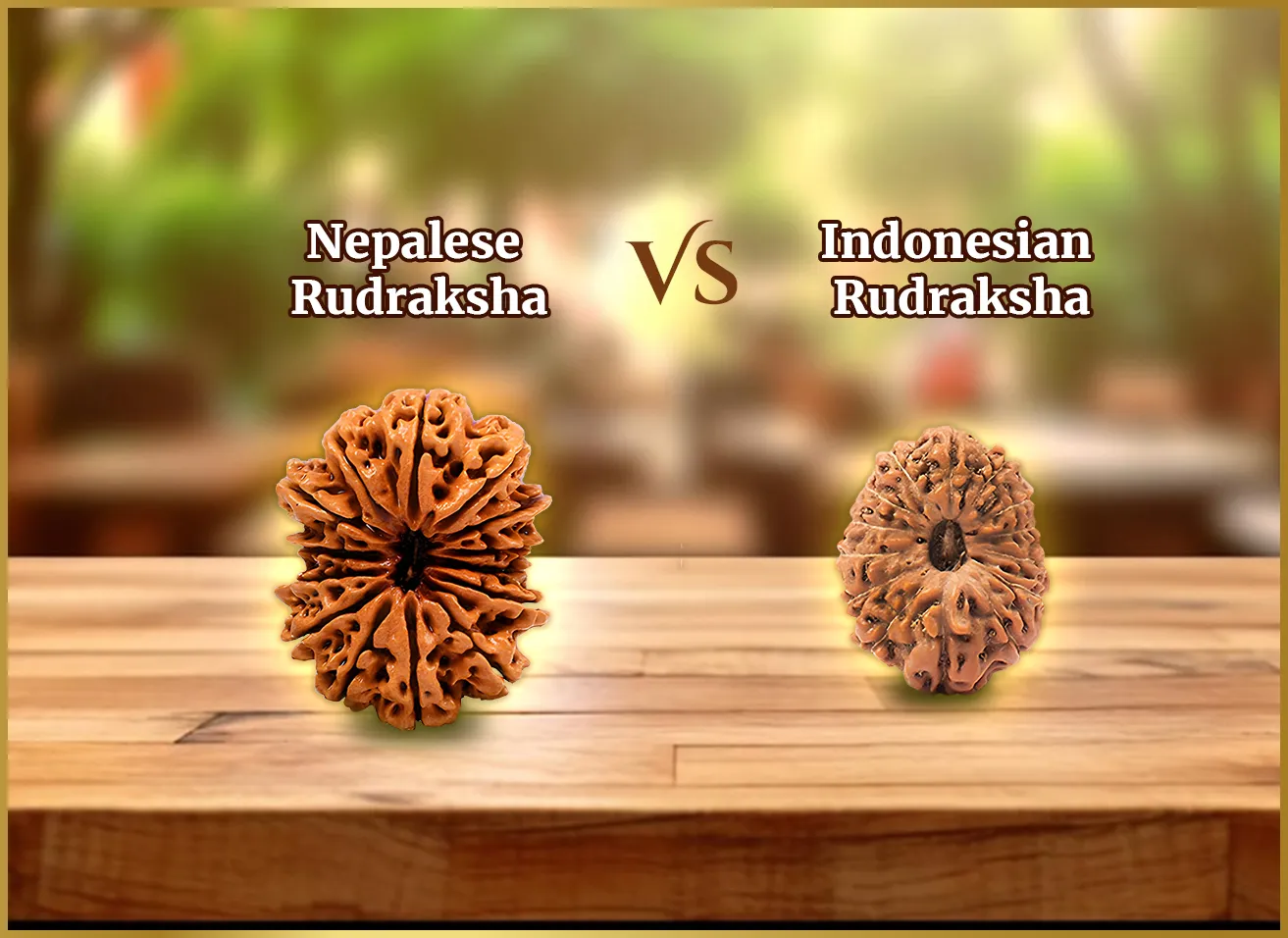
Nepal Rudraksha beads are generally larger, with well-defined mukhi lines and a rougher texture. They appear bold and prominent, which often leads people to associate them with stronger energy.
Indonesian Rudraksha, on the other hand, tends to be smaller, smoother, and more compact. The mukhi lines are present but often less pronounced, giving the bead a subtler appearance.
This visual contrast has led to a widely accepted belief that Nepal Rudraksha is more powerful. But is that really true?
At Nabatara, the teaching is clear: appearance does not determine spiritual effectiveness.
The Role of Perception in Spiritual Choices
Human beings are naturally drawn to what looks more "visible" or "impressive." This psychological tendency plays a major role in the Rudraksha debate. A larger bead feels more significant. A deeper texture feels more authentic. A bold appearance creates a sense of trust.
But spirituality does not function on visual bias.
Energy is not measured by size. It is experienced through sensitivity, alignment, and intention. A smaller bead with genuine formation and proper energization can be far more effective than a larger bead that lacks authenticity.
This is where many seekers unknowingly go wrong. They rely on external comparison instead of internal understanding.
Nabatara emphasizes this shift in perspective through its teachings in astrology, tantra, and spiritual sciences. Because true knowledge begins when perception moves beyond surface-level judgment.
How Geography Influences Rudraksha Formation
To truly understand the difference between Indonesian and Nepalese Rudraksha, one must look at the environment in which they grow. Rudraksha trees thrive in specific climatic conditions, and variations in geography naturally affect the physical characteristics of the seeds.
In Nepal, the climate is cooler and the soil composition is different, which contributes to the formation of larger and more textured beads. The slower growth process allows the bead to develop deeper grooves and a more defined structure.
In Indonesia, the climate is more tropical and humid. This leads to faster growth cycles, resulting in smaller and smoother beads. The mukhi lines are still present, but the surface appears less rugged.
These differences are natural outcomes of environmental conditions, not indicators of superiority.
At Nabatara, students are trained to understand these subtle influences so they can make informed decisions without falling into common misconceptions.
The Misconception of "Power" in Rudraksha
One of the biggest myths in the Rudraksha world is the idea that certain origins automatically make a bead more powerful. This belief is often reinforced by sellers who highlight Nepal Rudraksha as premium and position Indonesian Rudraksha as secondary.
But traditional knowledge tells a different story.
The effectiveness of Rudraksha depends on three fundamental factors—"authenticity, compatibility, and intention. Origin plays a role in physical appearance, but it does not define spiritual potency.
An authentic Indonesian Rudraksha, properly selected and energized, can offer the same benefits as a Nepalese Rudraksha. What matters is whether the bead is genuine and whether it aligns with the wearer's energy.
This understanding forms a core part of Nabatara's teaching philosophy. Because without clarity, seekers can easily be misled by external narratives.
Authenticity: The Real Foundation of Power
If there is one factor that truly determines the effectiveness of Rudraksha, it is authenticity. A genuine bead carries natural energy that interacts with the wearer's system. A fake or altered bead, no matter how visually appealing, lacks this connection.
Unfortunately, the market today is flooded with artificial Rudraksha, chemically treated beads, and manipulated mukhis. These products are often sold with convincing stories, making it difficult for buyers to distinguish real from fake.
This is why education becomes essential.
At Nabatara Institute, authenticity is not treated as a secondary concern—it is the foundation of everything. Students are taught how to identify real Rudraksha, understand its structure, and recognize signs of tampering.
Because without authenticity, no comparison between Indonesian and Nepalese Rudraksha holds any meaning.
The Beginning of True Understanding
As we move deeper into this guide, it will become clear that the Indonesian vs. Nepal debate is not about which is better but about how each serves different individuals in different ways.
What truly matters is not where the Rudraksha comes from, but how it connects with you.
And this is where Nabatara stands apart—not by offering opinions, but by guiding seekers toward direct understanding.
Physical Differences That Mislead Most Buyers: Size, Texture, Density & Internal Structure
Why Most People Judge Rudraksha Incorrectly
When someone first encounters Rudraksha beads, their judgment is almost always visual. The eyes instinctively scan for size, surface depth, symmetry, and overall appearance. A bead that looks bold and well-defined immediately feels more "powerful," while a smaller or smoother bead is often dismissed without much thought.
This instinct is natural, but it is also one of the biggest reasons why so many seekers make the wrong choice.
In the case of Indonesian vs. Nepalese Rudraksha, this visual bias becomes even stronger. Nepal beads, with their larger size and deeper grooves, create an impression of strength and authenticity. Indonesian beads, being smaller and smoother, are often perceived as weaker or less effective.
But this perception is not rooted in spiritual science. It is rooted in human psychology.
At Nabatara, students are trained to move beyond this first layer of judgment. Because when it comes to sacred objects like Rudraksha, what you see is only a fraction of what truly exists.
Size: The Most Misunderstood Factor
The most obvious difference between Indonesian and Nepalese Rudraksha is size. Nepal beads are typically larger, often ranging between medium and big dimensions, while Indonesian beads are comparatively smaller and more compact.
This size difference is the primary reason why many people assume Nepal Rudraksha to be more powerful. The logic seems simple—"bigger bead, stronger energy.
But this assumption does not hold up under deeper understanding.
Rudraksha is not a container of energy in the way people imagine. It is not about how much energy is stored inside the bead, but about how the bead interacts with the wearer's subtle body. This interaction is influenced by the bead's natural structure, its mukhi formation, and its authenticity—not its physical size.
In fact, many experienced practitioners find smaller Indonesian Rudraksha easier to wear for long durations. Their compact nature allows them to sit comfortably on the body, maintaining consistent contact with the skin. This continuous contact plays a subtle but important role in how the bead influences the wearer.
At Nabatara Institute, this is often explained through direct experience rather than theory. Students who experiment with both types begin to realize that size does not dictate effectiveness—comfort, connection, and authenticity do.
Texture: Rough vs. Smooth and the Illusion of Authenticity
Another major point of comparison is texture. Nepal Rudraksha typically has a rough, deeply grooved surface with clearly visible mukhi lines. Indonesian Rudraksha, in contrast, has a smoother outer layer, with finer and less pronounced lines.
To an untrained eye, the rough texture of Nepalese beads feels more "natural" and therefore more authentic. The deep grooves give a sense of complexity, which people often associate with higher quality.
But this is where misunderstanding begins.
Texture is a result of environmental conditions, not a measure of spiritual value. The climate in Nepal allows the bead to develop a thicker outer surface with deeper ridges. In Indonesia's tropical environment, the bead forms with a smoother finish.
Both are natural outcomes. Neither is superior.
What truly matters is whether the mukhi lines are naturally formed and continuous from one end of the bead to the other. Artificially altered beads can sometimes mimic rough textures, making them appear more authentic than they actually are.
This is why Nabatara places such strong emphasis on proper identification techniques. Because relying solely on texture can easily lead to misjudgment.
Density and Weight: Subtle Differences That Matter Less Than You Think
Some discussions around Rudraksha also include density and weight. Nepal Rudraksha is often described as denser and heavier, while Indonesian beads are lighter due to their smaller size and compact structure.
While this observation is generally true, it is frequently misinterpreted.
A heavier bead does not necessarily mean a more powerful bead. Density can vary based on natural growth conditions, internal composition, and even the age of the seed. These variations are part of nature's diversity, not indicators of spiritual hierarchy.
In certain practices, lighter beads are actually preferred for long-term wear, especially in malas used for meditation and japa. Their reduced weight allows the practitioner to remain focused without physical discomfort.
At Nabatara, this balance between physical comfort and spiritual utility is always emphasized. Because a bead that feels right on your body is more likely to support your practice consistently.
Internal Structure: Where the Real Truth Lies
If there is one area where the comparison becomes meaningful, it is the internal structure of the Rudraksha. This is where the mukhis are formed and where the bead's natural channels exist.
Both Indonesian and Nepalese Rudraksha have the same fundamental structure. Each mukhi corresponds to a natural division inside the bead, creating compartments that are aligned with specific energetic patterns.
The number of mukhis determines the type of Rudraksha, not its origin.
A five-mukhi Indonesian Rudraksha and a five-mukhi Nepal Rudraksha share the same underlying structure. Their external appearance may differ, but their fundamental classification remains identical.
This is a crucial point that is often overlooked in commercial narratives.
At Nabatara Institute, students are taught to understand Rudraksha from this internal perspective. Because once you recognize that the essence lies within, external comparisons begin to lose their significance.
The Role of Mukhi Clarity
One visible difference that does matter to some extent is the clarity of mukhi lines. Nepal Rudraksha usually has more distinct and easily countable lines, which makes identification simpler. Indonesian beads may require closer observation, as the lines can be finer.
This has led to a practical preference among beginners for Nepal Rudraksha, simply because it is easier to verify.
However, for experienced practitioners, this difference becomes irrelevant. With proper knowledge, even subtle mukhi lines can be identified accurately.
Nabatara addresses this gap through detailed training, ensuring that students do not remain dependent on superficial indicators.
Why Surface-Level Comparison Fails
When all these factors—size, texture, density, and structure—are considered together, a pattern begins to emerge. Most of the commonly discussed differences are external. They influence perception, but they do not define spiritual effectiveness.
This is where many buyers get trapped. They compare what is visible and ignore what is essential.
The truth is that Rudraksha does not operate on the principles of visual superiority. It functions through natural alignment, authenticity, and the wearer's receptivity.
At Nabatara, this understanding is not just taught—it is experienced. Because real learning happens when theory meets practice.
The Emotional Influence of Appearance
There is another layer to this discussion that is rarely addressed—the emotional response to appearance. A larger, more textured bead can create a stronger psychological impact. It feels more sacred, more valuable, more "special."
This emotional response can influence how a person perceives their spiritual practice. If someone believes their Rudraksha is powerful, they may feel more confident and connected.
But this effect comes from belief, not from the bead itself.
While belief is an important part of spirituality, it should not replace understanding. True growth comes from clarity, not illusion.
Nabatara encourages seekers to move beyond emotional dependency and develop a deeper connection with knowledge. Because when understanding becomes strong, belief naturally aligns with truth.
Practical Usage Differences
From a practical standpoint, Indonesian and Nepalese Rudraksha can feel different when worn.
Nepal beads, due to their size, are often used as statement malas or in situations where visibility is preferred. They are commonly chosen for rituals, ceremonies, or occasions where the bead is meant to be seen.
Indonesian beads, being smaller and lighter, are frequently used for daily wear. They are comfortable, subtle, and easy to integrate into everyday life.
This difference does not indicate superiority. It simply reflects variation in usage.
At Nabatara, individuals are guided to choose based on their lifestyle, comfort, and purpose—not on perceived hierarchy.
Moving Beyond the Comparison
By now, it should be clear that the physical differences between Indonesian and Nepalese Rudraksha are real, but their importance is often exaggerated.
Size, texture, and appearance can influence preference, but they do not determine spiritual value.
The real question is not which Rudraksha is better, but which Rudraksha is right for you.
And this is where the journey begins to shift from comparison to understanding.
The Nabatara Perspective
At Nabatara, Rudraksha is not treated as a product—it is treated as a tool for transformation. The focus is not on promoting one type over another but on helping individuals make informed, conscious choices.
Because when knowledge is clear, confusion disappears.
And when confusion disappears, the path becomes visible.
Energy, Vibration & Spiritual Effect: What Truly Makes Rudraksha Powerful
The Question Everyone Asks but Few Truly Understand
At some point in their journey, every Rudraksha seeker asks the same question: "Which one has more energy?" Is Nepal's Rudraksha stronger? Does Indonesian Rudraksha carry less vibration? Can origin really influence spiritual power?
These questions seem logical on the surface, but they arise from a fundamental misunderstanding of how Rudraksha actually works.
Energy, in the context of spirituality, is not something you can measure with physical parameters like size, weight, or geographic origin. It is not a visible force that sits inside the bead waiting to be released. It is a subtle interaction—one that depends as much on the wearer as it does on the Rudraksha itself.
At Nabatara, this is where the teaching shifts from information to realization. Because unless you understand how energy truly functions, every comparison will lead you further away from clarity.
What Does "Energy" Mean in Rudraksha?
The word "energy" is often used loosely in spiritual discussions. For some, it means power. For others, it means vibration, aura, or even divine presence. But in the context of Rudraksha, energy refers to its ability to influence your internal state—your thoughts, emotions, focus, and awareness.
Rudraksha does not create energy out of nothing. Instead, it interacts with your existing system. It works like a tuning device, helping your mind and body align with a more balanced and stable frequency.
This is why two people wearing the same Rudraksha can have completely different experiences.
One may feel calm and centered, while the other may feel nothing at all.
The difference is not in the bead. The difference is in receptivity.
Nabatara emphasizes this understanding across all its teachings—whether it is astrology, tantra, or meditation. Because true spiritual tools do not impose change; they facilitate it.
The Myth of "Stronger" and "Weaker" Rudraksha
One of the most persistent myths in the Rudraksha world is the idea that certain beads are inherently stronger than others. This belief is especially common in the Indonesian vs. Nepalese comparison, where Nepalese Rudraksha is often labeled as more powerful.
But this claim does not align with traditional knowledge.
A Rudraksha bead does not function like a battery with varying levels of charge. Its effectiveness is not determined by how much "power" it contains, but by how accurately it resonates with your energy system.
Think of it like sound. A loud sound is not necessarily better than a soft one. What matters is whether the frequency is in harmony with you.
Similarly, a larger Nepal Rudraksha may feel more prominent, but that does not mean it is more effective than a smaller Indonesian bead.
At Nabatara Institute, this concept is often demonstrated through direct experience. When individuals wear different Rudraksha types under proper guidance, they begin to notice that the impact depends more on alignment than on origin.
How Rudraksha Interacts with the Human System
To understand why origin is not the deciding factor, you need to look at how Rudraksha interacts with the human body.
The human system is not just physical. It includes layers of energy, often referred to in spiritual traditions as prana, chakras, or subtle bodies. Rudraksha works primarily at this subtle level.
When worn, the bead comes into contact with the skin, allowing its natural structure to influence the body's electromagnetic field. This interaction is gentle, continuous, and often imperceptible in the beginning.
Over time, it can help stabilize emotional fluctuations, improve focus, and create a sense of inner balance.
But this process depends on consistency and compatibility.
If the Rudraksha is authentic and suited to the individual, the effect becomes noticeable. If not, it remains dormant.
This is why Nabatara does not promote one-size-fits-all solutions. Every individual is guided based on their unique constitution, astrological alignment, and spiritual goals.
Does Origin Affect Energy at All?
This is where clarity is needed.
While Indonesian and Nepalese Rudraksha differ in physical characteristics, their fundamental nature remains the same. Both originate from the same species of tree and carry the same basic structure.
The environment in which they grow can influence their external form, but it does not alter their intrinsic properties.
In simpler terms, origin affects appearance, not essence.
However, there is a subtle nuance here. Because Nepal Rudraksha is larger and has more pronounced mukhi lines, some practitioners find it easier to connect with. This is not due to higher energy but due to stronger perception.
When something feels more "visible," the mind engages with it more actively.
Indonesian Rudraksha, being subtler in appearance, may not create the same immediate impression. But for those who wear it consistently, the experience can be equally profound.
At Nabatara, this distinction is explained carefully to prevent misunderstanding. Because once you equate visibility with power, you lose sight of how spiritual tools actually function.
The Role of Intention in Spiritual Effectiveness
If there is one factor that consistently influences the effectiveness of Rudraksha, it is intention.
Intention is not just a thought. It is a directed awareness—a conscious alignment of your mind toward a purpose. When you wear Rudraksha with clarity and sincerity, it becomes part of your spiritual process.
Without intention, even the most authentic Rudraksha remains underutilized.
This is why rituals, mantras, and proper wearing methods exist. They are not superstitions; they are ways of establishing connection.
At Nabatara, great importance is given to this aspect. Students are not just told what to wear but how to wear it, why to wear it, and what to cultivate internally while wearing it.
Because a bead alone cannot transform you. But a bead combined with awareness can.
Energization: The Missing Link Most People Ignore
Another critical aspect that is often overlooked is energization. Many people purchase Rudraksha and start wearing it immediately, without any preparation or process.
While an authentic Rudraksha naturally carries its own vibration, energization enhances its alignment with the wearer.
This can be done through specific rituals, mantras, or guided practices.
At Nabatara, energization is treated as an essential step, not an optional one. Because it bridges the gap between object and experience.
Without this step, even a genuine Nepal or Indonesian Rudraksha may not deliver its full potential.
Personal Experience vs. Market Narratives
Much of what people believe about Rudraksha comes from market narratives rather than personal experience. Sellers often emphasize differences that are easy to communicate—"size," "origin," and "rarity"—because these factors influence buying decisions.
But spiritual effectiveness cannot be packaged into simple comparisons.
It has to be experienced.
This is why Nabatara focuses on education over promotion. Instead of telling people what to believe, it encourages them to explore, observe, and understand.
Because once you experience the effect of Rudraksha firsthand, external opinions lose their hold.
Why Some People Feel Immediate Effects
There are instances where individuals report immediate changes after wearing Rudraksha—calmness, clarity, or a sense of protection. These experiences are real, but they are not universal.
They depend on several factors, including sensitivity, openness, and prior spiritual exposure.
Someone who is already engaged in practices like meditation or mantra chanting may feel the effects more quickly. Others may require time.
This variation is normal.
At Nabatara, this is explained clearly to avoid unrealistic expectations. Because spiritual growth is not a race—it is a process.
The Truth That Simplifies Everything
After exploring all these layers, the conclusion becomes surprisingly simple.
The effectiveness of Rudraksha does not depend on whether it comes from Indonesia or Nepal. It depends on whether it is authentic, properly selected, and consciously used.
This understanding removes unnecessary confusion and brings the focus back to what truly matters.
And this is the essence of Nabatara's approach—cutting through complexity to reveal clarity.
Moving Toward Real Understanding
As we move into the next part of this guide, we will address one of the most influential aspects of this topic—"myths vs reality.
Because much of what people believe about Rudraksha is shaped by assumptions, half-truths, and repeated misinformation.
Breaking these myths is not just about correcting facts. It is about freeing seekers from confusion so they can move forward with confidence.
Indonesian vs. Nepalese Rudraksha Myths vs. Reality: What You Should Stop Believing Today
The Invisible Problem: Misinformation Disguised as Tradition
By the time most people begin searching for Rudraksha, they have already been exposed to dozens of opinions. Some come from sellers, some from online forums, some from videos, and a few from traditional sources. The challenge is that all of these voices sound equally convincing.
Over time, repetition turns assumption into belief.
This is how myths are created—not through intention, but through unchecked information.
In the case of Indonesian vs. Nepalese Rudraksha, the number of myths is surprisingly high. Many of them are so widely accepted that questioning them feels uncomfortable. But if you are serious about understanding Rudraksha, this is exactly where clarity must begin.
At Nabatara, this stage is considered essential. Because unless false ideas are removed, true knowledge has no space to settle.
Myth One: Nepal Rudraksha Is Always More Powerful
This is perhaps the most dominant belief in the entire Rudraksha market. Nepal beads are often presented as premium, superior, and more spiritually effective.
The reasoning usually points to their larger size, deeper grooves, and more visible mukhi lines.
But as we have already explored, these are physical characteristics—not indicators of spiritual strength.
The idea that Nepal Rudraksha is always more powerful comes largely from visual bias and market positioning. Bigger beads naturally attract more attention, and over time, this attention gets translated into perceived value.
In reality, an authentic Indonesian Rudraksha with proper mukhi formation can be just as effective as a Nepal bead.
At Nabatara, students are taught to question this assumption early in their learning. Because once you understand how Rudraksha actually works, this myth loses its foundation completely.
Myth Two: Indonesian Rudraksha Is Inferior or "Less Spiritual"
Closely connected to the first myth is the belief that Indonesian Rudraksha is somehow inferior. This perception often leads buyers to avoid Indonesian beads altogether, assuming they are a compromise or a second option.
This is not only incorrect—it is limiting.
Indonesian Rudraksha comes from the same botanical source and carries the same fundamental structure as Nepalese Rudraksha. Its smaller size and smoother texture are simply the result of environmental conditions.
Nothing about it makes it less spiritual.
In fact, many practitioners prefer Indonesian Rudraksha for daily wear because of its comfort and subtlety. Its lighter weight allows for longer usage without distraction, making it highly practical for meditation and continuous contact.
Nabatara emphasizes this balance between practicality and spirituality. Because a bead that supports your daily life is far more valuable than one that only looks impressive.
Myth Three: Bigger Rudraksha Means Stronger Results
This myth goes beyond the Indonesian vs. Nepalese debate and influences how people perceive Rudraksha in general.
The assumption is simple: larger beads must contain more energy and therefore produce stronger effects.
But this idea does not align with how Rudraksha interacts with the human system.
As discussed earlier, Rudraksha does not function based on the quantity of energy. It works through resonance. A smaller bead that aligns well with your system can be far more effective than a larger bead that does not.
This is similar to how certain sounds can feel soothing while others feel uncomfortable, regardless of volume.
At Nabatara Institute, this concept is explained through both theory and experience. Because once you feel the difference yourself, the need for comparison disappears.
Myth Four: Only Rare or Expensive Rudraksha Works
Another widespread belief is that only rare or high-priced Rudraksha can deliver real benefits. This idea is often reinforced by marketing strategies that highlight exclusivity and scarcity.
While it is true that certain mukhi types are rare, rarity does not automatically translate to effectiveness.
A simple, authentic five mukhi Rudraksha can be extremely beneficial when worn correctly. It is one of the most commonly recommended beads for general well-being, and its accessibility does not reduce its value.
The focus should always be on authenticity and suitability, not on price or rarity.
Nabatara consistently guides seekers toward this understanding, helping them avoid unnecessary expenditure driven by misunderstanding.
Myth Five: Origin Determines Destiny
Some people believe that the origin of Rudraksha can directly influence their life outcomes. For example, choosing Nepal Rudraksha is thought to bring better results compared to Indonesian beads.
This belief places too much importance on geography and ignores the role of personal alignment.
Your experiences with Rudraksha are shaped by multiple factors—your intention, your consistency, your mental state, and your openness to change.
The bead supports your journey, but it does not control it.
At Nabatara, this perspective is reinforced across all teachings. Because spiritual growth is always a partnership between the tool and the individual.
Myth Six: You Can Judge Authenticity by Appearance Alone
Many buyers believe they can identify genuine Rudraksha simply by looking at it. They rely on surface features like texture, symmetry, and color to make their decision.
While these indicators can provide clues, they are not foolproof.
Artificial beads can be designed to mimic natural textures. Chemically treated beads can appear more polished or more rugged, depending on how they are processed.
Authenticity requires deeper examination—understanding the internal structure, verifying natural mukhi formation, and ensuring there has been no tampering.
This is why education becomes essential.
At Nabatara Institute, identifying genuine Rudraksha is taught as a skill, not a guess. Because without this knowledge, even experienced buyers can be misled.
Myth Seven: Rudraksha Works Instantly for Everyone
In today's fast-paced world, people often expect immediate results from everything, including spiritual tools. Some believe that wearing Rudraksha will instantly solve problems or bring sudden transformation.
While some individuals may feel quick changes, this is not the norm.
Rudraksha works gradually, influencing your internal state over time. Its effects become noticeable with consistent use and conscious engagement.
Expecting instant results can lead to disappointment and misunderstanding.
Nabatara encourages a more grounded approach—one that values patience, observation, and steady progress. Because real transformation is rarely immediate.
How Myths Shape Buying Decisions
These myths do more than create confusion—they directly influence how people make decisions. Buyers often prioritize appearance, origin, or price based on what they have heard, rather than what they have understood.
This leads to choices that may not align with their actual needs.
Over time, this misalignment can reduce the effectiveness of the Rudraksha and create doubt about its value.
Breaking these myths is not just about correcting information. It is about helping individuals make decisions that truly support their journey.
The Nabatara Approach to Clarity
At Nabatara, the goal is not to promote one type of Rudraksha over another. The goal is to provide clarity.
Clarity removes confusion. Clarity builds confidence. And confidence allows individuals to move forward without hesitation.
Through its structured teachings in astrology, tantra, and spiritual sciences, Nabatara ensures that seekers are not dependent on external opinions. Instead, they develop the ability to understand and choose for themselves.
This approach creates not just informed buyers but also aware practitioners.
Reality Is Simpler Than You Think
After removing all the myths, what remains is surprisingly straightforward.
Indonesian and Nepalese Rudraksha differ in size, texture, and appearance, but not in their fundamental ability to support spiritual growth.
Effectiveness depends on authenticity, alignment, and conscious usage.
Once this is understood, the need for comparison fades away.
What remains is a clearer, more confident approach to choosing and using Rudraksha.
Preparing for the Final Understanding
In the final part of this guide, we will bring everything together. Instead of comparing or debating, we will focus on practical guidance—"how to choose the right Rudraksha for yourself, how to use it correctly, and how to integrate it into your life.
This is where knowledge becomes action.
And this is where your journey with Rudraksha truly begins.
How to Choose the Right Rudraksha for You: A Practical Guide Rooted in Real Understanding
When Confusion Ends, the Real Journey Begins
After exploring differences, breaking myths, and understanding how Rudraksha truly works, one question naturally remains: "How do you actually choose the right Rudraksha for yourself?"
This is where most people expect a simple answer. A quick recommendation. A fixed formula.
But the truth is, choosing Rudraksha is not a one-size-fits-all decision.
It is a process of alignment.
At this stage, everything you have learned begins to come together. The debate between Indonesian and Nepalese Rudraksha fades into the background, and a more meaningful question takes its place: "What is right for you at this point in your life?"
At Nabatara, this shift is considered the beginning of real understanding. Because once you stop looking for the "best" and start looking for the "right," your entire approach changes.
Step Into Clarity: Start With Purpose, Not Preference
Most people begin their search with preference. They look at size, origin, or price and then try to decide. But this approach often leads to confusion because it focuses on external factors.
A more effective way is to begin with purpose.
Why do you want to wear Rudraksha?
Is it for mental clarity, emotional balance, spiritual growth, or protection? Are you seeking stability in your daily life, or are you exploring deeper spiritual practices?
Your intention shapes your experience.
When your purpose is clear, the choice becomes simpler. Because instead of comparing options blindly, you begin to look for what aligns with your needs.
At Nabatara Institute, this is always the first step. Students are guided to understand their own goals before selecting any spiritual tool. Because without clarity of purpose, even the right Rudraksha may feel ineffective.
Understanding Your Own System
One of the most overlooked aspects of choosing Rudraksha is self-awareness. People often focus entirely on the bead and ignore their own state of mind and body.
But Rudraksha does not work in isolation. It interacts with you.
Your mental patterns, emotional tendencies, lifestyle, and even your level of spiritual openness influence how Rudraksha affects you.
This is why two individuals wearing the same bead can have completely different experiences.
At Nabatara, this understanding is developed through structured learning in astrology, meditation, and spiritual sciences. Because when you understand yourself, your choices naturally become more accurate.
Indonesian or Nepalese: What Should You Actually Choose?
Now that you have clarity, the question of Indonesian vs. Nepalese Rudraksha can be answered in a practical way.
If you prefer a bead that is visually prominent, easier to identify, and traditionally valued for its appearance, Nepal Rudraksha may feel more suitable. Its larger size and deeper texture make it noticeable and often preferred for ceremonial or visible use.
If you are looking for something subtle, comfortable, and easy to wear daily without drawing attention, Indonesian Rudraksha can be an excellent choice. Its lighter weight and compact form make it ideal for continuous use.
But beyond these practical differences, both serve the same purpose.
Neither is inherently superior.
The right choice is the one that fits naturally into your life.
At Nabatara, individuals are encouraged to move beyond comparison and choose based on comfort, authenticity, and personal alignment. Because a bead that you wear consistently will always be more effective than one you keep aside.
Authenticity: The Decision That Changes Everything
If there is one decision that matters more than any other, it is authenticity.
A genuine Rudraksha carries natural integrity. Its structure is untouched, its mukhi lines are naturally formed, and its internal channels remain intact.
A fake or altered bead, no matter how attractive, cannot offer the same connection.
This is why authenticity should never be compromised.
At Nabatara, this principle is non-negotiable. Every student is taught how to identify genuine Rudraksha, not just through theory, but through observation and practice.
Because when you know what to look for, you no longer depend on claims or marketing—you rely on understanding.
The Importance of Proper Guidance
While self-learning is valuable, there are moments in a spiritual journey where guidance becomes essential. Choosing Rudraksha is one of those moments.
A knowledgeable guide can help you avoid mistakes, understand subtle differences, and select a bead that truly aligns with your needs.
This is where institutions like Nabatara play a crucial role.
With its deep-rooted expertise in astrology, tantra, and spiritual sciences, Nabatara does not just provide information—it offers direction. The guidance is not generic; it is personalized, thoughtful, and grounded in authentic tradition.
For those who wish to go beyond surface-level understanding, this kind of guidance can make a significant difference.
Wearing Rudraksha the Right Way
Choosing the right Rudraksha is only the beginning. How you wear it also matters.
Rudraksha is traditionally worn in a way that allows it to remain in contact with the skin. This contact supports its interaction with your system, making the experience more consistent.
Cleanliness, respect, and awareness are important. The bead should be treated as a sacred object, not just an accessory.
Simple practices like maintaining purity, avoiding unnecessary handling, and wearing it with intention can enhance its effect.
At Nabatara, these practices are explained in detail, ensuring that individuals do not miss the subtle aspects that make a difference.
The Role of Consistency
One of the most important yet overlooked factors in working with Rudraksha is consistency.
Many people wear it for a few days, expect immediate results, and then lose interest. This approach limits the potential of the bead.
Rudraksha works gradually. Its influence builds over time, creating a steady shift in your internal state.
Consistency allows this process to unfold naturally.
At Nabatara, this principle is emphasized across all practices. Because real transformation is not sudden—it is sustained.
When Rudraksha Becomes More Than an Object
At a certain point, Rudraksha stops feeling like an external object and becomes part of your daily experience. You begin to notice subtle changes—"greater calmness, improved focus, a sense of grounding.
These changes are not dramatic, but they are meaningful.
They reflect a shift in your internal alignment.
This is the true purpose of Rudraksha—not to create instant miracles, but to support steady growth.
And this is where its real value lies.
Why Learning Matters More Than Buying
In today's world, it is easy to purchase Rudraksha. It is available across platforms, in different forms, with endless claims.
But access does not equal understanding.
Without knowledge, even the best tools remain underutilized.
This is why learning becomes essential.
At Nabatara Institute, the focus is not just on providing Rudraksha but on educating individuals about its deeper significance. Through courses in astrology, tantra, meditation, and spiritual practices, seekers are given the tools to understand, not just follow.
Because when you understand, every choice becomes meaningful.
Nabatara: Where Knowledge Meets Experience
What sets Nabatara apart is not just its teachings but also its approach.
Founded by Gaurav Tribedi, whose decades of experience in astrology and tantra bring depth and authenticity, Nabatara represents a space where tradition meets practical application.
Here, Rudraksha is not treated as a trend or a product. It is approached as a sacred science—one that requires respect, understanding, and proper guidance.
For those who wish to explore spirituality beyond surface-level information, Nabatara offers a path that is both structured and transformative.
The Final Truth About Indonesian vs. Nepalese Rudraksha
After everything we have explored, the conclusion becomes clear.
Indonesian and Nepalese Rudraksha differ in appearance but not in their fundamental ability to support your journey.
The real factors that determine effectiveness are authenticity, alignment, intention, and consistency.
Once you understand this, the debate loses its importance.
What remains is a simpler, more grounded approach—one that allows you to choose with clarity and move forward with confidence.
Your Journey Starts With Understanding
Rudraksha is not just something you wear. It is something you grow with.
And like any meaningful journey, it begins with understanding.
If you approach it with awareness, patience, and the right guidance, it can become a powerful companion in your path toward balance and clarity.
At Nabatara, this journey is not just taught—it is lived.
A Gentle Invitation
If this guide has brought clarity, consider taking the next step.
Explore deeper. Learn the science behind these traditions. Understand not just what to use, but why it works.
Because true transformation does not come from objects alone—it comes from knowledge.
And the right knowledge can change everything.
Why You Can Trust This Rudraksha Guide: Real Experience, Authentic Knowledge & Spiritual Authority
In today's digital space, information about Rudraksha is everywhere—but genuine understanding is rare. Much of what you find online is either repeated content, surface-level comparisons, or commercially influenced opinions that prioritize selling over educating. This is exactly why it becomes important to understand the source behind the knowledge you are reading.
This guide is not based on assumptions or generic research. It is built upon traditional wisdom, years of practical experience, and structured spiritual study as practiced and taught at Nabatara.
Nabatara Foundation, a registered not-for-profit organization under Section 8 of the Companies Act, Government of India, operates with a clear mission: to preserve, practice, and share authentic Vedic knowledge in a way that is relevant to modern seekers. Through the Nabatara Institute of Astrology, individuals from different parts of the world are trained in astrology, tantra, Rudraksha science, and deeper spiritual disciplines with a focus on real understanding rather than blind belief.
The insights shared in this article reflect teachings that come from direct lineage-based knowledge and years of hands-on experience with Rudraksha in both personal practice and student guidance. Under the leadership of Gaurav Tribedi, who has spent over two decades immersed in astrology, tantra shastra, and spiritual sciences, the approach has always remained rooted in authenticity.
What makes this perspective different is its emphasis on clarity over claims. Instead of promoting one type of Rudraksha over another, the focus is on helping individuals understand the deeper principles that govern their effectiveness. This includes authenticity, energetic alignment, proper usage, and the role of intention—factors that are often overlooked in mainstream discussions.
At Nabatara, Rudraksha is not treated as a product or trend. It is approached as a sacred tool that requires proper knowledge, respect, and guidance. Every recommendation is based on structured learning, traditional references, and real-world application rather than marketing narratives.
This commitment to authenticity and education is what allows Nabatara to stand as a trusted source for those who are serious about their spiritual journey. Whether you are a beginner trying to understand the basics or a dedicated seeker looking to deepen your practice, the goal remains the same: to provide knowledge that is reliable, practical, and transformative.
When you read this guide, you are not just consuming content. You are engaging with a body of knowledge that has been carefully preserved, practiced, and shared with responsibility.
And that is what truly makes the difference.