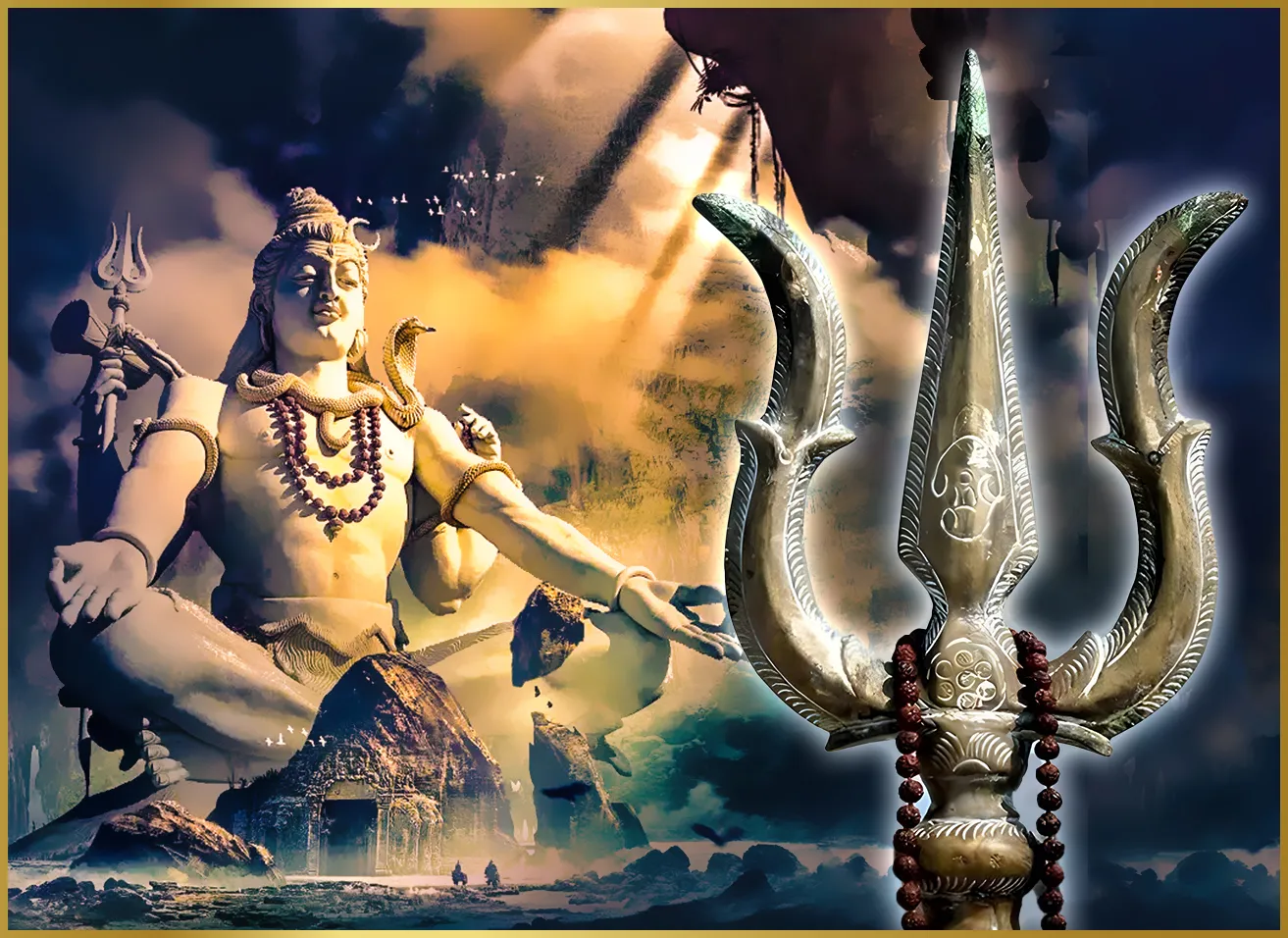
The Silent Power Behind Shiva's Trishul
There is something deeply mysterious about the image of Lord Shiva standing still, calm, detached from the chaos of the world, yet holding the Trishul with absolute authority. For centuries, seekers, sages, and spiritual practitioners have tried to understand why this symbol appears so prominently in every depiction of Shiva. It is not just a weapon. It is not just an ornament. It is a message, encoded in spiritual language, waiting to be understood.
In today's fast-moving world, where people constantly search for balance, clarity, and purpose, the symbolism of the Trishul becomes more relevant than ever. It speaks directly to the inner conflict every human experiences, the struggle between thoughts, emotions, and actions. When understood correctly, it becomes a guide, almost like a spiritual compass.
At Nabatara, where ancient Vedic knowledge is not just taught but experienced, the Trishul is seen as a living symbol. It represents the very foundation of spiritual growth and transformation. The teachings shared at Nabatara Institute of Astrology often revolve around decoding such symbols, because true wisdom is never superficial. It is layered, subtle, and deeply connected to one's inner journey.
The Trishul is one such key.
Understanding Shiva Beyond Mythology
Before diving into the Trishul itself, it is important to understand Shiva not just as a deity, but as a state of consciousness. In Vedic philosophy, Shiva represents the ultimate stillness, the unchanging reality behind everything that changes. He is the observer, the witness, the silent presence within every being.
This is where many people misunderstand spirituality. They see symbols like the Trishul and interpret them literally, missing the deeper meaning. But ancient sciences like astrology, tantra, and spiritual sadhana"all of which are taught at Nabatara"reveal that every symbol is a doorway.
Shiva holding the Trishul is not about power over others. It is about mastery over oneself.
It is about understanding life in its three fundamental processes: creation, preservation, and destruction.
The Trishul as a Symbol of Universal Forces
Look closely at the Trishul. It has three sharp points, each equally powerful, each connected to a single base. This design is not accidental. It reflects one of the most fundamental truths of existence.
Everything in this universe operates through three forces.
Creation is the beginning, the spark, the birth of ideas, emotions, and life itself. Preservation is the continuation, the nurturing, the sustaining energy that keeps things going. Destruction is the ending, the transformation, the clearing away of what no longer serves a purpose.
Most people fear destruction. They resist change. They hold on to things long after they should have let go. This is where imbalance begins.
Through the teachings at Nabatara, students begin to understand that destruction is not negative. It is necessary. Without it, there can be no renewal, no evolution, no growth. The Trishul reminds us of this truth constantly.
When Shiva holds the Trishul, it symbolizes perfect control over these three forces. It represents a state where creation is conscious, preservation is balanced, and destruction is fearless.
Why This Symbol Matters in Today's Life
In modern life, people often feel overwhelmed. There is constant mental noise, emotional instability, and physical exhaustion. The root cause of this is imbalance.
The mind creates endless thoughts, the body struggles to keep up, and the soul feels disconnected.
This is where the deeper meaning of the Trishul becomes incredibly practical.
It teaches us how to align these aspects of life. It shows us that balance is not achieved by avoiding challenges but by understanding them. When a person learns to consciously create, wisely preserve, and courageously let go, life becomes more harmonious.
At Nabatara, this understanding is not limited to theory. Through astrology, meditation, and spiritual practices, individuals are guided to observe these forces within themselves. They learn how their thoughts are created, how their habits are maintained, and how they can release what no longer serves them.
This is the real power of the Trishul.
The Hidden Connection Between Trishul and Inner Balance
One of the most profound interpretations of the Trishul is its connection to the human system"the mind, body, and soul.
These three aspects define our entire experience of life.
The mind is constantly active, generating thoughts, ideas, and perceptions. The body is the physical vehicle, responding to actions and carrying out daily functions. The soul is the silent observer, the deeper consciousness that remains unchanged.
When these three are not aligned, life feels chaotic.
A restless mind leads to stress. A neglected body leads to illness. A disconnected soul leads to emptiness.
The Trishul represents the alignment of these three.
This is why Shiva, who represents ultimate awareness, holds it so effortlessly. It is a reminder that true power lies not in external achievements but in internal harmony.
At Nabatara Institute, this concept is explored deeply through practices like meditation and spiritual sadhana. Students are taught how to observe their thoughts, care for their physical energy, and connect with their inner self. Over time, this creates a natural balance.
And that balance is exactly what the Trishul symbolizes.
The Role of Ancient Knowledge in Understanding Symbols
In today's digital world, information is everywhere, but wisdom is rare. People often read about symbols like the Trishul but fail to experience their meaning.
Ancient sciences like astrology and tantra were never meant to be just studied. They were meant to be practiced, lived, and realized.
This is where institutions like Nabatara play a crucial role. By preserving authentic teachings and making them accessible in a structured way, they bridge the gap between ancient wisdom and modern life.
Understanding the Trishul is not about memorizing its meaning. It is about recognizing these forces within yourself.
It is about observing how you create your reality, how you maintain it, and how you respond to change.
This awareness itself becomes transformative.
A Symbol That Speaks to Every Seeker
The beauty of the Trishul lies in its universality. It is not limited to any one belief system or tradition. Its meaning applies to everyone, regardless of background.
Every person experiences creation, preservation, and destruction in their daily life.
Every person struggles with balancing mind, body, and soul.
And every person, at some point, seeks deeper meaning.
The Trishul becomes a guide in this journey. It does not impose answers. It invites reflection.
At Nabatara, this journey is supported through structured learning and guidance. Whether someone is completely new to spirituality or already on a path, the teachings are designed to meet them where they are.
Because true spirituality is not about escaping life. It is about understanding it more deeply.
Moving Deeper Into the Meaning
So far, we have only touched the surface of what the Trishul represents. In the next part, we will go deeper into the three fundamental forces"creation, preservation, and destruction"and understand how they operate within us on a daily level.
We will explore how these forces influence our decisions, relationships, and life path, and how mastering them can lead to true inner freedom.
This is where the symbolism becomes even more powerful.
And this is where real transformation begins.
The Three Forces of the Trishul: Creation, Preservation, and Destruction
When we look at the Trishul from a deeper spiritual lens, its three sharp edges are not just symbolic"they represent the very mechanics of existence. Every moment of life, whether visible or subtle, is governed by three continuous processes: creation, preservation, and destruction.
Most people imagine these as large, cosmic events. Birth, life, and death. But what ancient Vedic wisdom reveals"and what is deeply emphasized in the teachings at Nabatara"is that these processes are happening within you every single moment.
Every thought you generate is creation. Every belief you hold onto is preservation. Every habit you break or pattern you release is destruction.
This is not philosophy. This is lived reality.
Understanding this changes the way you see your life.
Creation: The Beginning of Everything Within You
Creation is the most celebrated aspect of existence. It is associated with beginnings, opportunities, and possibilities. In spiritual terms, it is often linked with the energy of Brahma"the force that initiates.
But creation is not limited to physical birth. It begins much earlier, at the level of thought.
Every action you take first appears as a thought. Every emotion you feel is triggered by an internal process. Your entire reality is shaped by what you continuously create within your mind.
This is why, at Nabatara Institute, the focus is not just on external rituals but on internal awareness. Students are trained to observe how thoughts arise, how intentions are formed, and how subtle energies influence decision-making.
Because if you are not conscious of what you are creating, you are creating unconsciously.
And unconscious creation leads to confusion.
Think about how many thoughts pass through your mind in a single day. Thousands. Most of them repetitive, many of them negative, and very few intentional.
This is where imbalance begins.
The Trishul reminds us that creation must be conscious. It must come from clarity, not chaos.
When Shiva holds the Trishul, it signifies mastery over creation itself. It shows that true power lies not in creating more, but in creating wisely.
Preservation: The Energy That Sustains Your Life
Once something is created, the next natural process is preservation. This is the energy that maintains, nurtures, and sustains.
In Vedic understanding, this force is associated with Vishnu"the preserver of the universe. But again, this is not just a cosmic concept. It operates within your daily life.
Your habits are preservation. Your routines are preservation. Your relationships, your beliefs, your identity"all are sustained through this force.
Preservation gives stability. Without it, nothing would last.
But here is where most people struggle.
They preserve things that should be released.
They hold onto outdated beliefs, unhealthy relationships, and limiting patterns simply because they are familiar. Over time, this creates stagnation.
At Nabatara, students are guided to recognize what they are preserving in their lives. Through astrology and spiritual practices, they begin to see patterns that they were previously unaware of.
They understand why certain cycles repeat, why certain emotions persist, and why change feels difficult.
Because preservation, when unconscious, becomes attachment.
And attachment leads to suffering.
The Trishul teaches us that preservation must be balanced. It must support growth, not hinder it.
Destruction: The Most Misunderstood Force
Among the three forces, destruction is the most feared and misunderstood. It is often associated with loss, pain, and endings. But in reality, destruction is one of the most compassionate forces in existence.
Without destruction, there would be no transformation.
Imagine holding onto everything forever. Every past mistake, every failed relationship, every outdated belief. Life would become unbearably heavy.
Destruction is what frees you.
It clears space. It removes what is no longer needed. It allows something new to emerge.
In spiritual terms, this force is associated with Shiva himself. But again, this is not about external destruction. It is about internal release.
Letting go of ego. Letting go of fear. Letting go of identity that no longer serves you.
At Nabatara, this aspect is deeply explored through practices rooted in tantra and spiritual sadhana. Students are taught that true growth requires courage"the courage to face oneself and release what is unnecessary.
This is not easy.
But it is essential.
The Trishul, in Shiva's hand, represents complete acceptance of this process. It shows that destruction is not something to avoid but something to understand.
When you learn to let go consciously, life becomes lighter.
How These Three Forces Operate Within You Daily
What makes the symbolism of the Trishul so powerful is its relevance to everyday life.
You do not need to be a monk or a spiritual seeker to experience these forces. They are already active within you.
When you wake up in the morning and decide how your day will begin, you are engaging in creation.
When you follow your routine, go to work, interact with people, and maintain your responsibilities, you are in preservation.
When you choose to change something"a habit, a thought pattern, a decision"you are engaging in destruction.
These are not separate events. They are continuous.
The problem is not their existence. The problem is lack of awareness.
Most people create without intention, preserve without reflection, and resist destruction altogether.
This creates imbalance.
At Nabatara, one of the core teachings is awareness of these cycles. Through structured courses and spiritual guidance, individuals begin to observe their own patterns.
They start to see how their life is shaped not by external circumstances, but by internal processes.
And once this awareness develops, transformation becomes natural.
The Balance That Leads to Inner Stability
Balance is a word that is often used but rarely understood deeply. It does not mean equal distribution. It means appropriate alignment.
There are times in life when creation is needed. New beginnings, new ideas, new directions.
There are times when preservation is essential. Stability, consistency, nurturing what already exists.
And there are times when destruction becomes necessary. Letting go, ending cycles, creating space.
Wisdom lies in knowing which force to apply and when.
This is exactly what the Trishul represents.
Its three points are not in conflict. They are in harmony. Each one supports the other.
When Shiva holds the Trishul, it symbolizes perfect balance. A state where nothing is forced, nothing is resisted, and everything flows naturally.
This is the state that spiritual practices aim to achieve.
At Nabatara, this balance is not taught as an abstract idea. It is cultivated through real practices. Astrology helps individuals understand their natural tendencies. Meditation helps calm the mind. Spiritual sadhana helps deepen awareness.
Over time, this creates a shift.
Life becomes less reactive and more conscious.
Why Modern Life Needs This Understanding More Than Ever
In today's world, people are constantly creating. New goals, new ambitions, new distractions. But very few take time to preserve what truly matters.
Even fewer are willing to let go.
This creates a cycle of stress and dissatisfaction.
People feel overwhelmed, not because they lack opportunities, but because they lack balance.
The wisdom of the Trishul offers a solution.
It reminds us to slow down, observe, and align.
To create with intention, preserve with awareness, and release with courage.
This is not just spiritual advice. It is practical guidance for living a more balanced life.
And this is exactly what Nabatara aims to provide.
By combining ancient Vedic knowledge with modern understanding, Nabatara helps individuals navigate their lives with clarity.
Because true spirituality is not about escaping the world. It is about engaging with it more consciously.
The Beginning of True Transformation
Understanding the three forces of the Trishul is just the beginning. The real transformation begins when you start applying this awareness to your own life.
When you question your thoughts.
When you observe your habits.
When you consciously choose what to hold onto and what to release.
This is where spirituality becomes real.
This is where knowledge becomes transformation.
And this is where the teachings of Nabatara truly come alive.
What Comes Next
In the next part, we will go even deeper into the connection between the Trishul and the human system"specifically the mind, body, and soul.
We will explore how imbalance in these three creates suffering and how aligning them leads to clarity, peace, and purpose.
This is where the symbolism becomes personal.
This is where the Trishul becomes not just a symbol of Shiva but a guide for your own life.
The Trishul Within You: Mind, Body, and Soul Connection
So far, we have understood the Trishul as a symbol of creation, preservation, and destruction. But its deepest meaning unfolds when we turn inward and begin to see how this symbol reflects our own inner structure.
The ancient sages never created symbols for decoration. Every element in Vedic spirituality is a mirror of the human system. The Trishul is no exception.
Its three prongs represent the three fundamental aspects of human existence"the mind, the body, and the soul.
This is where the symbolism becomes deeply personal.
Because no matter who you are or where you come from, your entire life experience is shaped by how these three interact with each other.
When they are aligned, life flows effortlessly. When they are not, even the simplest things feel overwhelming.
At Nabatara, this understanding forms the foundation of spiritual growth. Students are not just taught concepts"they are guided to observe themselves, to recognize how their mind behaves, how their body responds, and how disconnected or connected they feel to their inner self.
Because without this awareness, true balance is impossible.
The Mind: The Creator of Your Reality
The mind is the most active and powerful aspect of your being. It is constantly thinking, analyzing, imagining, remembering, and projecting.
In many ways, it is the creator of your personal reality.
Every experience you have is filtered through your mind. Two people can go through the same situation and experience it completely differently, simply because their minds interpret it differently.
This is why the mind is associated with the creation aspect of the Trishul.
It is always generating something.
Thoughts, ideas, fears, desires, and expectations"the mind never stops creating.
But here lies the challenge.
Most people are not in control of their mind. Instead, the mind controls them.
It jumps from one thought to another, often without awareness. It creates stories that may not even be true. It holds onto past experiences and projects them into the future.
This creates anxiety, confusion, and inner noise.
At Nabatara, one of the first things students learn is how to observe the mind without immediately reacting to it. Through meditation and guided practices, they begin to see that they are not their thoughts.
This realization is powerful.
Because the moment you create a distance between yourself and your mind, you begin to gain control over what you create internally.
The Trishul reminds us that creation must be conscious.
And that begins with the mind.
The Body: The Vehicle That Sustains You
If the mind is the creator, the body is the preserver.
It carries out every action. It responds to every stimulus. It stores the effects of your thoughts, emotions, and lifestyle.
The body is incredibly intelligent. It constantly works to maintain balance, heal itself, and keep you functioning.
But just like the mind, it can also fall out of alignment.
When the mind is restless, the body becomes tense. When emotions are suppressed, the body stores that stress. Over time, this can lead to fatigue, illness, and discomfort.
Most people ignore their body until something goes wrong.
They push through exhaustion, neglect proper care, and treat the body as a machine rather than a living system.
This is where imbalance deepens.
At Nabatara, the approach to the body is holistic. Through yoga, breathwork, and mindful practices, individuals learn to reconnect with their physical self.
They begin to understand that the body is not separate from the mind. It reflects everything happening within.
When the body is cared for, it becomes a strong foundation for spiritual growth.
The Trishul's second prong reminds us of this responsibility"to preserve, nurture, and respect the body.
Because without stability in the body, deeper awareness becomes difficult.
The Soul: The Silent Witness Within
Beyond the mind and the body lies something more subtle"the soul.
It is not something you can see or touch, but it is something you can experience.
The soul is the observer. It does not think like the mind or act like the body. It simply witnesses.
It is the part of you that remains unchanged, no matter what happens in your life.
When you feel a sense of deep peace without any reason, that is the soul.
When you become aware of your thoughts without getting lost in them, that is the soul.
When you feel connected to something beyond yourself, that is the soul.
In the symbolism of the Trishul, the soul is often associated with the destructive aspect"not because it destroys physically, but because it dissolves illusion.
It breaks identification with the ego.
It removes false identities.
It brings you back to your true nature.
At Nabatara, this aspect is explored through deeper spiritual practices, including meditation and advanced sadhana. Students are gradually guided toward experiencing this inner stillness.
Because without connecting to the soul, life remains incomplete.
You may have success, comfort, and achievements, but something will always feel missing.
The Trishul reminds us that true balance includes this deeper connection.
When Mind, Body, and Soul Fall Out of Alignment
Most of the struggles people face today can be traced back to imbalance between these three aspects.
The mind is overactive, filled with endless thoughts and distractions.
The body is neglected, either overworked or under-cared for.
The soul is ignored, leading to a sense of emptiness.
This creates a cycle.
The restless mind affects the body. The unhealthy body affects the mind. And both disconnect you further from your inner self.
This is why people often feel stuck.
They try to fix one area without addressing the others.
They focus on physical health but ignore mental stress. They work on their mindset but neglect their emotional depth. They seek spiritual experiences without grounding themselves.
This fragmented approach does not work.
The Trishul offers a different perspective.
It shows that all three must be aligned.
At Nabatara, this integrated approach is at the heart of every program. Whether it is astrology, yoga, or spiritual sadhana, the goal is not just knowledge but alignment.
Because once alignment is achieved, transformation becomes effortless.
The State of Balance: What It Truly Feels Like
Balance is not something you force. It is something you experience when everything falls into place naturally.
When the mind is calm, thoughts become clear.
When the body is healthy, energy flows freely.
When the soul is connected, there is a sense of peace that does not depend on external situations.
This is the state that the Trishul represents.
It is not about perfection. It is about harmony.
At Nabatara, many students begin their journey seeking answers to specific problems. But as they go deeper, they realize that the real goal is not solving individual issues but achieving overall balance.
Because once you are balanced, challenges no longer feel overwhelming.
You respond instead of reacting.
You understand instead of resisting.
You grow instead of getting stuck.
Practical Awareness: Bringing the Trishul Into Daily Life
Spiritual symbols often feel distant, as if they belong to temples and scriptures rather than everyday life. But the true power of the Trishul lies in its practical application.
You can begin by simply observing yourself.
Notice your thoughts. Are they creating clarity or confusion?
Observe your body. Are you supporting it or neglecting it?
Check your inner state. Do you feel connected or disconnected?
These small observations can lead to powerful insights.
At Nabatara, this process is guided step by step. Students are not expected to figure everything out on their own. They are supported through structured learning and practices that gradually deepen their awareness.
Because transformation is not a sudden event. It is a gradual process.
And the Trishul becomes a constant reminder along the way.
Why This Understanding Changes Everything
Once you begin to see the connection between the Trishul and your own life, your perspective shifts.
You stop blaming external circumstances.
You start taking responsibility for your internal state.
You realize that balance is not something you find outside. It is something you create within.
This is a powerful realization.
Because it gives you control.
Not over everything that happens, but over how you respond to it.
And that changes everything.
Moving Deeper Into Spiritual Dimensions
What we have explored so far is still just one layer of the Trishul's meaning. In the next part, we will go even deeper into its spiritual dimensions.
We will explore its connection to energy channels, higher consciousness, and advanced spiritual practices rooted in tantra and Vedic wisdom.
This is where the symbolism becomes even more profound.
And this is where the teachings at Nabatara truly stand apart.
The Hidden Energy Science Behind the Trishul
Up to this point, we have explored the Trishul as a symbol of life processes and inner balance. But in the deeper layers of Vedic and Tantric wisdom, the Trishul is not just symbolic"it is energetic.
It represents the very structure of human consciousness.
Ancient sages did not separate spirituality from science. What they discovered through meditation and inner exploration is now slowly being understood in modern terms. The human system is not just physical; it is energetic, subtle, and deeply interconnected.
The Trishul reflects this subtle structure.
Its three prongs correspond to three primary energy channels within the human body"pathways through which life force flows continuously.
At Nabatara, this knowledge is not treated as mythology. It is studied, practiced, and experienced. Because understanding energy is the key to understanding life itself.
Ida, Pingala, and Sushumna: The Three Energy Channels
In yogic and tantric traditions, the human body is said to contain thousands of energy channels, known as nadis. Among them, three are considered the most "important—"Ida, Pingala, and Sushumna.
These three channels are directly connected to the symbolism of the Trishul.
Ida represents the left channel. It is associated with calmness, intuition, and the cooling energy of the moon. It governs emotions, creativity, and the inner world.
Pingala represents the right channel. It is linked with activity, logic, and the heating energy of the sun. It governs action, decision-making, and the external world.
Sushumna is the central channel. It runs along the spine and represents balance. When energy flows through this channel, a person experiences higher awareness and inner stillness.
The Trishul mirrors this structure perfectly.
The left prong reflects Ida. The right prong reflects Pingala. The central prong represents Sushumna.
When Shiva holds the Trishul, it symbolizes complete mastery over these energies.
At Nabatara, students are gradually introduced to this understanding through yoga, meditation, and advanced spiritual practices. They learn that imbalance in these channels is what creates restlessness, confusion, and emotional instability.
And when these channels are aligned, life begins to transform naturally.
Why Energy Imbalance Leads to Modern Problems
Most people today are either too active or too passive.
Some are constantly thinking, planning, and pushing themselves without rest. Others feel stuck, low on energy, and unable to take action.
This imbalance is not random. It is a reflection of how energy flows within.
When Pingala dominates, a person becomes overly driven, restless, and mentally exhausted.
When Ida dominates, a person becomes overly emotional, passive, and disconnected from action.
Very few people experience balance.
And without balance, the central channel Sushumna remains inactive.
This is why even successful individuals often feel incomplete. They may achieve external goals, but internally, something feels off.
At Nabatara, this is where the approach becomes truly transformative. Instead of only addressing external problems, the focus shifts to internal alignment.
Through structured practices, individuals learn how to balance these energies.
They begin to experience moments of stillness, clarity, and deep awareness.
And this is where real spiritual growth begins.
The Awakening of Higher Consciousness
When the energy within the body becomes balanced, something profound begins to happen.
Awareness deepens.
Thoughts slow down.
Perception becomes clearer.
This state is often described as awakening, but it is not something mystical or unreachable. It is a natural outcome of alignment.
The Trishul represents this possibility.
Its central prong, Sushumna, is not active by default. It becomes active when the left and right channels are balanced.
This is why spiritual practices focus so much on discipline, awareness, and inner work.
Because without preparation, higher awareness cannot be sustained.
At Nabatara, this process is approached with care and authenticity. Students are not rushed into advanced practices. They are guided step by step, ensuring that their foundation is strong.
Because true awakening is not about sudden experiences. It is about stable transformation.
The Tantra Perspective: Beyond Surface-Level Understanding
The word "tantra" is often misunderstood. Many people associate it with misconceptions, missing its true depth and purpose.
In reality, tantra is a path of expansion. It is about understanding energy, consciousness, and the connection between the individual and the universe.
From a tantric perspective, the Trishul is not just a symbol of balance. It is a tool of transformation.
It represents the ability to move beyond limitations.
To transcend duality.
To experience life in its fullest dimension.
At Nabatara, tantra is taught in its authentic form"rooted in tradition, guided by lineage, and practiced with discipline.
Students are introduced to the deeper meaning of symbols like the Trishul, not as abstract ideas, but as practical tools for inner growth.
Because tantra is not about escaping reality. It is about experiencing it more completely.
The Role of Discipline in Achieving Balance
One of the most important lessons that the Trishul teaches is discipline.
Balance does not happen automatically. It requires awareness, consistency, and effort.
In today's world, people often look for quick solutions. Instant results. Immediate transformation.
But spiritual growth does not work that way.
It is a process.
A gradual unfolding.
At Nabatara, this is clearly understood. The courses and teachings are designed to guide individuals step by step, helping them build a strong foundation before moving into deeper practices.
Because without discipline, even the most powerful knowledge remains unused.
The Trishul, held firmly by Shiva, represents this steadiness.
It shows that true power comes from control, not force.
From awareness, not reaction.
Bridging Ancient Wisdom with Modern Life
One of the reasons why many people feel disconnected from spirituality is because they see it as something separate from their daily life.
Ancient teachings feel distant. Symbols feel abstract.
But the truth is, these teachings were always meant to be practical.
The Trishul is not just relevant in temples or scriptures. It is relevant in how you think, how you act, and how you respond to life.
At Nabatara, this bridge between ancient wisdom and modern life is carefully built.
Students are not asked to leave their world behind. Instead, they are guided to understand it more deeply.
They learn how to apply spiritual principles in their daily routine.
How to maintain balance while pursuing goals.
How to stay centered even in challenging situations.
This is what makes the teachings practical.
And this is what creates lasting transformation.
Why Authentic Guidance Matters
In today's digital age, information is easily available. Anyone can read about spirituality, watch videos, or explore concepts online.
But information alone is not enough.
Without proper guidance, it is easy to misunderstand, misinterpret, or misuse spiritual knowledge.
This is especially true for deeper subjects like energy work and tantra.
At Nabatara, the presence of an experienced guide makes all the difference. With years of study and practice, the teachings are shared with clarity and authenticity.
Students are supported throughout their journey, ensuring that they progress safely and effectively.
Because true knowledge is not just about learning.
It is about transformation.
And transformation requires guidance.
The Trishul as a Path, Not Just a Symbol
At this stage, the Trishul is no longer just an object.
It becomes a path.
A way of understanding life.
A way of aligning with deeper truths.
It teaches you how to create consciously, preserve wisely, and let go fearlessly.
It shows you how to balance your mind, body, and soul.
It guides you toward higher awareness.
And most importantly, it reminds you that everything you seek is already within you.
At Nabatara, this journey is not just explained. It is experienced.
Because spirituality is not about collecting knowledge.
It is about living it.
What Comes Next
In the final part, we will bring everything together.
We will explore how the wisdom of the Trishul can be applied in real-life situations and how it can guide decision-making, relationships, and personal growth.
We will also understand how learning these ancient sciences through Nabatara can open new doors"not just spiritually, but professionally as well.
This is where the journey becomes complete.
Living the Wisdom of the Trishul in Everyday Life
After understanding the deeper layers of the Trishul"from creation, preservation, and destruction to mind, body, soul, and even the subtle energy channels"the most important question arises.
How does this actually help in real life?
Because knowledge, no matter how profound, only becomes valuable when it can be lived.
The beauty of the Trishul lies in its simplicity. It does not demand that you change your life overnight. It simply invites you to become more aware of how you are already living.
Every situation you face can be seen through the lens of the Trishul.
When you start something new, you are in the phase of creation. When you maintain consistency, relationships, or discipline, you are in preservation. When you decide to walk away from something that no longer serves you, you are in destruction.
The difference is not in the action itself, but in your awareness while doing it.
At Nabatara, this awareness is what transforms ordinary living into a conscious journey. Students are encouraged not just to learn concepts but to observe their own life as a reflection of these universal principles.
And slowly, something begins to shift.
Life stops feeling random.
It starts feeling meaningful.
Decision Making Through the Lens of the Trishul
One of the biggest challenges people face today is decision-making. Whether it is related to career, relationships, or personal growth, confusion often takes over.
This confusion usually arises because the three forces within are not aligned.
The mind wants one thing. The body feels something else. And deep within, there is a silent voice that often goes unheard.
The Trishul provides a powerful way to navigate this.
Before making any decision, you can ask yourself three simple questions.
Am I creating something meaningful, or am I reacting impulsively?
Is this worth preserving in my life, or am I holding onto it out of habit?
Is there something I need to let go of before moving forward?
These questions bring clarity.
They help you step back from emotional reactions and see things more objectively.
At Nabatara, this level of awareness is developed through consistent practice. Over time, students begin to trust their inner clarity rather than external noise.
And this changes the quality of decisions they make.
Relationships and the Balance of Energies
Relationships are one of the most important aspects of life, yet they are also one of the most complex.
Most conflicts arise not because of the situation itself, but because of imbalance within individuals.
When the mind overthinks, misunderstandings grow.
When the body is stressed or exhausted, patience decreases.
When there is no connection to the inner self, relationships become dependent and fragile.
The Trishul offers a different perspective.
It shows that every relationship goes through phases of creation, preservation, and destruction.
New connections are created. Bonds are nurtured and maintained. And sometimes, certain relationships naturally come to an end.
The problem begins when people resist these natural phases.
They try to preserve what should be released.
Or they destroy something that needed more care.
At Nabatara, students are guided to understand relationships not just emotionally, but energetically and spiritually. This brings a deeper level of maturity.
They learn to value connections without becoming overly attached.
They learn to let go without bitterness.
And most importantly, they learn to maintain balance within themselves, which naturally reflects in their relationships.
Career, Purpose, and Spiritual Alignment
In today's world, career and success are often seen as separate from spirituality. But in reality, they are deeply connected.
When a person is aligned internally, their external path becomes clearer.
The Trishul can also be applied to career and purpose.
Creation represents new ideas, opportunities, and directions.
Preservation represents consistency, discipline, and long-term effort.
Destruction represents the courage to leave paths that no longer align with your growth.
Many people stay stuck in careers that no longer fulfill them, simply because they fear change.
Others keep jumping from one opportunity to another without building anything stable.
Both are forms of imbalance.
At Nabatara, this understanding is combined with astrology and spiritual insight to help individuals find clarity in their path. They begin to see their strengths, tendencies, and life patterns more clearly.
This does not just help in personal growth. It opens doors for professional direction as well.
For many, this journey even becomes a calling.
They move from seeking knowledge to sharing it.
From learning to guiding others.
And this is where spirituality and profession merge.
The Deeper Transformation That Most People Seek
If you look closely, most people are not just searching for success or happiness.
They are searching for something deeper.
A sense of peace that does not depend on circumstances.
A sense of clarity that removes confusion.
A sense of connection that goes beyond temporary experiences.
This is what the Trishul ultimately points toward.
Not just balance in life, but transformation in consciousness.
At Nabatara, this transformation is at the heart of every teaching. The goal is not just to provide information but to guide individuals toward experiencing this shift.
Because once this shift happens, life does not need to be forced.
It begins to flow.
Challenges still come, but they are handled differently.
Situations still change, but they do not create the same level of disturbance.
There is a quiet strength that develops within.
And that changes everything.
Why Learning These Ancient Sciences Matters Today
In a world filled with distractions, quick solutions, and surface-level information, there is a growing need for depth.
People are beginning to realize that external achievements alone do not bring lasting fulfillment.
They are turning toward ancient knowledge, not out of tradition, but out of necessity.
But learning these sciences requires authenticity.
It requires proper guidance, structured learning, and a deep respect for the tradition.
This is where Nabatara stands apart.
By offering comprehensive education in astrology, tantra, yoga, meditation, and spiritual practices, it creates a space where individuals can explore these subjects seriously.
Not as a hobby, but as a path.
Not just for personal growth, but for a deeper understanding of life itself.
For those who feel drawn to this journey, Nabatara becomes more than an institute.
It becomes a gateway.
The Trishul as a Guide for a Purpose-Driven Life
At the end of everything, the Trishul leaves you with a simple yet powerful message.
Life is not meant to be lived unconsciously.
It is meant to be understood.
Every thought you create, every action you sustain, and every attachment you release shapes your journey.
When these are aligned, life becomes purposeful.
You stop drifting.
You start directing.
The Trishul does not remove challenges from your life.
It gives you the strength and clarity to face them.
And that is far more valuable.
A Final Reflection
If you have read this far, it means something within you is already seeking deeper understanding.
That curiosity is not accidental.
It is the beginning of awareness.
The Trishul is not asking you to believe anything.
It is inviting you to observe.
To reflect.
To align.
And if you choose to explore this path further, the right guidance can make all the difference.
At Nabatara, this journey is not just taught.
It is lived.
Begin Your Journey
Whether you are a seeker looking for clarity, a student wanting to learn authentic astrology and spiritual sciences, or someone searching for deeper meaning in life, the path is open.
The wisdom is ancient.
The relevance is timeless.
And the transformation is real.
🠕‰ï¸ About Nabatara: Authentic Vedic Wisdom Backed by Experience and Lineage
In an age where spiritual knowledge is often diluted or misinterpreted, authenticity becomes the foundation of true learning. The insights shared in this article are not based on surface-level interpretations or generic explanations but are deeply rooted in traditional Vedic knowledge systems that have been preserved and practiced for generations.
Nabatara Foundation, a registered not-for-profit organization under Section 8 of the Companies Act, Government of India, stands as a dedicated institution committed to preserving and sharing these ancient sciences in their purest form. Through the Nabatara Institute of Astrology, the organization offers structured and comprehensive education in astrology, tantra shastra, numerology, vastu, yoga, meditation, and spiritual sadhana.
What sets Nabatara apart is not just the breadth of subjects it covers, but the depth and authenticity with which they are taught. Every concept, including the spiritual symbolism of the Trishul explained in this blog, is drawn from time-tested traditions and interpreted in a way that remains relevant to modern life.
Guided by Experience: The Vision of Gaurav Tribedi
At the core of Nabatara's teachings is the guidance of its founder, Gaurav Tribedi, who brings over two decades of dedicated study and practice in astrology, tantra, and spiritual disciplines. His journey is not limited to academic understanding but is deeply experiential, shaped by years of sadhana and spiritual exploration.
As a Tantra Avishikta and a disciple within the revered Shankaracharya lineage, his teachings are grounded in authentic parampara, ensuring that the knowledge shared is both accurate and transformative. This lineage-based learning adds a layer of credibility and trust that cannot be replicated through self-study or fragmented information.
Under his guidance, students are not just taught theories. They are guided to experience the deeper truths behind these teachings, allowing real transformation to take place.
A Trusted Learning Platform for Global Seekers
Nabatara has emerged as a trusted destination for individuals across the world who seek serious and authentic spiritual education. The institute's structured courses are designed to cater to both beginners and advanced learners, making complex subjects accessible without losing their depth.
Whether it is understanding the symbolism of Lord Shiva's Trishul, exploring the science of astrology, or practicing meditation and energy alignment, every program is crafted with clarity, precision, and purpose.
This commitment to quality education has helped Nabatara build a growing community of students, practitioners, and seekers who value genuine knowledge over superficial content.
Bridging Ancient Knowledge with Modern Understanding
One of the key strengths of Nabatara lies in its ability to bridge the gap between ancient wisdom and modern life. While the teachings remain rooted in tradition, they are explained in a way that resonates with contemporary challenges and lifestyles.
The explanation of the Trishul in this blog is a reflection of that approach. It connects timeless spiritual principles with practical aspects of daily life, helping readers not just understand the concept but also apply it.
This blend of authenticity and practicality strengthens both the learning experience and the trustworthiness of the content.
Commitment to Truth, Clarity, and Transformation
At its core, Nabatara is driven by a simple yet powerful "belief—"true knowledge should lead to transformation. Every piece of content, every course, and every teaching is aligned with this principle.
There is a strong emphasis on clarity, ensuring that concepts are not unnecessarily complicated or distorted. At the same time, the depth of the knowledge is preserved, allowing serious learners to explore these subjects meaningfully.
This commitment to honesty and authenticity is what builds long-term trust"not just with students, but also with readers who engage with the content.
Why This Matters for You
When you read about spiritual concepts like the Trishul, it is important to know the source of that knowledge. In a space where misinformation is common, credible guidance becomes essential.
This article is designed not just to inform but to guide—drawing from authentic teachings, real experience, and a lineage that values truth above all.
If you feel a deeper connection with these teachings, it may be the right time to explore them further through structured learning.
Because understanding is the first step.
Experience is what transforms it into wisdom.