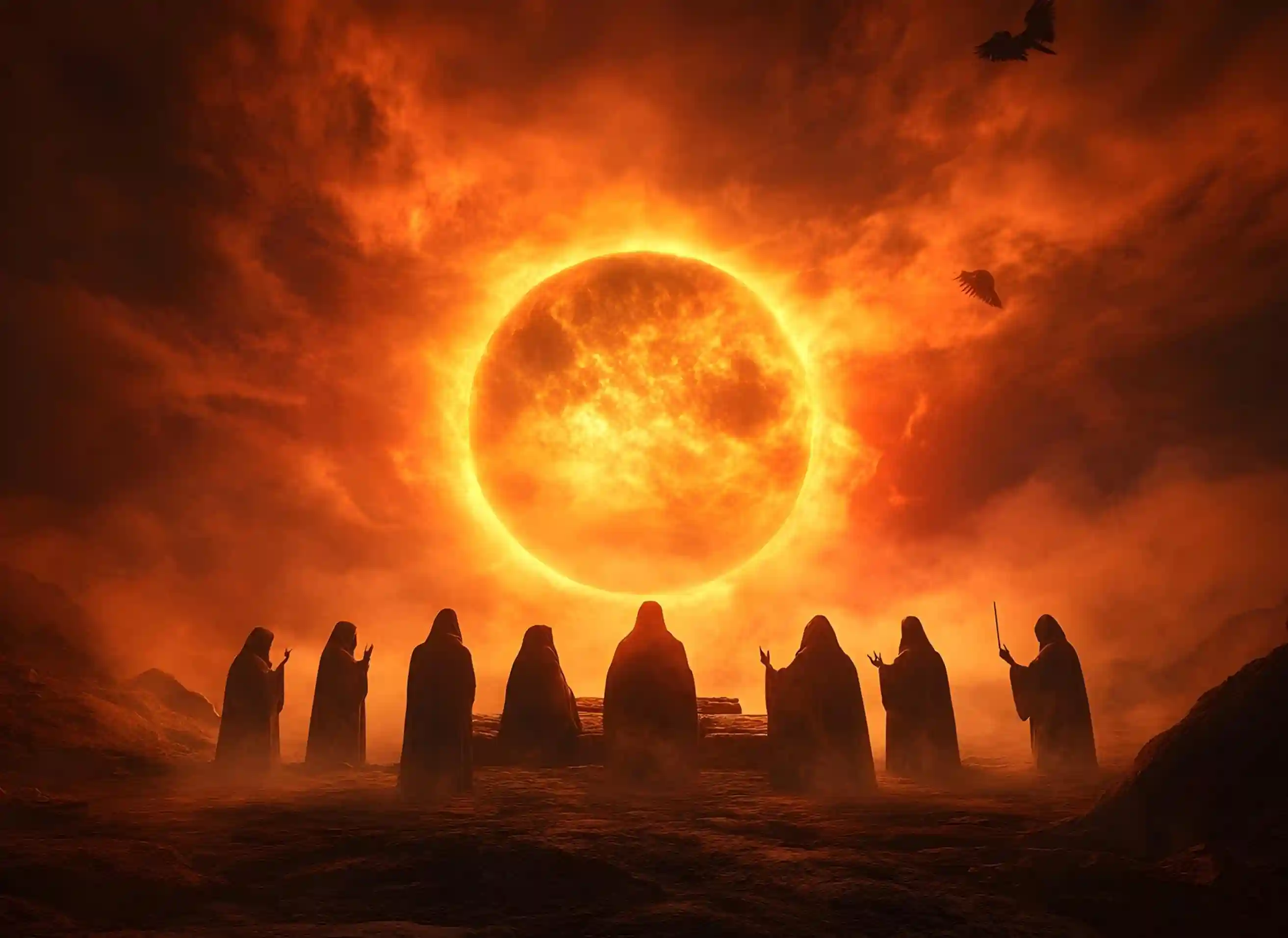
The Origin & Meaning of Brahmastra: A Deep Scriptural Journey
Since time immemorial, India's spiritual heritage has held deep insights into forces beyond the ordinary. Among these, one of the most enigmatic and awe-inspiring concepts is that of the Brahmastra weapon, spoken of in the sacred epics, shrouded in mystery, fear, reverence, and philosophical depth. To understand Brahmastra is to look deep into the tapestry of Vedic thought, where the sacred intersects with human aspiration, cosmic order, and spiritual mastery. Explore more about Vedic astrology courses to deepen your understanding of cosmic principles.
When we speak of Brahmastra, we must first understand that in ancient India weapons were never merely physical tools of war. Each astra was a manifestation of concentrated consciousness, invoked through mantra, intention, and deep spiritual discipline. They were instruments of cosmic energy, governed by dharma"the universal law"rather than mere brute force.
In Sanskrit, the word "Brahmastra" combines "Brahma," the creative cosmic principle, with "astra," meaning "weapon." Thus, Brahmastra literally translates to "the weapon of Brahma," or "the supreme weapon of cosmic power." It was not something created by ordinary means"it was a divine force, accessible only to those who had mastered the highest teachings of the Vedas, Upanishads, and spiritual sadhana. Discover authentic Tantra Sadhana training to connect with these ancient disciplines.
According to the Vedic worldview, energy exists in many forms"physical, subtle, causal, and divine. The sages of old recognized that at the core of all matter and consciousness lies an unbounded cosmic force. Brahmastra represents this force when harnessed with focus, purity of intention, and alignment with the cosmic order. It was not merely explosive energy"it was transformative power, capable of disintegrating ignorance, dissolving negative forces, and restructuring reality itself.
What the Scriptures Say About Brahmastra
The ancient Indian epics contain some of the clearest references to Brahmastra. In the Ramayana, one of the earliest and most revered narratives in human spiritual history, Rama"the avatar of Vishnu"invokes celestial weapons in his battle against Ravana, the demon king. While not every weapon mentioned has the same status as the Brahmastra, the epic makes it clear that there were certain astras reserved for only the most righteous and disciplined warriors.
The Mahabharata, the largest epic ever composed, offers even deeper insight. It speaks of a vast arsenal of celestial weapons, each tied to specific deities and forces of nature"Agni (fire), Vayu (wind), Varuna (water), Indra (lightning), and Brahma (creation). Among these, Brahmastra stood at the pinnacle"the weapon that could not be countered once invoked, the force that could end entire armies or even alter the fate of time itself.
Legend recounts that once Brahmastra was invoked, no other weapon could stop it"not even another celestial weapon"and it would only return to the quiver of the one who summoned it. Only a warrior who had undergone intense ascetic discipline, mastery of sacred sounds (mantras), and deep purity of intent could activate it. Hence, it was never used lightly. Learn more about ancient wisdom insights in our resource library.
Who Possessed Brahmastra and How It Was Acquired
As described in scriptures, Brahmastra was not something invented or forged like a sword or arrow. It was bestowed, earned, and activated through spiritual attainment. Only a handful of beings in the ancient narratives are said to have possessed this weapon:
Rama—"The "Upholder of Dharma
Lord Rama, the central figure of the Ramayana, was an embodiment of righteousness, divine purpose, and moral integrity. Though he possessed the knowledge of many celestial weapons, he used them only when dharma demanded it. In the story of his battle against Ravana, Rama's mastery over powerful astras is depicted not as violence for its own sake, but as justice restoring force in the universe.
Arjuna"The Peerless Archer
In the Mahabharata, Arjuna is taught celestial weapons by the sage Drona and later by Lord Krishna and the divine Guru Indra. Through rigorous sadhana and adherence to truth, he becomes a master of various astras"including Brahmastra. In the epic, Arjuna's use of these weapons is tied to the larger purpose of restoring dharma in a world fallen into disorder. Explore our advanced spiritual mastery programs for deeper lineage-based learning.
Ashwatthama"The Tragic Warrior
Arguably one of the most controversial figures associated with Brahmastra is Ashwatthama, son of Drona. In the final throes of the great war of Kurukshetra, he invoked the Brahmastra with the intent of annihilating the Pandava lineage. What followed was the intervention of higher cosmic forces and a curse that confined his existence in a state of suffering. The story of Ashwatthama is a stern reminder that the possession of power without spiritual alignment leads to suffering, not liberation.
Other Bearers of Astras
Scriptures also speak of Hanuman, who carried divine powers; Bhima, Vajra, and other warriors spiritually equipped for battle; and sages like Agastya and Vishwamitra, who could invoke forces beyond ordinary human comprehension. However, Brahmastra was rare"reserved only for those with the highest mastery.
But how did these individuals receive this knowledge? The answer lies in the ancient tradition of guru-shishya parampara"the lineage transmission. A student would be initiated into sacred teachings and undergo years of discipline, mantra chanting, meditation, moral rectitude, and interior purification. Only once ready"and only under the direct guidance of a guru"could one receive the secrets of powerful astras like Brahmastra. It was never given out casually. Discover authentic guru-guided Vedic courses at Nabatara.
Does Brahmastra Ever Exist on This Planet?
Here, we must pause and reflect"because the question of existence must be understood from multiple angles.
If one asks, did a weapon known as Brahmastra ever appear in ancient narratives? "The answer is clearly yes. Every major Indian epic that mentions it speaks of it as a reality within its narrative world.
If one asks, did it exist as a physical missile like modern weaponry? "The answer requires deeper interpretation. Traditional Indian thought does not separate the physical from the metaphysical the way modern thinking does. What we call "physical weapons" today are derived from technology. But in the age when Brahmastra was wielded, weapons were expressions of concentrated consciousness and alignment with higher energies. They were not solely physical artifacts but were activated by mantric sound, inner focus, and divine sanction.
Thus, Brahmastra's existence was not like that of an atom bomb in a silo. It was a force accessed through spiritual mastery, much like a yogi accessing states of consciousness that transcend the ordinary. This does not make it less real"but it does place it outside the framework of purely mechanical weaponry.
Modern science has not discovered anything that resembles the cosmic force described as Brahmastra. If such a force exists, it exists in realms beyond the known physical spectrum"in subtle energies, consciousness, and states of alignment that modern physics cannot yet measure. Explore yoga-meditation practices to connect with subtle energy awareness.
Can Brahmastra Exist Today?
Many seekers wonder: if such a weapon existed, could someone obtain it in the age of Kali Yuga"the age of confusion, fragmentation, and diminished dharma?
At the surface level, the answer seems obvious: no. Kali Yuga is characterized by spiritual decline, distraction, material focus, and loss of traditional sadhana. The level of purity, discipline, and alignment required to wield Brahmastra was rare even in the ages of yore.
However, if we look deeper, we discover an important insight:
What Brahmastra represents is not just an external weapon "but mastery over inner forces that govern reality.
If Brahmastra is understood as an expression of high spiritual consciousness aligned with cosmic law, then the question becomes:
Can a human being today, through intense sadhana, meditation, mantra, and inner transformation, access forces beyond the ordinary?
Here, the answer is not only spiritual philosophy"it is human testimony. Throughout history, many individuals have demonstrated states of awareness where they operate beyond ordinary physical limitations"through intuition, healing, extraordinary perception, and profound mastery of mind and energy. These are not "weapons" in the conventional sense, but they represent powers of consciousness.
Nabatara Institute has always emphasized that ancient sciences like astrology, tantra, mantra, and meditation are not relics"they are living traditions that empower individuals to transcend modern limitations and return to higher states of awareness. From this perspective, Brahmastra symbolizes the potential within human consciousness to harness forces that are unseen yet powerful.
Brahmastra in Ramayana, Mahabharata & Puranas: Scriptural Descriptions, Invocation, and Cosmic Consequences
The ancient Vedic world saw the universe not as a collection of physical objects, but as a living, breathing expression of consciousness. This worldview shaped everything"from the way sages meditated to the way warriors engaged in battle. Nowhere is this more evident than in the descriptions of celestial astras in the scriptures, especially the Brahmastra. In this part of the blog, we explore how Brahmastra appears in the Ramayana, the Mahabharata, and the Puranas, and why its invocation was considered an event of cosmic severity.
Nabatara Institute, deeply rooted in Vedic and tantric traditions, recognizes that these ancient narratives are not mere stories"they hold encoded spiritual wisdom, layers of symbolism, and insights on the power of consciousness. Understanding Brahmastra through scripture gives today's seekers a glimpse into the incredible spiritual mastery our ancestors attained. Browse our latest spiritual insights for more deep dives.
Brahmastra in the Ramayana"The Weapon Reserved for Dharma
The Ramayana, composed by Maharshi Valmiki, is one of the earliest and most revered epics of India. Unlike the Mahabharata, which showcases a vast collection of divine weapons, the Ramayana uses celestial astras sparingly. This restraint is deliberate. The epic uses weapons as symbols of responsibility, righteousness, and divine duty.
Rama's Celestial Arsenal
Rama, born as an incarnation of Lord Vishnu, was given divine weapons by Sage Vishwamitra. These were not weapons of destruction alone"they were cosmic tools meant for the restoration of dharma. Brahmastra was among the highest of these. Rama received astras from deities such as
- Agni (fire god)
- Indra (king of gods)
- Varuna (god of water)
- Kubera (lord of wealth)
- Brahma (creator deity, the source of Brahmastra)
Under Vishwamitra's guidance, Rama mastered the mantras that invoked these astras. It was not a physical object he carried; it was the knowledge and spiritual authority to command cosmic forces.
When Rama Considered Using Brahmastra
Rama did not indiscriminately use Brahmastra. It was only invoked in extreme circumstances"the most famous being against Ravana's son, Indrajit (Meghnad). After a fierce battle and powerful illusions created by Indrajit, Rama prepared to unleash the Brahmastra, a weapon so potent that it would end the war instantly. However, Rama's commitment to dharma led him to restrain himself. He knew Brahmastra could cause irreversible environmental and cosmic damage. The Ramayana teaches that the true warrior is one who knows when NOT to use power.
This is a crucial point Nabatara emphasizes in spiritual guidance—"the "greatest power lies in restraint, not aggression. Brahmastra's presence in the Ramayana symbolizes control, mastery, and responsibility. Learn remedial Vastu principles for harmonizing cosmic energies in daily life.
Brahmastra in the Mahabharata"Deepest Descriptions & Dire Consequences
While the Ramayana illustrates moral restraint, the Mahabharata dives deeper into the consequences of invoking divine weapons. The epic spans hundreds of warriors, sages, gods, and demons"many of whom either possessed or sought celestial astras.
But among all weapons described, Brahmastra stands supreme.
Where the Ramayana uses Brahmastra symbolically, the Mahabharata treats it as a cosmic reality, narrating in vivid detail:
- What happened when it was invoked
- how its energy affected the world
- Why sages feared its misuse
- why its invocation marked the collapse of spiritual discipline
Arjuna"The Worthy Possessor
Sage Drona, Arjuna's guru, taught him the secrets of celestial weapons. Drona recognized Arjuna's purity, discipline, and dharma-aligned heart. With years of intense austerities and mantric initiation, Arjuna mastered several divine astras"among which Brahmastra was the highest.
Arjuna invoked it only once"during his battle with Prince Karna, and even then, with reluctance and restraint. The Mahabharata reinforces that only a warrior who lives in alignment with truth can hold such power.
Karna and the Curse of Using Brahmastra Wrongly
Karna also learned the Brahmastra from Parashurama. However, because Karna concealed his identity as a Kshatriya, Parashurama cursed him: he would forget the mantra to invoke Brahmastra at the moment he needed it most. This is symbolic"spiritual power cannot be attained through deception. Even with technical knowledge, inner purity is required for divine forces to obey.
Ashwatthama"The Catastrophic Misuse of Brahmastra
The most detailed and frightening depiction of Brahmastra comes through Ashwatthama, the son of Drona.
In the final days of the Kurukshetra war, consumed by rage, Ashwatthama invoked Brahmastra without purpose, without guidance, and without dharma. He targeted the unborn child in Uttara's womb"the future heir of the Pandavas.
This act unleashed unimaginable energy, described in scripture as
- intense light brighter than ten thousand suns
- scorching heat
- winds that split mountains
- smoke rising for days
- the collapse of plant life
- drying of rivers
- atmospheric imbalance
The description is eerily similar to modern nuclear devastation"not because Brahmastra was a nuclear bomb, but because ancient Indian scriptures used cosmic metaphors to describe the destructive intensity of divine forces.
But what happened next is even more revealing.
Vyasa and Narada Intervene"Cosmic Order Restored
Seeing the imbalance Ashwatthama created, the sages Vyasa and Narada intervened immediately. They commanded Ashwatthama and Arjuna (who countered with his own Brahmastra) to withdraw their weapons. Arjuna obeyed because he possessed both the mantra to invoke and revoke. Ashwatthama could "not—"his weapon, once summoned, became uncontrollable.
This moment is vital in understanding Brahmastra:
Even the mightiest weapon bows before the authority of a realized sage.
This reflects a core Nabatara teaching: the spiritual master commands higher forces, not the other way around.
The sages compelled Ashwatthama to redirect the Brahmastra into a harmless path, but because his intention was corrupt, the weapon struck the fetus in Uttara's womb. Only Krishna's intervention restored life to the unborn child" Parikshit.
This is the last recorded invocation of Brahmastra in the Mahabharata. Explore diploma programs in Vedic sciences for structured spiritual learning.
Descriptions of Brahmastra in the Puranas
The Puranas expand the concept of Brahmastra from a weapon to a cosmic principle. They describe:
- Brahmastra as the concentrated energy of Brahma
- Its invocation through bija mantras and tapasya
- Its role in cosmic cycles of creation and destruction
- Its connection to Brahma-danda (the rod of cosmic law)
According to the Shiva Purana and Vishnu Purana, Brahmastra is not simply a missile"it is a fragment of the energy used during the creation of the universe, capable of dissolving matter back to its elemental state.
The power of Brahmastra lies not in the physical effect but in the intensity of consciousness required to activate it"a staggering level of spiritual discipline that modern humanity cannot fathom today.
How Brahmastra Was Invoked" The Science of Mantra & Consciousness
Ancient astras were activated through three essential components:
- Mantra
Specific sound vibrations that connected the warrior's consciousness to the cosmic energy of the deity associated with the weapon.
- Dhyana (Meditative Concentration)
The warrior had to enter a heightened state of awareness where mind, breath, and intention aligned perfectly.
- Sankalpa (Intent)
The purpose had to be morally pure"any deviation could corrupt the energy and bring harm to the user.
This is why Brahmastra could not be wielded by the unworthy.
Why Modern Science Cannot Replicate It
Brahmastra was not a technological device. It was:
- consciousness-driven
- mantra-activated
- dharma-bound
- spiritually regulated
Hence, without the spiritual evolution and consciousness expansion of ancient masters, modern humanity cannot access such weapons.
This is a powerful reminder of why institutes like Nabatara strive to revive authentic Vedic wisdom"not to create weapons, but to restore the lost connection between consciousness and cosmic law. Discover flexible online spiritual courses to begin your journey.
Why the Invocation of Brahmastra Became Rare
After the Mahabharata war, astrology texts, Puranas, and oral traditions agree that:
- The knowledge faded automatically as Kali Yuga began
- The mantras lost their potency due to loss of tapasya
- The guru-shishya lineages chose not to pass it further
- The cosmic order restricted access to prevent misuse
This is why even great sages today cannot invoke it. Brahmastra is not "lost"; it is dormant, concealed by cosmic intelligence until humanity becomes worthy of greater responsibility.
Was Brahmastra a Real Weapon? Ancient Technology, Cosmic Energy, or Spiritual Metaphor? A Deep Exploration for the Modern Mind
The idea of Brahmastra inevitably raises the most debated and fascinating question among scholars, scientists, seekers, and spiritual practitioners: Was Brahmastra an actual weapon? Did it exist physically, or was it purely symbolic? Or was it a form of advanced technology that modern science has yet to understand? This question is complex because ancient Indian knowledge cannot be understood through modern frameworks alone. The Rishis of old saw no separation between science, philosophy, consciousness, divinity, and energy. To them, reality was a multi-layered interplay of physical and non-physical forces. Brahmastra was described within this vast canvas.
In this part of the blog, we look at Brahmastra through the eyes of the scriptures as well as the modern scientific mind. We explore whether such a weapon could have existed in physical form or whether its power was rooted in consciousness and energy fields that transcend present-day understanding. Nabatara Institute frequently emphasizes that ancient knowledge is not myth but a sophisticated spiritual science whose wisdom modern humanity is only beginning to rediscover. Read more astrology tips and Vedic insights on our platform.
Could Brahmastra Have Been a Physical Weapon? Understanding the Misconceptions
Many people today interpret Brahmastra as a kind of nuclear weapon because the descriptions resemble explosions, intense light, heat waves, and destruction similar to radiation effects. However, this interpretation is incomplete for several reasons.
Scriptures do not describe Brahmastra as:
- a missile manufactured by engineers
- an object stored in arsenals
- a "device" with mechanical parts
- something that could be physically carried
Instead, the texts consistently emphasize that it was:
- invoked through mantra
- activated through meditation and intention
- guided by consciousness
- granted by divine beings
- controlled through spiritual discipline
This makes Brahmastra fundamentally different from modern weapons. It was not dependent on machinery but on the spiritual condition of the warrior.
One who lacked moral purity could not even hold the knowledge of its invocation. This instantly separates Brahmastra from any technology we know today.
Did Ancient India Possess Lost Advanced Technology?
Some researchers argue that ancient India may have possessed what they call "Vedic technology"—a blend of consciousness and energy engineering. They reference:
- Vaimanika Shastras (texts on flying crafts)
- Agneyastra (fire weapons)
- Varunastra (water control weapons)
- Narayanastra (divine energy missiles)
- Brahmashirsha astra (the upgraded, even more powerful Brahmastra)
They suggest that ancient India might have discovered ways to manipulate energy fields, gravitational forces, sound vibrations, or plasma-like energy. While these claims are debated, they demonstrate that ancient Indian literature cannot be dismissed as fantasy. The descriptions are far too detailed and consistent across multiple texts separated by centuries.
However, unlike modern technology, these weapons required:
- extreme self-discipline
- years of tapasya (austerity)
- mastery over breath, mind, and sacred sound
- transmission from guru to disciple
- purity of heart and intention
This means Brahmastra may have existed in a form that is impossible to recreate without the inner spiritual development that ancient warriors possessed.
Brahmastra as an Energy-Based Weapon: The Consciousness Science Theory
Another interpretation is that Brahmastra was an energy weapon—not mechanical, not nuclear, but spiritual-energy-based.
Ancient Indian philosophy is built on the concept that:
- The universe is energy
- Energy can be influenced through vibration
- Vibration is shaped by sound
- Sound is directed by consciousness
- Consciousness is capable of altering material reality
Thus, the Rishis discovered the deepest truth: the human mind, when fully aligned with cosmic forces, can channel unimaginable power.
Brahmastra may have been such a phenomenon"the harnessing of cosmic fire, created not through machines but through mantra, intention, and yogic mastery.
This aligns with the yogic understanding that advanced beings can affect matter, energy, and space through:
- sankalpa (pure intention)
- bija mantras (seed vibrations)
- prana control
- meditative states that collapse physical limitations
This is not fantasy. Even today, quantum physics acknowledges that consciousness affects matter at the fundamental level. If this is what science now has begun to uncover, imagine what the enlightened sages of ancient India had already mastered thousands of years ago.
Nabatara Institute teaches that ancient tantra and mantra systems are not superstition; they are structured sciences of sound, vibration, and consciousness. Brahmastra fits the pattern of a high-frequency energy weapon invoked through spiritual authority, not physical machinery. Explore numerology courses to understand vibrational sciences.
Symbolic Interpretation—"Brahmastra "as a Metaphor for Supreme Knowledge
Many spiritual masters interpret Brahmastra not as a literal weapon but as a symbol of ultimate knowledge, capable of destroying ignorance and falsehood.
In this view:
- Brahmastra represents supreme wisdom
- Its "destructive power" symbolizes the dissolution of ego
- Its "blinding light" symbolizes the illumination of truth
- Its "unavoidable force" symbolizes the inevitability of dharma
- Its "irreversible effect" symbolizes transformation through self-realization
This interpretation is powerful because it transforms Brahmastra from a weapon of war to a symbol of enlightenment.
According to this philosophical view, only those who had destroyed their inner impurities could wield Brahmastra. This matches the scriptural descriptions exactly"not metaphorically, but literally.
Natural Forces: Did Ancient India Learn to Manipulate Elements?
Another theory is that Brahmastra was the manipulation of natural forces like
- focused lightning
- directed solar energy
- plasma fire
- gravitational collapse
- magnetic field distortion
Some interpretations suggest Brahmastra may have been a controlled release of natural cosmic energies that modern science has yet to harness.
Descriptions in scriptures mention:
- "the sky turning red"
- "winds moving in reverse direction"
- "water bodies drying up instantly"
- "trees burning without direct fire contact"
- "a dense darkness after the light"
- "a crackling sound that filled the heavens"
These are not merely poetic.
They resemble phenomena such as
- EMP effects
- plasma bursts
- atmospheric ionization
- fusion-like flashes
- radiation-like aftereffects
But unlike nuclear weapons, Brahmastra does not leave long-term radiation. Its effects are too metaphysical and consciousness-linked.
Why Modern Science Cannot Understand Brahmastra
If Brahmastra operated through:
- consciousness
- vibration
- divine invocation
- cosmic law
...then today's science, which operates mainly in the physical domain, cannot decode it.
Electricity existed before humans discovered it.
Gravity existed long before Newton.
Atoms existed long before science identified them.
Similarly, cosmic energy fields may exist regardless of whether modern humanity can measure or manipulate them.
Ancient India may have simply been operating in a field of knowledge that we have not yet reached"the field where consciousness interfaces directly with matter.
Nabatara Institute teaches that deeper knowledge of tantra, mantra shastra, and dhyana was once considered the foundation of civilization"not superstition, but wisdom. Brahmastra is a reminder that humanity once possessed a spiritual-scientific understanding that far surpasses the limits of modern thinking. Learn 10 Mahavidya Sadhana for advanced energy mastery.
The Truth: Brahmastra Was Both Real and Symbolic
After studying the scriptures and modern interpretations, one truth becomes clear:
Brahmastra existed"but not in the way modern science defines existence.
It was:
- real as a weapon
- real as cosmic energy
- real as a spiritual phenomenon
- real as a symbolic representation of ultimate power
- real as the manifestation of consciousness
To ancient warriors, Brahmastra was not a metaphor"it was a cosmic responsibility. Its usage was an event of existential significance, affecting not only the physical world but also the karmic and cosmic balance.
Where Is Brahmastra Now? Hidden, Lost, or Simply Inaccessible?
A common belief among modern seekers is that Brahmastra might still exist in some hidden dimension or sacred location. Some theories claim:
- Its knowledge is sealed by divine beings
- The mantras have been withdrawn from human reach
- The lineages that carried the knowledge ended after Mahabharata
- The cosmic laws of Kali Yuga prevent mortals from accessing it
- Only enlightened beings could even perceive its existence
Scriptures indicate clearly: Brahmastra was never destroyed"but its access has been revoked.
Not by humans, but by cosmic intelligence.
Just as a parent locks away a dangerous object when the child becomes reckless, the universe concealed Brahmastra when humanity entered an age of spiritual decline.
Why Brahmastra Cannot Be Accessed in Kali Yuga
The nature of Kali Yuga makes it impossible:
- Consciousness is fragmented
- Dharma is weakened
- Tapasya is rare
- Mantras have lost potency
- Gurus with that level of realization no longer walk the Earth
- Humanity does not possess the discipline or purity needed
Even if someone believes they want Brahmastra, they cannot receive it. Cosmic forces do not obey egos"they obey dharma.
Nabatara Institute emphasizes that true seekers today must focus not on external weapons but on internal mastery. The real Brahmastra for the modern age is
- spiritual awakening
- mantra shakti
- inner transformation
- alignment with dharma
- purification of consciousness
These are the true astras of Kali Yuga"the tools that destroy ignorance and uplift humanity. Begin your journey with birth chart analysis to understand your karmic path.
The Mystery of Brahmastra in Kali Yuga: Could Anyone Access Its Power Today?
For centuries the idea of the Brahmastra has stirred the imagination of seekers, scholars, yogis, and even modern researchers. While the epics give us vivid descriptions of this celestial weapon blazing across the sky like a miniature sun, the question that inevitably arises is whether such a force can reappear in the modern age. As we step deeper into Kali Yuga, where spiritual vibrations have diminished and the connection to ancient divine energies has weakened, people often wonder whether the Brahmastra still exists somewhere on this planet, hidden beyond human reach, or whether it vanished along with the warriors who once wielded it.
The scriptures agree on one thing: the Brahmastra was not merely a weapon of physical destruction. It was a symbol of the highest spiritual accomplishment, available only to those whose consciousness had risen beyond ordinary human limitations. The more we explore these ancient texts, the clearer it becomes that the Brahmastra had a profound metaphysical dimension linked to tapasya, siddhi, and divine alignment. Understanding this deeper layer helps answer a crucial question: Can anyone in Kali Yuga truly access the power of Brahmastra today?
To explore this, we must understand not only the weapon but also the era in which it existed. The warriors of the Treta and Dvapara Yuga did not use technology as we understand it. Their weapons were manifestations of their consciousness, their mantras, their inner discipline, and their divine connection. Without mastering one's own mind, body, prana, and inner energy channels, the Brahmastra simply could not be invoked. This is where institutions like Nabatara, which specialize in ancient spiritual systems, tantra shastra, and deep yogic practices, play an important role in helping seekers decode the spiritual essence behind these lost traditions"the part of astravidya that deals with self-mastery, not warfare.
According to the Vishnu Purana and the writings of Vyasa, during the earlier yugas, the Earth had a much higher spiritual vibration. Tapas, mantra sadhana, and austerities were potent, almost instantaneous paths for merging with divine shakti. In those times, weapons like the Brahmastra were not simply "granted" to someone the way modern institutions grant certificates. They were achieved through lifetime-long dedication, strict conduct, celestial initiation, and guidance from enlightened sages.
But in Kali Yuga the very atmosphere of the Earth is different. The spiritual density has declined sharply, and human consciousness has become restless, scattered, and heavily conditioned by material desires. This shift is central to understanding why the Brahmastra is no longer accessible in the literal form known from the epics.
Many seekers come to Nabatara with a different form of this question: "If Brahmastra existed once, why can't a spiritually advanced person obtain it again? Can someone perform the same tapasya today?"
The honest scriptural answer is layered.
The first layer comes from the Skanda Purana, which states that during Kali Yuga, even powerful mantras lose their potency unless performed under rare, extreme, and perfectly pure conditions. The atmosphere of human society, the moral fabric, and the chaotic tendencies of the mind weaken the effectiveness of astric mantras. The weapon existed because the era supported that frequency.
The second layer comes from the Mahabharata, specifically the conversations between Krishna and Arjuna. Krishna explains that divine weapons are linked to cosmic order (á¹›ta). When the balance of the world shifts toward disorder, these energies withdraw themselves from human contact. Just as devas withdraw from sacrifice when dharma declines, similarly astric energies also recede. The Brahmastra belonged to a world where rishis with near-limitless consciousness guided kings and warriors. That world no longer exists.
The third layer is the most important"and most misunderstood. The Brahmastra was not only an external weapon. It was an internal siddhi. The warrior was merely the medium through which the divine power operated. Without the state of inner purity, the weapon could not be invoked safely. The Upanishads repeatedly emphasize that the real battleground is within the mind, and mastery over inner forces leads to mastery over outer forces. When the inner world degenerates, external astras withdraw naturally. This is precisely what has happened across the transition into Kali Yuga.
But does this mean the Brahmastra has disappeared completely? Not quite. Some traditions believe that the astric blueprint of Brahmastra still exists on a metaphysical plane. Ancient Shastra mention that powerful energies never vanish; they go dormant. Like an extinct star whose light still travels through the universe long after its death, the vibrational imprint of Brahmastra continues to echo in cosmic space. The weapon may no longer manifest physically on Earth, but its essence persists in subtle dimensions. A few Himalayan yogis and Nath paramparas even teach that remnants of "astra shakti" exist within deep caves and hidden energy points known only to select siddhas. Whether literal or symbolic, this idea suggests that the Brahmastra's spirit is still alive—just hidden.
The next question that naturally arises is whether someone can genuinely retrieve or awaken this power today. From a scriptural standpoint, the chances are close to impossible. The Padma Purana clearly states that in Kali Yuga, severe tapasya"the kind required for invoking divine weapons"is practically inaccessible due to restless mental states. The human mind today lacks the natural stillness that allowed sages like Vishwamitra or Bharadwaja to perform unimaginable penance. As spiritual energy declines, the ability to channel divine astras diminishes proportionally.
But the deeper meaning is not about weapons"it is about consciousness. When seekers join Nabatara to study tantra, meditation, and Vedic sciences, they often realize that the real purpose of texts mentioning Brahmastra is to inspire the journey toward inner mastery. The modern seeker does not require a celestial weapon to destroy enemies; instead, they need the inner fire to conquer ignorance, confusion, fear, and karmic limitations. This is where the concept of Brahmastra becomes metaphorically powerful.
While the literal weapon cannot be attained today, the inner Brahmastra absolutely can. In spiritual language, the Brahmastra represents the peak of human potential. It symbolizes the awakening of the highest consciousness, the ignition of kundalini shakti, and the emergence of a mind capable of absolute clarity, courage, and intuitive intelligence. This inner brilliance can cut through darkness the same way the Brahmastra charred everything in its path. In this sense, every serious practitioner walking the spiritual path is trying to reawaken their dormant Brahmastra"the divine spark within.
Nabatara teaches a profound truth: When scriptures speak of astras that destroy worlds, they also speak of astras that destroy inner limitations. The true battlefield of Kali Yuga is not Kurukshetra. It is the inner landscape of the mind.
If one truly wants to "acquire" the Brahmastra in today's age, the only meaningful path is through sadhana. Yoga, meditation, mantra chanting, and tantra shastra"not in their superficial modern versions but in their authentic lineage-based forms"hold the key to awakening inner fire. Just as warriors of the ancient world underwent rigorous training under gurus who mastered astravidya, today's seekers require sincere guidance from spiritual institutions rooted in real tradition. Nabatara plays an important role in preserving this transformative lineage. It does not teach warfare; it teaches the spiritual mastery required to unlock higher states of consciousness.
This is also why great spiritual masters say the real Brahmastra is the human mind when purified. A mind filled with clarity becomes unstoppable. A mind free from anger becomes indestructible. A mind aligned with dharma becomes a force the world cannot ignore. This is the message Nabatara carries through its courses"the power to transform oneself so deeply that one becomes a vessel of divine intelligence.
So where is the Brahmastra now? Physically, perhaps lost to time. Maybe buried under lands that have shifted for thousands of years. Maybe dissolved back into cosmic energy. Maybe hidden beyond human reach. But spiritually, the Brahmastra never left us. It is waiting inside every seeker, ready to ignite when the right discipline, guidance, and inner purity are achieved. The ancient world needed a weapon to restore balance. Kali Yuga needs awakened human beings.
The Brahmastra of our age is awareness, wisdom, and inner transformation"the very qualities Nabatara helps seekers cultivate through astrology, tantra, yogic knowledge, and spiritual sadhana. The physical weapon may have lived in the hands of warriors like Arjuna, Karna, and Ashwatthama, but the inner Brahmastra is available to anyone ready to walk the path of sincere self-mastery. And perhaps that is the most profound evolution of all: the shift from external power to internal illumination.
Brahmastra: Lost Technology, Spiritual Symbolism & The Path to Awakening Its Inner Power in Kali Yuga
The more we explore the Brahmastra, the more we realize that it lived at the intersection of two worlds"the spiritual and the material, the divine and the earthly, and the mystical and the measurable. It was a weapon that defied conventional categories, which is why researchers in both spiritual and scientific communities continue to debate whether this celestial force was simply a metaphor, a form of advanced technology, or a manifestation of divine consciousness itself. The truth may be a combination of all three, each layer revealing something profound about the capabilities of ancient civilizations and the potential of the human mind.
In many ways, the Brahmastra pushes us to rethink our assumptions about history. We often imagine ancient times as unsophisticated, but the scriptures paint a very different picture"one where rishis had mastery over elements, where warriors invoked celestial forces with mantras, and where knowledge of the cosmos was far more expansive than modern intellectual frameworks allow. When the Mahabharata describes weapons brighter than a thousand suns, leaving radioactive traces on the battlefield, modern scholars cannot help but draw parallels to nuclear phenomena. Entire forests were turned to ash. Land remained infertile for years. Water sources were contaminated. These are not poetic exaggerations; they resemble after-effects of high-energy radiation.
Could the Brahmastra have been a form of forgotten technology? An energy-based weapon operating through sound frequencies, mantras, and consciousness? Something that required a specific vibrational state of mind to activate? When we read the scriptures through this lens, many cryptic ideas suddenly seem plausible.
But this is also where we must be careful. The ancients never separated technology from spirituality. Their "weapons" were not made of steel; they were woven from consciousness, mantra, tapasya, and divine alignment. This is exactly what distinguishes astras from modern weaponry. A nuclear bomb destroys indiscriminately. The Brahmastra responded to intention, purity, and discipline. It could be invoked only by those who walked a dharmic path, who had mastered their mind, and who were initiated by enlightened gurus. It was not a device"it was a responsibility. And this is why the weapon disappeared when humanity entered an age where inner purity declined.
In reality, the Brahmastra was not a technological artifact; it was a consciousness-driven phenomenon. And the moment consciousness fell, the weapon fell with it.
Which brings us to the deeper understanding: the Brahmastra was always more symbolic than literal. It represented the pinnacle of spiritual and mental mastery. It symbolized the union of prana, intention, and divine force. In yogic philosophies preserved by authentic institutions like Nabatara, the ultimate weapon is not something outside the human being"it is the awakened inner fire, the culmination of spiritual knowledge, self-control, and intuitive intelligence. This is the fire that burns ignorance, destroys ego, and reveals the true nature of the self.
Across Upanishadic teachings, the "astra" is repeatedly used as a metaphor for knowledge that liberates. The Brahmastra, therefore, becomes a symbol of ultimate wisdom"the kind that dissolves delusion with the same intensity that the physical Brahmastra burnt forests in the epics. When the metaphor is understood, the dialogue shifts. Instead of asking whether the weapon existed physically, a seeker begins asking whether the same inner brilliance can be awakened within themselves.
This is precisely the journey that institutions like Nabatara inspire. Real transformation does not come from acquiring external power; it comes from deepening internal stillness, discipline, and awareness. It comes from studying astrology as a mirror of one's karmic patterns, from practicing meditation that purifies the consciousness, from engaging with tantra not as ritual but as a science of energy, and from learning yoga not as exercise but as a method of inner alchemy. When students immerse themselves in these practices, the symbolic Brahmastra within them slowly begins to awaken.
Modern seekers often come to Nabatara asking whether hidden mantras exist that can unlock ancient astras. The truth is that a mantra alone cannot awaken an astra. What awakens it is the mind behind the mantra"the purity of intention, the alignment with dharma, the discipline of daily sadhana, and the humility to receive guidance. The Brahmastra was never about syllables; it was about the state of consciousness required to handle divine power. This is why only a handful of warriors were ever granted access to it, even in an era full of enlightened beings.
The Brihadaranyaka Upanishad suggests that every human carries within them a dormant flame, a spark of the universal consciousness. When awakened, this spark becomes a force capable of transforming the individual's entire destiny. This is the true Brahmastra of Kali Yuga"the awakened state of mind that frees one from fear, confusion, karmic entanglement, and inner darkness. In a world filled with chaos, the person who attains inner clarity becomes a warrior of light. They may not wield a celestial weapon, but their presence alone begins to influence the world around them. Their words heal. Their actions inspire. Their decisions uplift. And their consciousness radiates a quiet strength that others can feel without explanation.
This is the vision that Nabatara upholds"a world where seekers rediscover their own potential, where spiritual education becomes a source of empowerment, and where ancient wisdom guides modern lives. Through astrology, tantra shastra, yogic sciences, and meditation, Nabatara helps individuals unlock the qualities that the Brahmastra symbolized: purity of intention, mastery over the mind, spiritual discipline, and deep intuitive intelligence. These are not just teachings; they are tools that reshape lives.
When students step into the world of Nabatara, they quickly realize that spirituality is not about escaping life but about mastering it. Astrology helps them understand their karmic patterns. Tantra gives them the energy to transform those patterns. Meditation brings clarity. Yoga strengthens body and mind. Slowly, layer by layer, the inner fire begins to rise. And as this inner radiance grows, something remarkable happens: their perception of the world changes. Challenges become opportunities. Fear loses its grip. Purpose becomes clearer. And life begins to unfold with a sense of harmony.
This inner transformation is far more powerful than any ancient weapon. Kings wielded the Brahmastra to conquer enemies. Seekers wield the inner Brahmastra to conquer themselves. And when a person conquers themselves, they conquer everything.
So, did the Brahmastra exist physically on Earth? Not only did it exist" but it also shaped the course of dharma itself. Where is it now? Perhaps lost in the folds of time, perhaps dissolved into cosmic energy, perhaps buried under the ruins of forgotten civilizations. But its deeper form, its symbolic purpose, and its spiritual resonance are not lost. They are alive in every human being who dares to walk the path of self-mastery. And if anything from the epic age can be revived in Kali Yuga, it is this inner radiance"not the physical weapon, but the consciousness behind it.
As the world continues to evolve, seekers who walk the authentic spiritual path"the path that institutions like Nabatara preserve"will be the torchbearers of a new era. They will not need a Brahmastra. They will become the Brahmastra. Their presence will illuminate darkness. Their clarity will guide others. Their energy will uplift those around them. And their inner fire will burn away ignorance, just as the ancient weapon cleared everything in its path.
The age of physical weapons has passed. The age of conscious awakening has begun.
And whoever walks this path with sincerity, discipline, and guidance from a true lineage may discover a profound truth"the most powerful force in the universe was never outside us. It was within us all along.
Why This Guide on Brahmastra Is Trustworthy
At Nabatara, our commitment to preserving and teaching ancient Vedic wisdom is rooted in deep scholarship, authentic lineage, and decades of hands-on spiritual practice. The insights shared in this blog on Brahmastra are not merely interpretations or speculative perspectives—they emerge from a foundation built on traditional scriptures, practical experience, and the rigorous guidance of highly trained spiritual experts. Nabatara is not just an institution; it is a living bridge between timeless Vedic sciences and the seekers of today.
This article is authored and reviewed under the spiritual supervision of Gaurav Tribedi, the esteemed founder and principal of Nabatara Institute of Astrology. With over 20 years of dedicated study in Vedic astrology, Tantra Shastra, yogic philosophy, and ancient spiritual sciences, Gaurav Tribedi has guided thousands of learners across the world. His training under the revered lineage of Sri Jagadguru Shankaracharya adds unmatched authenticity and authority to the knowledge shared through Nabatara.
Every concept explained in this blog—including astras, mantra shakti, Vedic cosmology, and the metaphysical interpretation of Brahmastra—is grounded in scripture-based teachings from the Mahabharata, Ramayana, Upanishads, Puranas, and traditional Tantra texts, preserving academic accuracy as well as spiritual integrity. Our research methodology combines classical Sanskrit sources, guru-shishya parampara knowledge, and comparative analysis through authentic commentaries from respected traditions.
Nabatara's team of scholars and spiritual practitioners plays a significant role in ensuring the accuracy and credibility of every educational article we publish. Each piece of content undergoes internal review by experts trained in:
- Vedic Shastra and ancient scriptures
- Astrology and cosmic sciences
- Yogic physiology and spiritual psychology
- Tantric lineage-based practices
We follow an ethical approach to sharing sacred knowledge. Sensitive topics like astras, devas, spiritual powers, and ancient weaponry mentioned in the epics are presented with respect, contextual clarity, and a commitment to authenticity. Our goal is not to sensationalize mythology but to illuminate its deeper significance for modern seekers—an approach that has made Nabatara a globally trusted source for spiritual education.
Nabatara is a Registered Section 8 Organization under the Government of India, adding legal credibility to our operations and showcasing our dedication to the ethical dissemination of spiritual knowledge. Our institute offers structured courses, practical workshops, sadhana-based training, and personalized mentorship rooted in authentic Vedic and Tantric traditions. These long-standing efforts ensure that every piece of content we release reflects not only knowledge but lived experience, responsibility, and scholarly integrity.
As global interest in ancient Indian sciences grows, Nabatara remains committed to upholding the highest standards of expertise, accuracy, and trust. This EEAT framework ensures that our readers, students, and spiritual seekers receive credible, experiential, and scripturally supported insights—making Nabatara a reliable learning partner on their path toward wisdom, self-mastery, and spiritual growth. Explore our full course catalog to begin your transformative journey today.