The Seeker's Dilemma and the Call of Tantra
There is a moment in the life of every sincere seeker when the noise of the world becomes too loud to ignore, yet too hollow to satisfy. You may find yourself sitting in the quiet of your room, surrounded by the comforts of modern life, yet feeling a profound sense of dislocation. The career is stable, the relationships are functional, and the social media feed is full of curated happiness, but inside, there is a gnawing emptiness. It is a thirst that water cannot quench and a hunger that food cannot fill. This is not depression, nor is it merely stress. It is the soul's urgent call for meaning. It is the recognition that the identity you have built—the name, the profession, the status—is a fragile shell, and beneath it lies a vast, uncharted ocean of consciousness waiting to be explored. In this moment of spiritual crisis, many turn to quick fixes, fleeting trends, or superficial spiritual practices that offer temporary relief but no lasting transformation. However, for those who are ready to dive deeper, the ancient traditions of Sanatan Dharma offer a radical and powerful path: the worship of the Dasa Mahavidya.
Demystifying the Ten Wisdom Goddesses
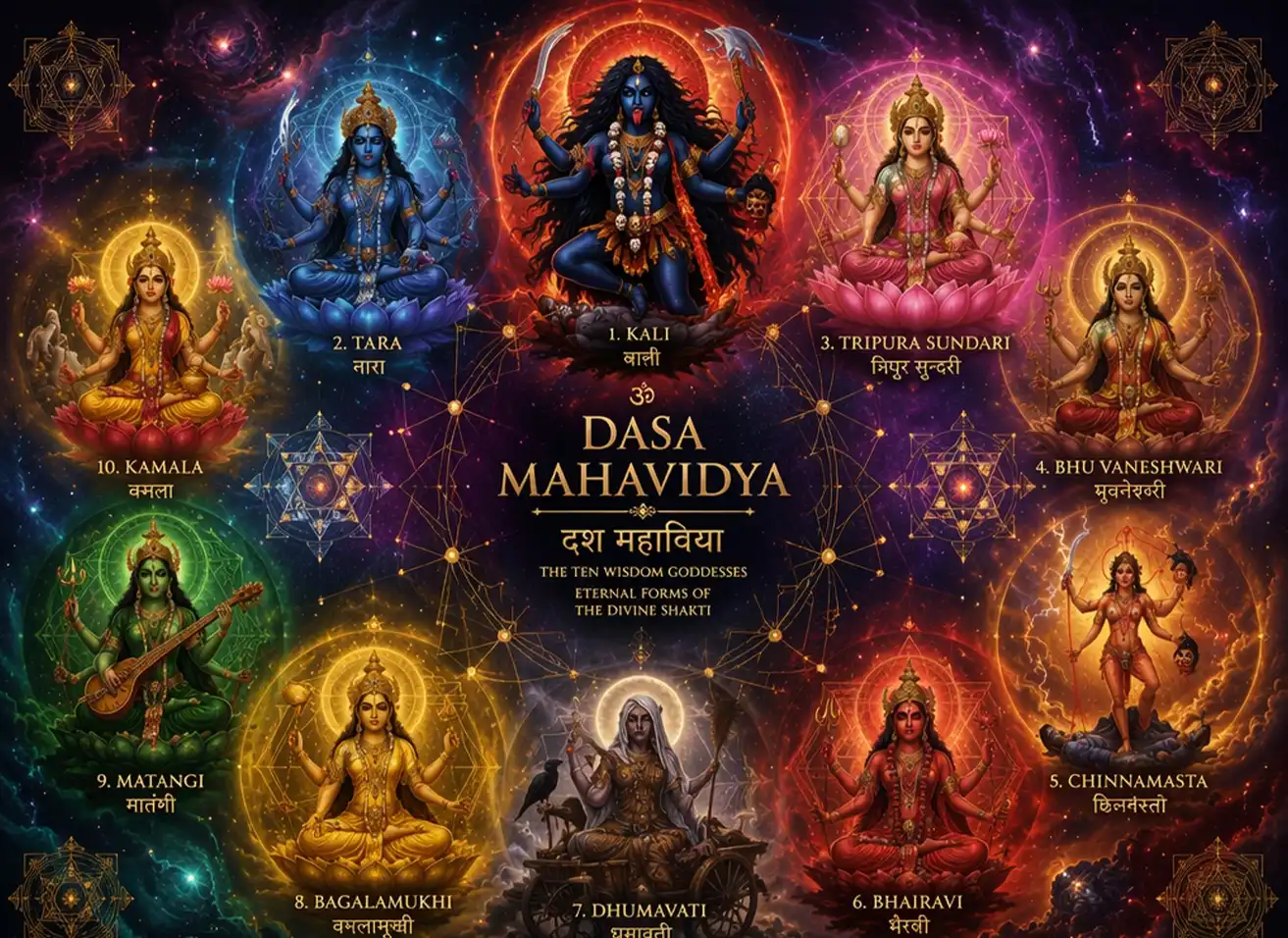
The term "Dasa Mahavidya translates to "the Ten Great Wisdoms." These are not ten separate gods in the polytheistic sense but ten distinct aspects of the one Supreme Divine Consciousness, often personified as the Divine Mother or Shakti. In the rich tapestry of Tantra Shastra, these goddesses represent the full spectrum of human experience and divine reality, from the fierce destruction of the ego to the serene beauty of cosmic order. To understand the Dasa Mahavidya is to understand the mechanics of your own mind and the universe itself. It is to recognize that the anger you feel, the desire that drives you, the silence that terrifies you, and the wisdom that eludes you are all faces of the same divine energy. When approached with the right guidance, these energies become tools for liberation rather than sources of bondage. This is the core teaching that flows through the veins of the Nabatara Institute of Astrology, a Section 8 not-for-profit organization dedicated to preserving the purity of these ancient teachings.
For many in the West and even in modern India, the word "Tantra" has been hijacked by commercial interests and misunderstood as solely related to sexuality or black magic. This distortion is a tragedy, for authentic Tantra is one of the most sophisticated psychological and spiritual systems ever devised by human consciousness. It is a science of energy, a method of using the very forces that bind us to the material world—desire, fear, power, and intellect—as ladder rungs to climb toward spiritual freedom. The Dasa Mahavidya are the central deities of this Tantric path. They are the keys that unlock the doors of perception, allowing the sadhaka, or spiritual practitioner, to see beyond the illusion of separateness. But this path is not for the casual tourist. It requires discipline, purity of intent, and, most importantly, the guidance of a realized guru. Without a teacher, the intense energies of the Mahavidyas can be overwhelming, leading to confusion rather than clarity. With a teacher, they become the most potent catalysts for enlightenment.
The Role of the Guru in Tantric Practices
This wisdom is not abstract philosophy. It is a lived experience. At the Nabatara Institute, founded by Gaurav Tribedi, we have witnessed countless individuals transform their lives by connecting with these divine energies. Gaurav Tribedi, known respectfully as Guruji by his students, is a devoted disciple of the Sri Jagadguru Shankaracharya lineage, a tradition that traces its roots back to the great Adi Shankaracharya himself. This lineage ensures that the teachings are not diluted by modern reinterpretations but are passed down in their pure, potent form. When you engage with the teachings of the Dasa Mahavidya through Nabatara, you are not just reading a blog post; you are stepping into a river of knowledge that has flowed uninterrupted for centuries. You are joining a community of seekers who are serious about their spiritual growth and who understand that true power comes from within, aligned with the divine will. If you are ready to commit to this profound inner work, we invite you to join our spiritual sadhana program and begin your transformation.
The journey into the heart of the Dasa Mahavidya begins with a shift in perspective. It requires you to stop seeing the divine as something outside of you, residing in a temple or a heaven far away, and start recognizing it as the very fabric of your existence. Kali is not just a goddess with a garland of skulls; she is the force of time that dissolves all things, including your attachments. Tara is not just a savior figure; she is the compassion that carries you across the ocean of suffering. Tripura Sundari is not just a beautiful deity; she is the harmony that underlies all creation. Each of the ten goddesses offers a unique entry point into the divine, catering to different temperaments and spiritual needs. Some seekers are drawn to the fierce energy of Kali, needing her destructive power to break through their inertia. Others are drawn to the gentle wisdom of Kamala, seeking abundance and grace. The beauty of the Dasa Mahavidya system is that it encompasses all paths, all emotions, and all aspects of life.
However, approaching these goddesses without proper preparation can be dangerous. The energies they represent are raw and primal. They do not care about your social status or your intellectual achievements. They respond only to sincerity, devotion, and purity of heart. This is why the role of the guru is indispensable. The Guru acts as a bridge between the individual consciousness and the universal consciousness, ensuring that the seeker is protected and guided at every step. Gaurav Tribedi emphasizes this point repeatedly in his teachings. He reminds his shishyas, or disciples, that Tantra is not a shortcut to power but a long, disciplined path of self-purification. It is about surrendering the ego, not inflating it. It is about serving the divine, not commanding it. This humble approach is what distinguishes the authentic Tantric path from the occult practices that seek to manipulate energy for personal gain.
The Vedic Foundations: Ancient Knowledge for Today
Scriptural Roots of the Mahavidyas
To truly appreciate the depth and significance of the Dasa Mahavidya, one must look beyond the surface level of popular culture and delve into the rich soil of ancient Indian scriptures. The roots of Tantric wisdom are deeply embedded in the Vedic tradition, although Tantra itself emerged as a distinct stream of spiritual practice later in history. While the Vedas focus largely on ritualistic worship and cosmic order, Tantra shifts the focus to the internalization of these rituals and the direct experience of divine energy. The Dasa Mahavidya are a quintessential product of this Tantric evolution, representing a synthesis of Vedic theology, Shakta philosophy, and yogic psychology. Understanding this historical and scriptural context is crucial for any serious student, as it provides the framework within which these goddesses operate and reveals the profound logic behind their seemingly paradoxical forms.
The primary textual source for the Dasa Mahavidya is the Mahavidya Khanda of the Brihat Tantra Sara, as well as various Puranas and Tantras, such as the Kalika Purana and the Guhyatiga Guhya Tantra. However, the philosophical underpinnings can be traced back to earlier texts like the Upanishads, which speak of the ultimate reality as Brahman, the formless absolute. In the Shakta tradition, this Brahman is viewed as having two aspects: Shiva, the static, conscious principle, and Shakti, the dynamic, creative energy. The Dasa Mahavidya are manifestations of Shakti, each representing a different mode of interaction between consciousness and energy. They are the tools through which the devotee can access and harmonize these fundamental forces within themselves. This duality is not a conflict but a dance, and the Mahavidyas are the choreographers of this cosmic dance.
The Guru-Shishya Parampara and Ethical Practice
One of the most important concepts in understanding the Mahavidyas is the idea of "vidya," which means "knowledge" or "wisdom." In the Vedic context, knowledge is not merely intellectual information but a transformative realization that liberates the soul from the cycle of birth and death. The ten goddesses are called Mahavidyas because they embody the highest forms of this liberating knowledge. Each goddess teaches a specific lesson about the nature of reality. For example, Kali teaches the impermanence of all things and the necessity of letting go. Tara teaches the power of compassion and the ability to cross over difficulties. Tripura Sundari teaches the beauty and harmony inherent in creation. By meditating on these forms, the sadhaka internalizes these lessons and undergoes a profound psychological and spiritual transformation. This is why the worship of the Mahavidyas is considered a path of Jnana, or knowledge, as much as it is a path of Bhakti, or devotion.
The transmission of this knowledge has always been through the Guru-Shishya parampara, the teacher-disciple lineage. In ancient times, these teachings were kept secret, revealed only to those who had proven their worthiness through years of service and dedication. This was not out of elitism but out of caution. The energies invoked in Tantric practices are powerful and can be destabilizing if not handled correctly. The Guru acts as a protector, ensuring that the student is psychologically and spiritually prepared for each stage of the practice. Today, while information is widely available, the need for a genuine guru is greater than ever. The internet is filled with distorted versions of Tantra, mixing authentic practices with New Age fantasies and commercial exploitation. The Nabatara Institute serves as a filter, preserving the purity of the tradition and providing a safe environment for learning.
Gaurav Tribedi, as a holder of this lineage, emphasizes the importance of Adhikara, or eligibility. Not everyone is ready for the path of the Mahavidyas. It requires a certain level of mental stability, ethical integrity, and spiritual maturity. Before initiating students into the deeper practices, Guruji assesses their readiness and guides them through preliminary stages of purification. This may involve basic yoga, meditation, and the study of foundational texts like the Bhagavad Gita and the Upanishads. Only when the ground is prepared can the seeds of Tantric wisdom take root and flourish. This meticulous approach ensures that the students of Nabatara are not just collecting information but are undergoing a genuine transformation. For those looking to build this essential foundation, you can enroll in our foundational yoga training and join our guided meditation retreats.
Integrating Vedic Astrology with Tantric Worship
Another key aspect of the Vedic foundation of the Mahavidyas is their connection to the Navagrahas, or nine planets, and the broader cosmic order. In Vedic astrology, the planets are seen as agents of karma, influencing our lives based on our past actions. The Mahavidyas are often associated with specific planetary energies, offering a way to harmonize these influences through worship and mantra. For example, Kali is associated with Saturn, the planet of discipline and restriction, while Kamala is associated with Venus, the planet of luxury and beauty. By worshipping the appropriate Mahavidya, a sadhaka can mitigate the negative effects of planetary doshas and enhance the positive ones. This integration of astrology and Tantra is a hallmark of the Nabatara curriculum, reflecting the holistic approach of Gaurav Tribedi, who sees no separation between the stars above and the psyche within. To understand your unique karmic blueprint, we encourage you to enroll in our Vedic astrology course and learn how the cosmos influences your spiritual journey.
The integration of Vedic astrology with Tantric worship is another unique feature of the Nabatara method. Gaurav Tribedi teaches that the horoscope is a map of the soul's journey, showing the karmic patterns that need to be resolved. The Mahavidyas offer specific remedies, or "upay," for these karmic challenges. For instance, if a person is struggling with career obstacles due to a weak Saturn, worshipping Kali can help them develop the discipline and resilience needed to overcome these hurdles. If someone is facing relationship issues due to an afflicted Venus, worshipping Kamala can bring harmony and grace into their interactions. This personalized approach makes the practice of the Mahavidyas highly relevant to the everyday lives of modern seekers.
The Hidden Dimensions: Secrets Only the Sadhaka Knows
Chakras, Beeja Mantras, and the Subtle Body
While the external forms of the Dasa Mahavidya are well-documented in art and literature, the inner dimensions of their worship remain hidden from the casual observer. These are the secrets that are whispered in the ear of the initiate, the nuances that transform a mechanical ritual into a living encounter with the divine. For the serious sadhaka, the Mahavidyas are not just objects of devotion but mirrors of the psyche, revealing the hidden corners of the mind and the subconscious. Understanding these hidden dimensions is crucial for anyone who wishes to move beyond superficial worship and experience the transformative power of Tantra.
One of the most profound secrets of the Mahavidyas is their relationship with the chakras, the energy centers in the subtle body. Each goddess is associated with specific chakras and nadis, or energy channels. For example, Kali is often linked to the Muladhara Chakra, the root center, representing the base instincts and the fear of survival. Worshipping Kali helps to purify this center, transforming fear into courage and instability into groundedness. Tara is associated with the Vishuddhi Chakra, the throat center, governing communication and truth. Her worship clears blockages in this area, allowing for authentic expression and deep listening. Tripura Sundari is connected to the Anahata Chakra, the heart center, fostering love and compassion. By aligning the worship of the Mahavidyas with the Chakra system, the sadhaka can achieve a holistic balance of energy, leading to physical health, emotional stability, and spiritual awakening.
Another hidden dimension is the use of beej mantras, or seed sounds. These are not ordinary words but vibrational keys that unlock specific energies within the consciousness. Each Mahavidya has a unique beejamantra that resonates with her essence. For instance, the Beeja for Kali is "Kreem," which carries the energy of destruction and transformation. The Beeja for Tara is "Hum," which embodies protection and liberation. Chanting these mantras with proper pronunciation and intention creates a resonance in the subtle body that aligns the practitioner with the frequency of the goddess. However, the power of the Beeja Mantra lies not just in the sound but in the state of mind of the chanter. It requires focus, devotion, and purity. This is why mantra diksha, or initiation, from a guru is essential. The Guru transmits the correct pronunciation and the spiritual charge of the mantra, activating its potential in the disciple.
Nyasa, Yantras, and the Timing of Sadhana
The concept of Nyasa, or placement of energy, is another esoteric practice that is often overlooked. In Nyasa, the sadhaka visualizes the different parts of the goddess's body and places them on the corresponding parts of their own body. For example, one might visualize the feet of the goddess on their own feet, the knees on their knees, and so on, up to the head. This practice dissolves the boundary between the worshipper and the worshipped, creating a sense of unity and identification with the divine. It is a powerful tool for overcoming the ego and experiencing non-duality. At Nabatara, students are taught the precise techniques of Nyasa under strict supervision, ensuring that they perform it correctly and safely. This personalized attention is a hallmark of the Guru-Shishya relationship and is rarely found in online courses or books.
The timing of sadhana is also a critical factor in the effectiveness of Mahavidya worship. Certain days of the week, phases of the moon, and astrological transits are considered more auspicious for worshipping specific goddesses. For example, Tuesdays and Saturdays are favorable for Kali, while Fridays are ideal for Kamala. The new moon and full moon days hold special significance for many Tantric practices. Gaurav Tribedi teaches his students to align their sadhana with these cosmic rhythms, maximizing the impact of their efforts. This integration of astrology and Tantra is a unique feature of the Nabatara approach, reflecting the holistic understanding of time and energy. By working with the natural cycles of the universe, the sadhaka flows with the current rather than swimming against it, making the journey smoother and more efficient.
The use of yantras, or geometric diagrams, is another esoteric tool in Mahavidya sadhana. Each goddess has a specific yantra that serves as a focal point for meditation. The yantra is not just a symbol but a living entity that contains the energy of the goddess. Meditating on the Yantra helps to calm the mind and open the heart to the divine presence. The construction and consecration of yantras are complex processes that require precision and purity. At Nabatara, students learn how to create and use Yantras effectively, enhancing their meditative practice. The Yantra acts as a bridge between the visible and the invisible, helping the sadhaka to transcend the limitations of the physical senses. To dive deeper into these advanced esoteric practices, you can explore our advanced Tantra and Sadhana courses.
Shadow Work and Psychological Integration
Furthermore, the hidden dimensions of the Mahavidyas include their role in shadow work. Each goddess represents an aspect of the human psyche that is often repressed or denied. Bhuvaneshwari represents the expansive power of space and creation, while Chinnamasta represents the fierce, self-sacrificing nature of life force. Bhairavi represents inner fire and transformation, Dhumavati represents the void and the wisdom of loss, and Bagalamukhi represents the power of stillness and paralysis of negative forces. Matangi governs the power of speech and deep knowledge. By confronting these aspects through worship, the sadhaka integrates their shadow, turning potential weaknesses into strengths. This process is not easy; it requires honesty and courage. It involves facing the parts of ourselves that we dislike or fear. However, it is only through this integration that true wholeness can be achieved. The Nabatara Institute provides a supportive environment for this difficult work, with teachers who guide students through the emotional upheavals that often accompany shadow work.
Finally, the secret of the Mahavidyas lies in the attitude of the sadhaka. It is not enough to perform the rituals correctly; one must cultivate the right inner state. This includes humility, surrender, and detachment. The goddesses respond to sincerity, not showmanship. They are not impressed by elaborate rituals or expensive offerings. They are moved by the purity of the heart and the depth of the longing. Gaurav Tribedi often reminds his students that the greatest offering one can make is the ego itself. When the ego is surrendered, the grace of the Mahavidyas flows freely, bringing about rapid transformation. This simple yet profound truth is the key to unlocking the hidden dimensions of Tantric practice.
Walking with the Master: Gaurav Tribedi's Teachings and Nabatara's Global Mission
The Lineage of Sri Jagadguru Shankaracharya
At the heart of the Nabatara Institute of Astrology beats the compassionate and wise spirit of its founder, Gaurav Tribedi. To understand the unique flavor of the teachings offered here, one must understand the man behind the mission. Gaurav Tribedi is not merely an academic scholar or a distant guru; he is a living embodiment of the traditions he teaches. His journey is one of relentless pursuit of truth, marked by decades of rigorous sadhana, deep study, and unwavering devotion. As a devoted disciple of the Sri Jagadguru Shankaracharya lineage, he carries the torch of ancient wisdom into the modern world, ensuring that the flame remains bright and pure. His approach to the Dasa Mahavidya and Tantra is characterized by a rare blend of intellectual rigor, spiritual depth, and practical applicability.
Gaurav Tribedi's training under the Shankaracharya parampara has instilled in him a profound respect for the scriptural authorities and the traditional methods of transmission. This lineage, which traces its origins to Adi Shankaracharya, the great consolidator of Advaita Vedanta, emphasizes the unity of all existence and the importance of direct realization. Under the guidance of his Guru, Gaurav Tribedi mastered the complexities of Vedic astrology, Tantra, and Vastu Shastra, integrating these diverse streams into a cohesive system of spiritual practice. This holistic approach is evident in every aspect of the Nabatara curriculum. Whether you are studying the movements of the planets or the intricacies of a Tantric mantra, you are always guided by the underlying principle of non-duality. This ensures that the practices are not fragmented but part of a unified journey toward self-realization. To harmonize your physical and spiritual environments, you can book a personalized Vastu consultation with our experts.
A Global Community of Seekers
One of the defining features of Gaurav Tribedi's teaching style is his emphasis on accessibility without compromise. He believes that the wisdom of the ancients should not be locked away in monasteries or reserved for the elite. It belongs to everyone who has the sincerity to seek it. However, he also understands that diluting the teachings to make them palatable does a disservice to the seeker. Therefore, he has developed a method of teaching that preserves the integrity of the tradition while making it understandable to the modern mind. He uses contemporary language and examples to explain complex concepts, but he never sacrifices the depth or the discipline required for true practice. This balance is what attracts students from diverse backgrounds to the Nabatara Institute.
The global reach of the Nabatara Institute is a testament to the universal appeal of Gaurav Tribedi's teachings. Today, the Institute has shishyas, or disciples, from over 15 countries, spanning continents and cultures. This diversity enriches the community, creating a vibrant exchange of perspectives and experiences. Despite the geographical distance, the bond between the Guru and the shishyas remains strong, facilitated by technology and sustained by shared devotion. Online classes, webinars, and digital resources allow students from around the world to participate in the teachings and receive guidance. This global mission is driven by a vision of spiritual unity, where people from different walks of life come together to seek the same truth.
The Nabatara Method: Holistic and Accessible
Gaurav Tribedi's personal sadhana is the foundation of his authority as a teacher. He spends hours each day in meditation, mantra recitation, and study. This personal practice keeps him connected to the source of wisdom and ensures that his teachings are not just theoretical but experiential. He often shares insights from his own journey, offering practical advice on how to overcome common obstacles in sadhana. His humility is striking; despite his extensive knowledge and following, he always points back to the lineage and the divine. He sees himself as a channel, not the source. This attitude inspires trust and devotion in his students, who recognize the authenticity of his transmission. For those interested in learning more about his profound journey, you can read About Gaurav Tribedi"His Full Spiritual Journey.
The environment at the Nabatara Institute is carefully curated to support spiritual growth. It is a space of silence, respect, and focused energy. The physical centers, located in India, serve as hubs for intensive retreats and initiations. Here, students can immerse themselves in the practice, free from the distractions of daily life. The atmosphere is charged with the collective sadhana of the community, creating a powerful field of transformation. Even for those who study online, the sense of belonging to this sacred space is palpable. The Institute operates as a Section 8 not-for-profit organization, a legal status that underscores its commitment to service rather than profit. This structural integrity ensures that the focus remains on the welfare of the students and the preservation of the tradition.
Gaurav Tribedi's teachings on the Dasa Mahavidya are particularly notable for their psychological depth. He interprets the goddesses not just as external deities but as archetypes of the human psyche. This approach resonates with modern seekers who are familiar with concepts from psychology and self-help. He shows how worshipping Kali can help one deal with anger and trauma, how connecting with Tara can foster resilience in the face of adversity, and how invoking Kamala can bring abundance and joy. By bridging the gap between ancient mythology and modern psychology, he makes the Mahavidyas relevant and actionable for contemporary life. This integrative approach is a hallmark of the Nabatara method. Furthermore, Gaurav Tribedi emphasizes the importance of ethical living as a prerequisite for Tantric practice. He teaches that spiritual power without moral grounding is dangerous and ultimately self-defeating. His students are encouraged to cultivate virtues such as honesty, compassion, and service. The Institute engages in various charitable activities, reflecting the spirit of seva, or selfless service, that is central to the tradition.
The transmission of initiation, or diksha, is a sacred event in the life of a Nabatara student. Gaurav Tribedi performs these initiations with great care and attention, ensuring that each student receives the personalized guidance they need. The diksha is not just a ritual; it is a transfer of energy and blessing that empowers the student to embark on their sadhana with confidence. Many students report profound experiences during and after their initiation, feeling a shift in their consciousness and a deepening of their connection to the divine. These testimonials are a powerful affirmation of the efficacy of the Guru-Shishya relationship.
Walking the Path: Integration, Real-Life Transformations, and Your Next Step
Practical Steps for the Modern Sadhaka
As we reach the conclusion of this exploration into the Dasa Mahavidya, it is time to integrate these insights into your daily life and consider the next steps on your spiritual path. The knowledge of the Ten Wisdom Goddesses is not meant to remain in the realm of theory; it is a practical toolkit for navigating the complexities of existence. By understanding and connecting with these divine energies, you can transform your challenges into opportunities for growth and your ordinary moments into sacred encounters. The journey does not end with reading this blog; it begins with the decision to apply these teachings in your own life.
Many seekers ask how to start practicing the worship of the Mahavidyas without formal initiation. While initiation is highly recommended for deep practice, there are preliminary steps you can take to prepare yourself. Begin by cultivating a daily routine of meditation and mindfulness. Spend a few minutes each day in silence, observing your thoughts and emotions without judgment. This practice helps to calm the mind and create the inner space necessary for deeper work. You can also start reading the stories and myths associated with each goddess, reflecting on their symbolic meanings and how they relate to your own life. This intellectual engagement lays the groundwork for emotional and spiritual connection.
Another important step is to purify your lifestyle. This does not mean adopting extreme asceticism but rather making conscious choices that support your spiritual goals. Eat sattvic, or pure, foods that promote clarity and calmness. Reduce exposure to negative media and toxic relationships. Practice honesty and kindness in your interactions. These small changes create a conducive environment for spiritual growth and make you more receptive to the grace of the Mahavidyas. Remember, the goddesses respond to purity of heart, so cultivating inner cleanliness is as important as external rituals. For those who feel a strong pull towards a specific goddess, you can begin by offering simple prayers and offerings. Light a lamp, offer flowers, or chant their names with devotion. The key is consistency and sincerity. Even a few minutes of focused devotion each day can create a powerful connection over time. However, avoid attempting complex rituals or mantra recitations without guidance, as these can be potent and require proper preparation. Instead, use this time to build a foundation of devotion and discipline.
Frequently Asked Questions About Tantric Practice
Is the worship of Kali dangerous, or does it attract negative energies?
This fear stems from misunderstandings about her fierce form. Kali is the destroyer of evil and ignorance, not a source of harm. Her fierceness is directed towards the ego and the illusions that bind us. When worshipped with pure intent and proper guidance, she brings protection, courage, and liberation. The key is to approach her with respect and humility, acknowledging her power and seeking her blessings for spiritual growth rather than material gain. With the right mindset, her energy is incredibly uplifting and transformative.
Can I worship multiple Mahavidyas at the same time?
While it is possible to have reverence for all ten goddesses, it is generally recommended to focus on one or two as your primary deities, especially in the beginning. This allows you to develop a deep and personal connection with their energy. Trying to practice too many forms at once can lead to confusion and dilution of effort. Once you have established a strong foundation with one goddess, you can naturally expand your practice to include others, as guided by your guru. This focused approach ensures steady progress and deeper realization.
Is there a role of gender in Tantric practice?
People often ask if women can worship the Mahavidyas. Absolutely. In fact, the Shakta tradition, which centers on the Divine Mother, is particularly empowering for women. The Mahavidyas represent the feminine aspect of the divine, and women often find a natural resonance with their energy. There are no restrictions based on gender in authentic Tantra. Both men and women are equally eligible to practice and benefit from these teachings. The only criteria are sincerity, discipline, and the guidance of a qualified teacher. The Nabatara Institute welcomes seekers of all genders, fostering an inclusive and supportive community.
How much time is required for daily sadhana?
The answer varies depending on your stage of practice and personal circumstances. For beginners, even 15 to 20 minutes of focused practice daily can be effective. The quality of your attention is more important than the quantity of time. As you progress, you may naturally feel drawn to spend more time in sadhana. The key is to establish a consistent routine that fits into your life. It is better to practice for a short time every day than for long periods irregularly. Consistency builds momentum and deepens the connection.
How do I find a genuine guru?
This is a crucial question, as the right teacher can make all the difference. Look for a teacher who is grounded in a recognized lineage, possesses deep knowledge of the scriptures, and demonstrates ethical integrity. Observe their behavior and the lives of their long-term students. A genuine guru will not promise quick fixes or supernatural powers but will guide you toward self-realization and ethical living. They will encourage your independence and critical thinking, not blind obedience. Gaurav Tribedi and the Nabatara Institute embody these qualities, offering a transparent and authentic path for seekers.
A Story of Transformation
To illustrate the transformative power of these teachings, consider the story of a recent student, let's call her "Anjali." Anjali came to Nabatara struggling with severe anxiety and a sense of purposelessness. She had tried various therapies and spiritual practices but found no lasting relief. Under the guidance of Gaurav Tribedi, she began the practice of Tara sadhana. Initially, she found it challenging to sit in silence and face her inner turmoil. But with consistent support and instruction, she learned to use the mantra and meditation to calm her mind. Over several months, she noticed a significant shift. Her anxiety decreased, and she began to feel a sense of inner peace and clarity. She discovered a new passion for helping others and started a community service project. Anjali's story is not unique; it is a testament to the power of authentic Tantric practice when guided by a compassionate teacher.
Your Next Step with Nabatara Foundation
Your next step is to decide how deeply you wish to engage with this path. If you feel a resonance with the teachings of the Dasa Mahavidya and the approach of the Nabatara Institute, we invite you to explore our offerings further. Visit nabatara.com to learn about our upcoming courses, workshops, and initiation programs. Whether you choose to discover our numerology classes to understand your personal vibrational blueprint, explore our occult science classes to delve into the hidden mechanics of the universe, or learn about authentic Puja practices to deepen your daily devotion, you are taking a significant step toward your spiritual evolution. The community at Nabatara is ready to welcome you, offering support, guidance, and friendship on your journey.
Remember, the path of the Mahavidyas is a journey of self-discovery. It is a path that demands everything from you but gives back infinitely more. It is a path that leads to the realization of your true nature, beyond the limitations of the ego and the illusions of the world. The Ten Wisdom Goddesses are waiting to guide you, to protect you, and to illuminate your way. All you need to do is take the first step. Let the wisdom of the ancients light your path, and let the grace of the Divine Mother carry you home. We look forward to walking this path with you. May your journey be filled with light, love, and liberation.