She came to our Gurukul with tears she could no longer hold back. Thirty-seven years old and successful by every worldly measure—a senior marketing director with a corner office, a husband who adored her, and two children who brought her laughter. And yet, she confessed through trembling lips that she had not slept properly in three years. Every night, the same question gnawed at her insides: Why do I feel so empty? Why does nothing I achieve ever feel like enough?
Her name was Priya, though she could have been anyone. She could have been you, reading these words right now, searching for something your tongue cannot quite name. She had tried therapy, meditation apps, weekend retreats in Rishikesh, and even a tarot reader in Bandra who told her she was "blocked." Nothing stuck. Nothing gave her that visceral sense of, "Oh, this is who I actually am."
When she finally sat before the Kundali that our Jyotish mentor had prepared from her birth details—"14th August 1987, 3:47 AM, Kolkata"—something shifted. For the first time, someone was not telling her to be more positive or to manifest harder. Someone was showing her the exact geometry of her confusion. Her fourth house of emotional security was crowded with a certain Graha placement that spoke of a childhood where love felt conditional. Her twelfth house whispered about past-life patterns of renunciation that clashed with her current worldly ambitions. Her Lagna Lord was dancing with Ketu in a way that made her feel perpetually split between two worlds.
Priya did not suddenly become happy overnight. But she stopped fighting herself. And that, dear seeker, is the real promise of Vedic astrology"not prediction without pain, but recognition without shame.
You have landed on this page because something inside you suspects that your life follows a rhythm you cannot quite hear yet. Perhaps you have glimpsed it: those uncanny patterns where the same relationship struggles repeat every seven years, or the way certain careers always collapse precede your deepest spiritual breakthroughs. Vedic astrology, or Jyotish, is the technology our rishis gave us to decode that rhythm. It is the eye of the Vedas, as the ancient texts call it, because it allows you to see your karma with the same clarity that a mirror shows your face.
In the tradition of Sanatan Dharma, a Kundali is not a novelty or a party trick. It is a sacred map drawn at the exact moment your soul chose to take this birth. The planets at that moment—"their positions, their relationships to each other, and their angles of gaze"—are not causing your life. They are reflecting the intentions you carried from countless previous incarnations. Shani is not punishing you. Mangal is not attacking you. They are simply showing you the curriculum your own soul signed up for.
At Nabatara Institute of Astrology, founded by Tantra Avishikta Gaurav Tribedi, a devoted disciple of the Sri Jagadguru Shankaracharya lineage, we do not teach astrology as a parlor game of "when will I get married" or "will I get that promotion?" Those questions have their place, certainly. But they are like asking about the paint color of a house while ignoring whether the foundation can withstand the coming storm. The foundation of any authentic astrological understanding is self-knowledge of a particular kind"not the self-help version that tells you to love yourself more, but the Vedic version that asks you to see yourself more clearly, including the shadows you would rather abandon at the temple doorstep.
This guide is your first step into that seeing. By the time you finish reading, you will understand what a Lagna actually represents in your daily experience. You will know why your moon sign explains your emotional reflexes better than any personality test ever could. You will learn to locate the houses where your life either flows or gets stuck. And most importantly, you will recognize that your Kundali is not a verdict—it is a conversation starter between you and your own soul.
The Vedic rishis did not invent astrology. They discovered it, etched into the fabric of spacetime itself, visible to anyone with the discipline to look. When you learn from Nabatara's lineage, you are not picking up a hobby. You are stepping into an unbroken current of transmission that flows directly from those ancient seers through the Shankaracharya parampara to Gaurav Tribedi Guruji and from him to sincere seekers like you. To begin your own journey, you can enroll in our Vedic astrology course and receive authentic guidance from the source.
The Vedic Foundations: Ancient Knowledge for Today
Before you can read your own Kundali, you must understand what a Kundali actually is in the Vedic worldview. This is not merely a chart or a diagram. In the tantric and Jyotish traditions that flow through the Nabatara Institute, the Kundali is understood as a frozen moment of the cosmic breath. When you took your first cry, the universe exhaled, and the positions of the Grahas at that exact second are like snowflakes catching the light of that exhalation.
The word "Kundali" comes from "kundala," meaning a coil or a ring. It refers to the coiled energy of consciousness itself—what the tantrikas call "Kundalini." "Your birth chart is literally a map of how that coiled energy has chosen to unfold in this particular lifetime. This is not poetry. This is the metaphysical reality that informs every authentic Vedic astrological reading.
Let us ground this in the scriptures. The Brihat Parashara Hora Shastra, attributed to the sage Parashara (father of Vyasa, who compiled the Vedas), states clearly that Jyotish is the eye of the Vedas because it allows a seeker to see their karma directly. Without this vision, spiritual progress is like walking through a dense forest at midnight without a lantern. You might eventually stumble onto the path, but why suffer unnecessarily when the rishis gave us a tool to see clearly? Read the authoritative Vedic scriptural source here.
Parashara explains that the nine Grahas—Surya (Sun), Chandra (Moon), Mangala (Mars), Budha (Mercury), Guru (Jupiter), Shukra (Venus), Shani (Saturn), Rahu, and Ketu—are not distant balls of rock and gas. They are devas, conscious beings who have accepted the duty of reflecting and administering karma across the solar system. When we say Shani is looking at a particular house in your chart, we mean that the intelligence we call Saturn is directing your attention to the areas of life where discipline, patience, and limitation will teach you something your soul needs to learn.
This is where Vedic astrology differs radically from the sun-sign columns in newspapers. Your true chart contains at least fifteen distinct factors that modify each other: your Lagna (ascendant), your Rashi (moon sign), the specific Nakshatra (lunar mansion) of your moon, the positions of all nine Grahas across twelve houses, the aspects they cast, the divisional charts, the dashas, and more. No two charts are identical, just as no two snowflakes are identical.
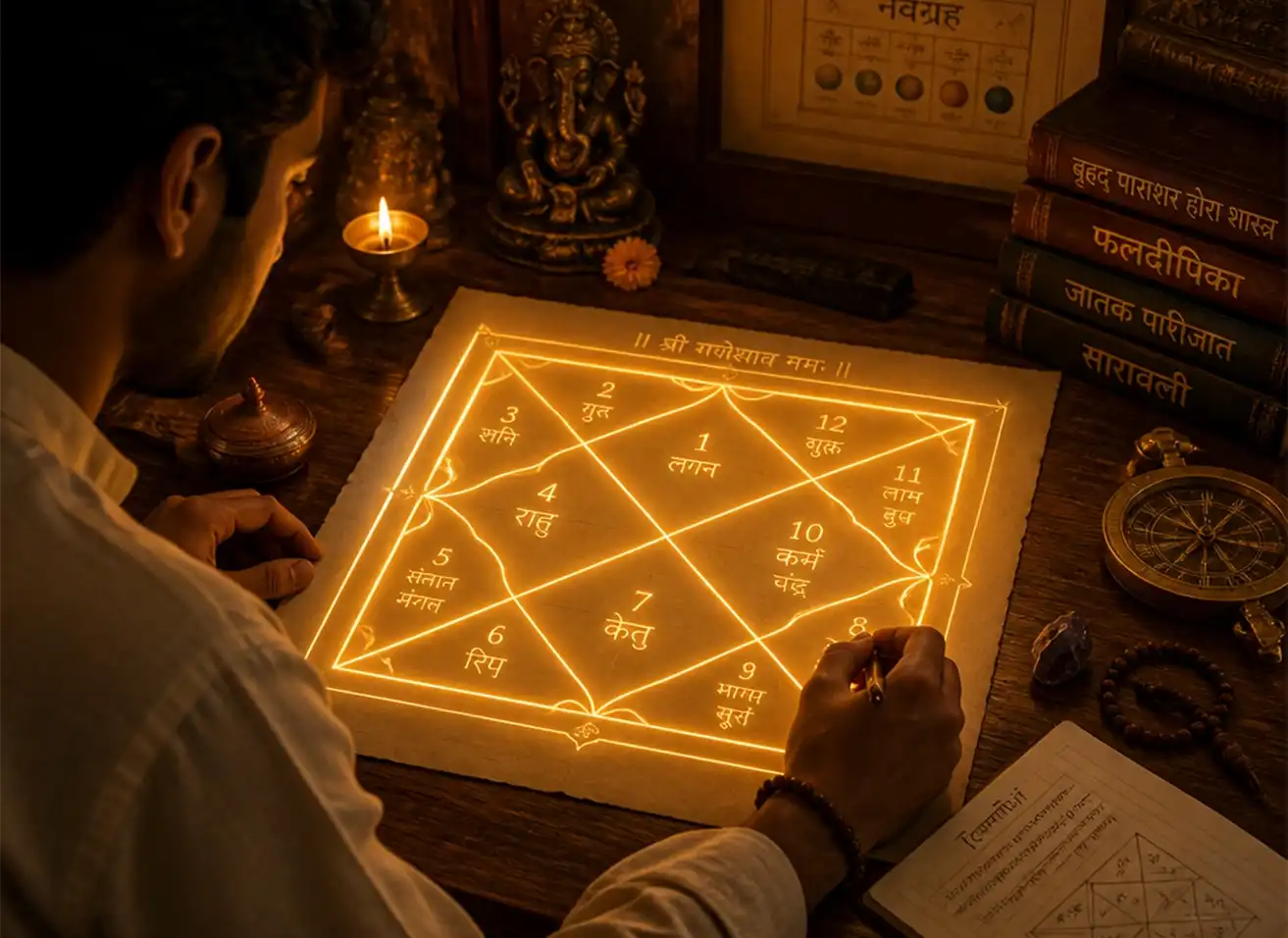
To read your own Kundali, you must first obtain an accurate chart. Do not rely on generic websites that ask only for your date of birth. Vedic astrology requires your exact time of birth (within a few minutes) and your place of birth. The Lagna changes approximately every two hours, so a difference of fifteen minutes can shift your entire chart. At Nabatara Institute, we always remind our shishyas that accurate data is essential. Once you have your chart, look for the number 1 in one of the twelve houses. That house is your Lagna, your ascendant. The Lagna represents your physical body, your outer personality, and the mask you wear when you meet the world. More profoundly, the Lagna is the lens through which your entire life will be experienced.
Now let us talk about your Rashi, which is the sign occupied by your Moon at birth. In Vedic astrology, the Moon is considered the most important factor for understanding your mind, your emotions, and your instinctive reactions. While the Lagna shows how the world sees you, the Moon shows how you see yourself when you are alone at 2 AM. If your Lagna is the actor on stage, your Rashi is the actor in the dressing room mirror.
Beyond the Rashi, we have the Nakshatras"the twenty-seven lunar mansions that divide the zodiac more finely than the twelve signs. Each Nakshatra carries a specific deity, energy pattern, and life lesson. Your Moon's Nakshatra is particularly important because it reveals your deepest psychological needs and the core flavor of your emotional life. The ancient texts say that a person's entire destiny can be read from the Nakshatra of their moon at birth, though this requires deep study and intuitive development. At Nabatara's Jyotish Foundation Program, students spend months simply learning to feel the difference between the Nakshatras before they ever attempt predictions. Join our Jyotish Foundation Program to learn directly from the lineage.
Let us introduce the twelve houses, because without them, planets are just dots floating in space. Each house represents a department of life, and the planets placed in those houses show where your attention and karma will naturally flow.
The first house is the house of self, body, health, and basic personality. The second house governs family, speech, wealth, and food. The third house is the house of courage, siblings, communication, and short travels. The fourth house represents the mother, home, emotional foundation, and the heart itself. The fifth house governs intelligence, creativity, children, romance, and spiritual practices (sadhana). The sixth house is the house of enemies, debts, disease, and daily work. The seventh house governs partnerships"marriage, business partners, and all one-to-one relationships. The eighth house is the house of secrets, sudden events, death, transformation, and hidden knowledge"the most misunderstood yet powerful house for tantric growth. The ninth house governs dharma, gurus, fathers, long journeys, and fortune. The tenth house is the house of career, public reputation, authority, and your actions in the world. The eleventh house governs gains, friendships, elder siblings, and the fulfillment of desires. The twelfth house is the house of loss, foreign lands, sleep, meditation, and liberation (moksha).
What does this mean for you, the beginner? It means you should approach your Kundali with humility. Do not read one planetary placement and conclude you are doomed or blessed. Astrology is not a collection of isolated facts. It is a living system where every factor modifies every other factor. At Nabatara, we teach that the foundation of authentic Jyotish is not memorization but relationship. You must develop a relationship with each Graha, each Nakshatra, and each house. This requires sadhana—"regular practice that includes mantra, meditation, and offerings. Gaurav Tribedi Guruji often says, "You cannot read the music of the spheres if you have never heard the silence between the notes." His Nabatara Tantra & Sadhana courses integrate Jyotish with tantric practices precisely because the two systems were never separate in the authentic tradition.
The Hidden Dimensions: Secrets Only the Sadhaka Knows
Now we arrive at the territory that separates surface-level astrology blogs from the living transmission of the Guru-Shishya parampara. Everything you have read so far is available in any introductory textbook. But what follows is the wisdom that flows only through initiation and direct experience"the dimensions of Jyotish that Nabatara Institute preserves because they cannot be learned from YouTube videos or weekend courses.
The first hidden dimension is the concept of Graha Drishti—planetary aspects—and how they differ fundamentally from what Western astrology calls aspects. In Vedic astrology, every planet aspects the seventh house from its position. Mars additionally aspects the fourth and eighth houses. Jupiter aspects the fifth and ninth. Saturn aspects the third and tenth. These aspects are not geometric angles. They are rays of attention cast by conscious beings.
When Saturn aspects your second house of speech, you will speak rarely and carefully, and your words will carry weight. When Guru aspects your seventh house of marriage, your partnership will be blessed with wisdom, though perhaps not with passion. Learning to read aspects is like learning to see the invisible threads that connect different areas of your life. A client once came to me with a beautiful fourth house—"Shukra and Chandra together," suggesting a loving mother and a peaceful home. But Shani was aspecting that fourth house from the tenth house of career. The result? Every time her career advanced, her home life became cold and distant. The chart did not create this dilemma. It revealed a pattern her soul had carried for lifetimes.
The second hidden dimension is Bhava Bala—the strength of houses. Not all houses are equally active in every chart. The calculation of house strength involves multiple factors. A mathematically strong house will manifest its significations easily. A weak house will require effort and may produce results only later in life after appropriate remedies. For example, a weak fifth house does not mean you will never have children or creativity. It means those areas will require conscious cultivation. You may need to perform specific upayas (remedies) like mantras for the fifth lord. The weakness is not a curse. It is an invitation to practice.
The third hidden dimension"and this is where Nabatara's tantric approach becomes essential"is the relationship between the Grahas and the chakras. In the authentic tradition, each planet corresponds to a specific energy center in the subtle body. Surya corresponds to the solar plexus (Manipura), the seat of will and identity. Chandra corresponds to the sacral chakra (Svadhisthana). Guru corresponds to the crown (Sahasrara). Shani corresponds to the root (Muladhara).
When a planet is afflicted in your chart, the corresponding chakra is also blocked or overactive. This is not a metaphor. This is energetic reality, verifiable through tantric sadhana. One of our shishyas at Nabatara had a severely afflicted Mercury (Budha) in her chart—"Mercury in the twelfth house, aspected by Shani, combusts the Sun. She suffered from chronic anxiety, communication blocks, and an inability to express her true thoughts. Through the guidance of Gaurav Tribedi Guruji, she received specific Mercury mantras and a sadhana that activated her throat chakra (Vishuddha). Within six months, not only had her anxiety decreased, but she had also begun writing poetry for the first time in her life—poetry that has since been published. This is what we mean when we say that authentic astrology is not fortune-telling. It is diagnosis and prescription. Join our spiritual sadhana program to harmonize your chakras through planetary wisdom.
The fourth hidden dimension is the Dasha system, particularly the Vimshottari Dasha. This is the predictive engine of Vedic astrology, and it is also the most profound tool for understanding the timing of your spiritual unfolding. The Vimshottari Dasha divides your life into periods ruled by each planet, based on the Nakshatra of your Moon at birth. Why does this matter for a beginner? Because your chart is not static. The promise of "you have a strong tenth house" is incomplete without knowing when that tenth house will activate. You may have the potential for career success written into your chart, but if that potential only flowers during your Guru Dasha (age 24 to 36), trying to force it during your Shani Dasha (age 0 to 12) would be like expecting a rose to bloom in winter.
The fifth hidden dimension is the role of Ketu in spiritual awakening. Ketu is the south node of the Moon, the point of eclipse. In practical terms, Ketu represents the area of life where you have already mastered your lessons and can now let go. Ketu brings detachment, confusion, and sudden loss, but also enlightenment, psychic ability, and liberation. Wherever Ketu sits in your chart, you will experience a strange mixture of ease and dissatisfaction. You are naturally good at that area of life, so good that you may not even remember learning the skills. But you also feel a subtle boredom there, an itch to move on to something else. The spiritual seeker often has a prominent Ketu. If you are reading this article, I would wager that Ketu is either strong in your chart or currently activated in your Dasha. You are not here by accident.
The sixth hidden dimension is the divisional chart, or varga. Your main chart (the Rashi chart) is only the beginning. Vedic astrology uses sixteen or more divisional charts to examine specific areas of life with microscopic precision. The Navamsha (ninth division) chart is almost as important as the Rashi chart"it shows your dharma, your spouse, and the deeper currents of your life after marriage. Do not be overwhelmed. No beginner needs to read all sixteen divisional charts. But know that they exist, and know that when a professional astrologer like those trained at Nabatara gives you a detailed reading, they are synthesizing multiple layers of information.
What makes Nabatara's approach unique in the modern landscape is our insistence on the sadhaka's intuition as the final arbiter of any reading. You can memorize every rule in Parashara. You can calculate every divisional chart to six decimal places. But without intuition—without the quiet voice that speaks after mantra and meditation—your readings will remain mechanical, accurate in detail, but empty of transformation. Gaurav Tribedi Guruji spent over two decades in sadhana before he began teaching astrology publicly. He did not learn Jyotish from books alone. He learned it from his Guru, who learned it from his Guru, in a chain stretching back to Adi Shankaracharya himself. Read the full journey of Gaurav Tribedi and discover what becomes possible when devotion meets discipline.
Walking with the Master Gaurav Tribedi's Teachings & Nabatara's Global Mission
There is a particular quality of silence that descends when a true master enters the room. Not the silence of fear or intimidation, but the silence of recognition—the soul remembering something it has always known. Those who have sat in the presence of Tantra Avishikta Gaurav Tribedi describe this silence. They describe how his eyes seem to look past your face and directly into the accumulation of karma you have carried across births. They describe how his voice, even when speaking the simplest instruction, carries a weight that bypasses the intellect and lands somewhere in the chest.
Gaurav Tribedi is not a celebrity guru. He does not have a massive social media following or a line of branded merchandise. What he has is something far rarer in this age of spiritual commodification: unbroken transmission from the Sri Jagadguru Shankaracharya lineage, combined with over twenty years of solitary tantric sadhana in the caves and cremation grounds that the texts describe as the fastest path to realization.
His story is not for casual consumption. Born into a family with no particular spiritual pedigree, he experienced his first spontaneous awakening at the age of twelve"a vision of a particular form of the Divine Mother that left him trembling for three days. His family, confused and frightened, took him to doctors who found nothing physically wrong. It was only when they encountered a wandering sadhu in the mountains of Uttarakhand that anyone recognized what was happening. The sadhu, who later became his first formal guru, said simply, "This boy does not need a doctor. He needs a mantra."
The initiation that followed was not gentle. Guruji describes it as being taken apart cell by cell and reassembled according to a different blueprint. He spent years in practices that would terrify most modern seekers"meditating in charnel grounds at midnight, consuming only what nature provided, allowing his body to become so thin that his ribs pressed against his skin like the strings of a veena. When students at Nabatara hear these stories, they sometimes ask why such intensity is necessary. Why cannot enlightenment be easier?
Guruji's answer is always the same. "The depth of your transformation is proportional to the intensity of your fire. You want a shallow fire; you get a shallow transformation. If you want to burn through karma that has accumulated for thousands of years, you need a fire that would frighten most people. I do not recommend my path to everyone. But I offer the fruits of my path to everyone. That is why Nabatara exists."
Nabatara Institute of Astrology was founded as a Section 8 nonprofit with a single mission: to preserve and transmit authentic Vedic and tantric knowledge without the distortions of commercialization. In an era where spiritual teachings are increasingly packaged, priced, and marketed like luxury goods, Nabatara operates on a different principle. Guruji says, "You cannot put a price on what was given freely. The rishis did not charge for the Vedas. My Guru did not charge for his wisdom. I will not charge for mine. But I will demand something more valuable than money. I will demand your sincerity."
This is why Nabatara's courses, including the Tantra & Sadhana Courses and the Jyotish Foundation Program, are offered on a donation basis. No one is turned away for lack of funds. But every applicant undergoes a screening process to ensure they are not merely curious but genuinely committed. The Institute has shishyas from over fifteen countries"India, the United States, Brazil, Russia, Japan, Germany, South Africa, and beyond. Some are university professors. Some are farmers. Some are mothers raising young children. Some are teenagers who found their way to Guruji through dreams they could not explain.
One such shishya is Dr. Anjali Sharma, a cardiologist from Pune who came to astrology as a skeptic. "I was trained in evidence-based medicine," she told me. "I laughed at astrology the way most doctors laugh. But then I started noticing patterns in my patients that medicine could not explain. Why did heart attacks cluster around certain planetary transits? Why did some patients respond to treatment while others with identical conditions did not? I needed a framework that could hold these observations. Jyotish provided that framework. "Anjali is now completing Nabatara's advanced certification in medical astrology, correlating planetary conditions with specific health patterns described in the classical texts. She does not use astrology to replace medicine. She uses it to understand the karmic context of illness and to recommend mantras and upayas that complement medical treatment.
Another shishya, Marco from Milan, came to Nabatara after a devastating divorce that left him suicidal. "I had everything"a beautiful wife, a successful architecture firm, and a home in the Italian countryside. And then in the span of six months, I lost all of it. I sat in my empty apartment holding a bottle of sleeping pills, and I heard a voice say, "Not yet. There is something you need to learn first.'" Marco found Nabatara through an online search for authentic Vedic astrology. He enrolled in the Jyotish Foundation Program not because he wanted to become an astrologer but because he wanted to understand his own chart. "When I saw my Shani placement in the eighth house, aspecting my seventh house, I cried for three hours. Not because I was sad. Because I finally understood. The suffering was not punishment. It was the surgical removal of everything I had mistaken for myself. Shani was not my enemy. Shani was my surgeon."
These stories multiply at Nabatara. A young woman from Brazil who was trafficked as a child and found healing through Venus mantras that restored her sense of beauty and worth. A retired army colonel from Rajasthan whose anger issues dissolved after he began a daily practice to honor Mangala. A non-binary teenager from California who found validation for their identity in the concept of the third sex described in the Vedic texts and correlated with specific Nakshatra placements.
What makes these transformations possible is not merely the astrological knowledge but the container in which it is transmitted. Guruji insists that Nabatara shishyas learn in community, not in isolation. There are regular group sadhanas, online and in person. There is a strict code of ethics that prohibits any form of exploitation. "I am not God," Guruji says. "I am a servant of God. If you worship me, you waste your time and embarrass me. If you practice what I teach, you will find your own direct connection to the divine. That is the only purpose of a guru—to make himself unnecessary." Explore our yoga and meditation courses to begin your own journey within an authentic spiritual community.
Integration, Real-Life Transformations & Your Next Step
You have traveled far in this guide. You have learned what a Kundali is and why it matters. You have explored the Lagna, the Rashi, the Nakshatras, the twelve houses, the nine Grahas, and the subtle dimensions of aspects, Dasha periods, and divisional charts. You have glimpsed the tantric understanding that connects planets to chakras and mantras to healing. You have heard the stories of those who found their way through darkness by learning to read their own birth chart.
Now comes the question that only you can answer: What will you do with this knowledge?
You could close this browser tab and return to your ordinary life, carrying these concepts as interesting trivia to pull out at dinner parties. Many people do. There is nothing wrong with that. Vedic astrology is fascinating even as an intellectual pursuit. But something brought you here, to this page, at this moment in your life. Perhaps you are in a Shani Dasha, and the weight of your responsibilities has become almost unbearable. Perhaps you are in a Rahu Dasha and you feel consumed by desires you cannot satisfy. Perhaps you are in a Ketu Dasha and you feel unmoored, disconnected from everything that used to matter, wondering if you are losing your mind or waking up for the first time.
Your chart holds the answer. Not because the chart determines your fate, but because the chart reflects your karma"the accumulated results of every choice you have made across countless lifetimes. And karma is not destiny. Karma is simply momentum. The momentum can be redirected. The momentum can be exhausted through sadhana. The momentum can be transformed into the fuel for liberation.
How accurate do my birth details need to be for Vedic astrology to work? Your birth time needs to be as accurate as possible, ideally within five minutes. The Lagna changes every two hours, so even a fifteen-minute error can shift your ascendant sign, which changes the entire house structure of your chart. If you do not know your exact birth time, Vedic astrologers can perform a process called birth time rectification, using major life events to reverse-engineer the correct Lagna. At Nabatara Institute, we recommend obtaining your birth certificate or asking older family members who remember the circumstances of your birth before seeking a reading.
Is Vedic astrology compatible with modern psychology? Absolutely, and this is one of the areas where Nabatara Institute does pioneering work. The Grahas correspond remarkably well to archetypes described by Jung and other depth psychologists. Shani maps to the superego and the reality principle. Chandra maps to the personal unconscious and emotional memory. Rahu and Ketu map to complexes and shadow material. Many of our shishyas are psychotherapists who use Jyotish as a diagnostic tool to understand their clients faster and more compassionately. The difference is that psychology describes patterns from the outside, while Jyotish reveals the karmic origins of those patterns.
Can I learn to read my own chart without a guru? You can learn the mechanics without a guru—the house meanings, the planetary significations, and the basic rules of aspect. Many books and websites offer this information. But reading a chart deeply requires the intuitive development that only comes through spiritual practice under qualified guidance. More importantly, certain combinations in a chart can be genuinely dangerous to interpret incorrectly. A person with a weak Moon and an afflicted fourth house may be suicidal, and an amateur reading that simply tells them their emotions are "complicated" could miss the emergency. This is why Nabatara emphasizes that ethical astrology requires both training and humility. Explore our occult science courses to learn from authentic masters.
What is the difference between a horoscope and a Kundali? In common usage, the terms are often interchangeable, but there is a technical difference. A horoscope typically refers to the Western tropical zodiac system, which is based on the seasons and moves relative to the fixed stars. "Kundali" refers specifically to the Vedic sidereal system, which is based on the actual positions of the constellations. Because of the precession of the equinoxes, these two systems are now about twenty-three degrees apart. That means your Sun sign in Western astrology (for example, Aries) is usually your previous sign in Vedic astrology (Pisces). Neither system is "correct"; they are different maps for different purposes.
How do I know if an astrologer is authentic and not a fraud? Authentic Vedic astrologers do not predict death dates, do not claim to remove all your problems with expensive rituals, and do not make you feel dependent on them. They will be transparent about their lineage and training. They will acknowledge the limits of their knowledge. They will encourage you to verify their insights against your own experience. At Nabatara Institute, we train our astrologers to give readings that empower rather than frighten. A genuine astrologer will never tell you that you are cursed or that your chart is "bad." Every chart has strengths and challenges. The purpose of a reading is to show you both. Book a personalized astrology consultation with a certified Nabatara astrologer.
How long does it take to become proficient in Vedic astrology? With dedicated study of two to three hours per day, most students can read their own chart competently within six months. Professional proficiency, including the ability to read for others ethically, typically takes two to three years of consistent practice and mentorship. Mastery, the level where astrology becomes as natural as breathing, usually requires a lifetime. This is not discouragement"it is an invitation. The depth of Jyotish is such that you will never exhaust it. There will always be another layer to discover, another mystery to unfold. For those who love learning, this is not a burden but a gift.
A Transformation Vignette
Let me share with you the story of Vikram, not his real name, who came to Nabatara after his wife left him and took their daughter. Vikram was a successful software engineer in Bangalore, logical to a fault, the kind of person who scoffed at anything he could not measure. His wife's departure blindsided him. He had provided everything—a beautiful home, international vacations, and the best schools for their daughter. What had he done wrong?
When he finally allowed a friend to drag him to a Nabatara introductory session, he sat through the lecture with his arms crossed, visibly skeptical. But something Guruji said caught his attention. "Your Venus is in the sixth house in the sign of Virgo, and you are currently in your Venus Dasha. Venus in the sixth house often manifests as a tendency to treat love like a problem to be solved rather than a mystery to be felt. You have been analyzing your wife instead of cherishing her."
Vikram requested a private consultation. Over the next two hours, the astrologer showed him placement after placement that explained patterns Vikram had never admitted even to himself: his fear of vulnerability (Shani in the fourth house), his habit of retreating into work during emotional stress (Mangala in the tenth aspect of the fourth), and his unconscious repetition of his father's emotional distance (ninth house afflictions). The reading did not bring his wife back. But it brought Vikram back to himself. He enrolled in the Jyotish Foundation Program, not to become an astrologer but to continue the process of self-examination. He started a daily practice of Venus mantras, chanting with a sincerity that would have embarrassed his former self. After eighteen months, something shifted. Vikram's ex-wife agreed to mediation. He saw his daughter regularly for the first time in two years. More importantly, he stopped seeing himself as a victim and started seeing his life as a curriculum. "I used to think astrology was for people who needed excuses for their failures," he told a gathering of new students. "Now I know that astrology is for people brave enough to stop blaming and start learning."
Your Next Step
You are not Vikram. You are not Priya from the opening of this article. You are yourself, with your own unique chart, your own specific karmic knots, and your own irreplaceable potential for awakening. The question is whether you will continue walking this path alone or whether you will accept the support that has been offered to sincere seekers for thousands of years.
Nabatara Institute of Astrology exists for exactly this moment. The world is burning with confusion—political chaos, environmental collapse, technological alienation, and spiritual confusion. Never has authentic guidance been more needed. Never has the signal been more drowned out by noise. The Shankaracharya lineage preserved the Vedas through millennia of invasion and upheaval. It will preserve them through this age as well. But preservation requires students. Transmission requires receptivity. The guru appears when the shishya is ready. If you are reading these words, some part of you is ready.
What does readiness look like in practical terms? It looks like picking up the phone. It looks like sending an email. It looks like typing your name into a registration form. It does not require you to be perfect, or pure, or even particularly spiritual. It only requires you to be honest"honest about your suffering, honest about your longing, and honest about your willingness to change.
The Nabatara team is small but dedicated. When you reach out through the website nabatara.com, a real human being will respond, not a chatbot. That human being will ask you about your background, your spiritual experience (or lack thereof), and what you hope to find through Jyotish. They will answer your questions honestly, without pressure. They will explain the different course options, the donation guidelines, and the time commitment involved. And then they will leave the decision to you, because authentic spiritual work cannot be coerced.
If you decide to join, you will receive access to the Jyotish Foundation Program, which includes video lessons, downloadable materials, monthly live sessions with Gaurav Tribedi Guruji, and a private community of fellow learners from around the world. You will also have the option to pursue advanced certifications in specific areas like medical astrology, relationship astrology, or the tantric integration of Jyotish with mantra and yantra. You can also enroll in Vastu Shastra classes to harmonize your living and working spaces.
But the courses are not the point. The point is the transformation that becomes possible when you see yourself clearly for the first time. The point is the relief of recognizing that your struggles are not random or meaningless but are precisely the lessons your soul came here to learn. The point is the liberation that comes when you stop fighting your chart and start dancing with it.
Gaurav Tribedi Guruji closes every teaching session with the same words. They are simple words, but they have stopped more than one shishya in their tracks, bringing tears to eyes that had forgotten how to cry. He says, "The stars show you the path. They do not walk it for you. The planets show you the obstacles. They do not remove them for you. The chart shows you who you are. It does not become who you can be. That part"the walking, the removing, the becoming"that part belongs to you. That part has always belonged to you. Go now, and do not wait. The next step is the only step that matters."
Your next step is waiting. Visit nabatara.com today. Your chart is not a prison. It is a door. And the key has been in your hand all along.