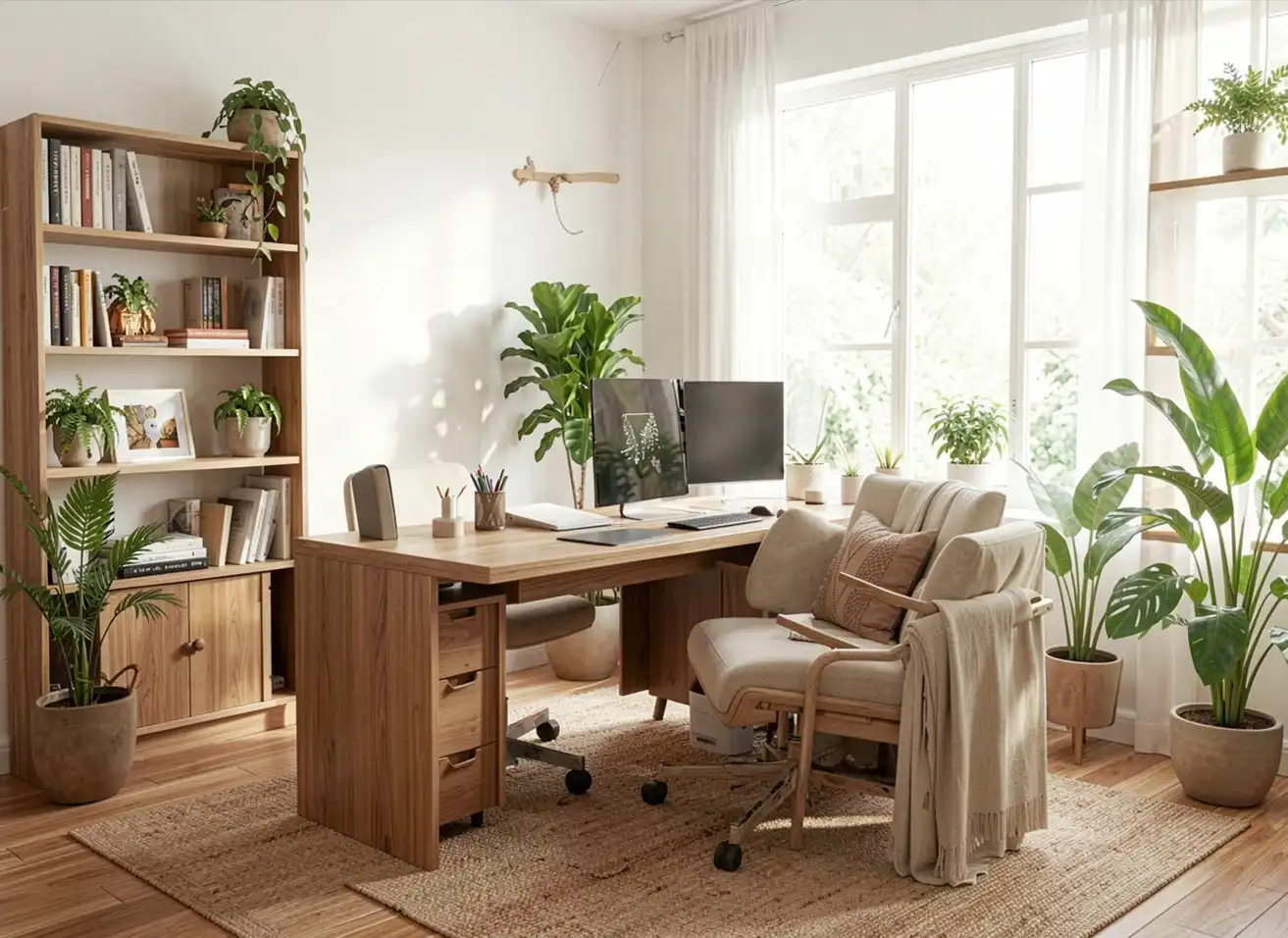
There is a quiet desperation that hums beneath the surface of modern remote work. It is not the loud chaos of a crowded marketplace or the frantic energy of a corporate floor, but something far more insidious. It is the silence of a room that feels heavy, the inexplicable drain of energy that hits you at three in the afternoon, and the subtle friction that arises when you try to focus on a task that should be simple. You sit at your desk, surrounded by the tools of your trade—laptops, notebooks, and perhaps a cup of tea that has long gone cold—and yet, your mind refuses to settle. It wanders. It resists. You feel as though you are swimming against an invisible current, pushing harder but moving slower. This is not merely a lack of discipline or a failure of time management. This is a misalignment of energy.
In the ancient wisdom of Sanatan Dharma, we understand that space is not empty. Space is alive. It breathes. It holds memory. It influences the consciousness of those who inhabit it. When we speak of the ideal Vastu layout for a productive and stress-free home office, we are not speaking of aesthetic trends or ergonomic fads. We are speaking of the fundamental relationship between the human spirit and the physical environment that houses it.
For centuries, the Rishis and sages of India understood that the direction in which one faces, the color of the walls that surround them, and the placement of the objects they interact with daily can either amplify their natural abilities or suppress them. This knowledge, encoded in the texts of Vastu Shastra, was never meant to be a superstitious ritual but a sophisticated science of environmental psychology and cosmic alignment. Today, as millions of professionals, entrepreneurs, students, and creative souls transition their workplaces into their living spaces, this ancient wisdom has become more relevant than ever.
The home is no longer just a place of rest; it is a place of production, of creation, of struggle, and of triumph. But the home also carries the energy of sleep, of intimacy, of relaxation, and of domestic routine. When these energies collide without proper harmonization, the result is a subtle but persistent stress that erodes productivity and peace. You may find yourself working longer hours but achieving less. You may feel irritable with clients or family members. You may experience a creative block that seems to have no logical cause. These are signs that the Vastu of your workspace is out of balance.
At the Nabatara Institute of Astrology, we have witnessed this phenomenon countless times. Seekers come to us seeking clarity in their careers, hoping that a change in strategy or a new skill will unlock their potential. Often, the breakthrough does not come from doing more but from aligning better. Under the guidance of Tantra Avishikta Gaurav Tribedi, a devoted disciple of the Sri Jagadguru Shankaracharya lineage, we teach that true success is a holistic state. It is not just about the money in the bank or the titles on the business card. It is about the peace in the heart and the clarity in the mind while one works.
Gaurav Tribedi has spent over two decades immersing himself in the depths of Tantra, Jyotish, and Vastu, understanding how these sciences interweave to shape human destiny. He teaches that your workspace is a yantra—a geometric instrument—that can either support your spiritual sadhana or hinder it. When your home office is aligned with the natural laws of the universe, work becomes a form of worship. It becomes a flow state where effort feels effortless, where ideas arrive with clarity, and where stress dissolves into focused action.
The concept of the ideal Vastu layout for a productive and stress-free home office is rooted in the understanding that we are microcosms of the macrocosm. Just as the planets move in specific orbits and the seasons change in a specific order, our lives thrive when we move in harmony with these rhythms. Vastu Shastra provides the map for this harmony. It tells us that the North is the direction of Kubera, the lord of wealth, and thus is associated with opportunities and financial flow. It tells us that the East is the direction of Indra, the king of gods, and is associated with new beginnings, clarity, and social connections. It tells us that the South is the direction of Yama, the lord of death and justice, and is associated with stability, strength, and completion. And it tells us that the West is the direction of Varuna, the lord of waters, and is associated with creativity, gains, and support.
When we place our desks, our seats, and our storage in alignment with these directional energies, we tap into a reservoir of support that is always available but often ignored. However, this is not a one-size-fits-all prescription. The ideal Vastu layout for a productive and stress-free home office must be tailored to the individual. Your profession matters. A writer needs different energy than a trader. A teacher needs different energy than a programmer. Your personal astrological chart also plays a role. The planets that are strong in your horoscope will indicate which directions are most supportive for you.
For example, if Jupiter is strong in your chart, facing East may bring you immense wisdom and teaching ability. If Saturn is strong, facing West may give you the discipline and endurance needed for long-term projects. This is where the integration of Vastu and Jyotish becomes powerful. At Nabatara, we do not treat these subjects in isolation. We see them as complementary lenses through which to view the human experience. Gaurav Tribedi often emphasizes that Vastu is the external manifestation of the internal state. If your mind is cluttered, your space will likely be cluttered. If your space is chaotic, your mind will struggle to find peace. By correcting the external, we can influence the internal. By correcting the internal through sadhana and meditation, we can perceive the external more clearly.
The journey to creating a sacred workspace begins with intention. It begins with the recognition that your work is not separate from your spiritual life. In the Vedic tradition, there is no division between the secular and the sacred. Every action, when performed with awareness and dedication, is an offering to the Divine. Your home office, therefore, is not just a room; it is a temple of your karma. It is where you exercise your free will, where you create value, and where you interact with the world. To neglect its energy is to neglect a significant part of your life. To honor it is to invite grace into your daily routine.
The Vedic Foundations: Ancient Knowledge for Today
To truly understand the ideal Vastu layout for a productive and stress-free home office, we must first root ourselves in the soil from which this knowledge grows. Vastu Shastra is not a recent invention of interior designers or a collection of folk remedies. It is an Upaveda, a subsidiary knowledge system attached to the Atharva Veda, one of the four primary scriptures of Hinduism. The term "Vastu" refers to the dwelling or the site, and "Shastra" means science or teaching. Thus, Vastu Shastra is the science of architecture and design, but its scope extends far beyond the physical structure of buildings. It is the science of living in harmony with the five great elements (Pancha Mahabhutas): Earth, Water, Fire, Air, and Space.
These elements are not just material substances; they are states of energy and consciousness that permeate the entire universe. When these elements are balanced in our living and working spaces, they create an environment that supports health, happiness, and prosperity. When they are imbalanced, they create disharmony, disease, and distress. The foundational text of Vastu Shastra, along with others like the Mayamatam and the Manasara, provides detailed guidelines on how to construct and arrange spaces to align with these elemental forces. But the application of these principles is not rigid. It is dynamic and responsive to the needs of the inhabitants.
Understanding the Pancha Mahabhutas in Your Workspace
In the context of a home office, we are dealing with a space that serves a dual purpose: it is a place of intellectual and creative activity (governed by the element of air and the planet Mercury) and a place of material achievement and stability (governed by the element of earth and the planet Saturn). Balancing these competing energies is the key to creating a workspace that is both dynamic and grounded.
One of the central concepts in Vastu Shastra is the Vastu Purusha Mandala. This is a metaphysical square grid that represents the cosmic being, the Vastu Purusha, lying face down on the plot of land. Each square in the grid is governed by a specific deity and planetary energy. The center of the grid, known as the Brahmasthan, is the most sacred spot, representing the core of existence. It should be kept open and free from heavy structures to allow the flow of prana (life force). In a home office, the Brahmasthan should ideally be a clear, open area, perhaps a small hallway or an open space in the middle of the room, rather than a place where a heavy desk or cabinet is placed. Blocking the Brahmasthan can lead to stagnation and a lack of clarity in decision-making.
Directional Energies and Their Impact on Productivity
The directions play a crucial role in the Vastu Purusha Mandala. The northeast corner, known as the Ishan Kona, is governed by Shiva and Jupiter. It is the zone of wisdom, spirituality, and new beginnings. This is the most auspicious direction for meditation, study, and planning. Placing your desk in the northeast can enhance your ability to learn and gain insights. However, it is important to note that the Northeast is a delicate entity. It should be kept clean, light, and uncluttered. Heavy weights or dark colors in this corner can suppress the positive energy and lead to confusion or mental blocks.
The Southwest corner, known as the Nairutya Kona, is governed by Nirriti and Saturn. It is the zone of stability, strength, and grounding. This is the ideal place for heavy furniture, storage units, and safe deposits. Placing your back towards the southwest while sitting at your desk can provide a sense of support and security, allowing you to face the north or east with confidence. This positioning is particularly beneficial for leaders, managers, and anyone who needs to make firm decisions. It anchors you in reality and prevents you from becoming too flighty or scattered.
The northwest corner, known as the Vayavya Kona, is governed by Vayu (the wind god) and the Moon. It is the zone of movement, change, and communication. This direction is suitable for activities that involve travel, networking, and frequent changes. If your work involves a lot of client interaction, phone calls, or short-term projects, the North-West can be a supportive direction. However, it is a restless energy. Sitting here for long periods of deep, focused work may lead to distraction and instability. It is better suited for collaborative spaces or areas where you handle correspondence and logistics.
The southeast corner, known as the Agneya Kona, is governed by Agni (the fire god) and Mars. It is the zone of energy, passion, and transformation. This direction is ideal for kitchens and electrical equipment, as it resonates with the fire element. In a home office, placing electronic devices like computers, printers, and servers in the southeast can help manage their heat and energy output. However, sitting directly in the southeast for long periods can lead to agitation, anger, and burnout. It is a high-energy zone that needs to be balanced with cooling elements.
Elemental Balance for Optimal Performance
Understanding these directional energies is the first step in creating the ideal Vastu layout for a productive and stress-free home office. But it is not enough to simply know the directions. We must also understand the qualities of the elements and how they interact. The element of Earth provides stability and structure. It is represented by the southwest direction and the color yellow or brown. Incorporating earth elements into your workspace, such as ceramic pots, stone sculptures, or earthy tones, can ground your energy and prevent you from feeling overwhelmed.
The element of water provides flow and flexibility. It is represented by the northeast direction and the color blue or black. Incorporating water elements, such as a small fountain, a fish tank, or images of water, can enhance creativity and emotional balance. However, water should be used sparingly and kept clean. Stagnant water can lead to financial losses and emotional stagnation. The element of fire provides energy and motivation. It is represented by the southeast direction and the color red or orange. Incorporating fire elements, such as candles, lamps, or bright lighting, can boost your productivity and drive. But too much fire can lead to conflict and stress. It is important to balance fire with water and earth.
The element of air provides movement and communication. It is represented by the northwest direction and the color white or grey. Incorporating air elements, such as wind chimes, fans, or open windows, can improve circulation and freshen the energy of the room. Good ventilation is essential for a healthy workspace. The element of space provides expansion and clarity. It is represented by the center of the room and the color white or transparent. Keeping the center of your workspace open and uncluttered allows the energy to flow freely and prevents feelings of confinement.
At the Nabatara Institute of Astrology, we teach these principles not as abstract theories but as practical tools for daily life. Our Jyotish Foundation Program and Advanced Vastu Consultation courses delve deep into the nuances of these elemental interactions. Students learn how to analyze a space using the Vastu Purusha Mandala and how to apply remedies to correct imbalances. They learn how to combine Vastu with Jyotish to create personalized solutions for each individual. For example, if a person has a weak Jupiter in their chart, we may recommend enhancing the northeast corner of their home office with yellow colors and wooden furniture to strengthen the Jupiter energy. If a person has a strong Saturn, we may recommend using the southwest corner for storage and heavy furniture to channel the Saturn energy positively.
Gaurav Tribedi emphasizes that the application of Vastu must be intuitive and responsive. It is not about following rules blindly but about sensing the energy of the space and adjusting it to suit your needs. He often shares stories from his own sadhana, where he has seen how small changes in the arrangement of a room can lead to significant shifts in the lives of his clients. One such story involves a writer who was struggling with writer's block. After analyzing her home office, Gauravji noticed that her desk was facing the southwest, which was blocking her creative flow. He advised her to move her desk to face the northeast and to place a small water feature in the north corner. Within weeks, she reported a surge in creativity and completed her manuscript. This is the power of Vastu when applied with wisdom and intention.
The Hidden Dimensions: Secrets Only the Sadhaka Knows
While the basic principles of Vastu Shastra are widely known, there are deeper, esoteric layers to this science that are rarely discussed in mainstream articles. These hidden dimensions are the secrets that only the sadhaka, the sincere practitioner, comes to understand through direct experience and guided instruction. At the Nabatara Institute of Astrology, under the tutelage of Gaurav Tribedi, we explore these subtleties to unlock the full potential of your home office. These insights go beyond the placement of furniture and delve into the realm of energy management, planetary influences, and psychological conditioning.
Prana Pratishta: Installing Life Force in Your Workspace
One of the most profound secrets is the concept of "Prana Pratishta," or the installation of life force in the workspace. Just as a deity is invoked into an idol through specific rituals, the energy of productivity and success can be invoked into your home office through intentional practices. This does not require elaborate ceremonies, but it does require awareness. Begin by cleansing the space energetically. You can do this by burning sage, camphor, or incense sticks made of natural herbs. As the smoke fills the room, visualize it clearing away any stagnant or negative energy. Set an intention for the space. Declare aloud or in your mind that this room is dedicated to focused work, creative expression, and ethical achievement. This simple act of consecration transforms the room from a mere physical structure into a charged field of intention.
Yantras for Enhanced Energy
Another hidden dimension is the role of "yantras," or geometric diagrams, in enhancing specific energies. A yantra is a visual representation of a deity or a planetary energy. Placing the appropriate Yantra in your home office can amplify the desired qualities. For example, the Sri Yantra is known to attract wealth and prosperity. Placing a small Sri Yantra in the north or northeast corner of your office can enhance financial opportunities. The Ganesh Yantra is known to remove obstacles. Placing it near the entrance of your office or on your desk can help clear the path for smooth workflow. The Saraswati Yantra is known to enhance knowledge and creativity. Placing it in the northeast corner can boost your learning and artistic abilities.
Gaurav Tribedi teaches that the effectiveness of a yantra depends on the purity of intent and the regularity of worship. It is not a magic charm but a focal point for concentration and devotion. To learn more about incorporating these powerful tools into your practice, explore our spiritual sadhana programs.
Graha Shanti and Planetary Influences
The influence of "Graha Shanti," or planetary pacification, is another critical aspect of creating a harmonious workspace. Each planet governs specific aspects of our life and career. If a planet is afflicted in your horoscope, it can create obstacles in your work environment. For example, an afflicted Mercury can lead to communication errors, technical glitches, and mental confusion. An afflicted Saturn can lead to delays, hardships, and feelings of isolation. An afflicted Mars can lead to conflicts, accidents, and aggression.
By identifying the afflicted planets in your chart and performing specific remedies, you can mitigate their negative effects. These remedies can include wearing gemstones, chanting mantras, or performing specific pujas. In the context of the home office, you can also use color therapy and directional alignment to balance the planetary energies. For instance, if Mercury is weak, you can enhance the North direction with green colors and wooden objects. If Saturn is weak, you can enhance the West direction with blue or black colors and metal objects. Book a personalized astrology consultation to understand your unique planetary influences.
Kundalini Energy and Workspace Vitality
The concept of "Kundalini" energy also plays a role in the vitality of your workspace. Kundalini is the dormant spiritual energy located at the base of the spine. When awakened, it rises through the chakras, leading to higher states of consciousness. Your home office can either support or hinder this awakening. A cluttered, dark, and chaotic space can block the flow of Kundalini energy, leading to lethargy and stagnation. A clean, bright, and organized space can facilitate the flow of Kundalini energy, leading to increased vitality and inspiration.
To support Kundalini, ensure that your workspace has good air circulation and natural light. Keep the floor clean and free of clutter. Place plants in the room to enhance the life force. Avoid sitting with your back to a door or a window, as this can create a sense of vulnerability and disrupt the energy flow. Join our yoga and meditation courses to learn techniques for awakening and channeling this powerful energy.
The Psychology of Space
The "Psychology of Space" is another hidden dimension that is often overlooked. The way we arrange our space reflects our inner state. A cluttered desk often indicates a cluttered mind. A dark room often indicates a depressed mood. By changing the outer space, we can influence the inner state. This is the principle of "As above, so below." If you want to feel more organized, start by organizing your desk. If you want to feel more confident, start by arranging your chair in a position of power. If you want to feel more creative, start by adding colors and art that inspire you.
Gaurav Tribedi emphasizes that this is not just superficial psychology but a deep energetic connection. The outer world is a mirror of the inner world. By polishing the mirror, we can see ourselves more clearly. The role of sound and vibration is also crucial. Sound has a profound effect on our brainwaves and emotional state. Constant noise from traffic, neighbors, or household appliances can disrupt focus and increase stress. To create a peaceful workspace, minimize external noise. Use soundproofing materials if necessary. Play soft, instrumental music or nature sounds to create a calming atmosphere.
Chanting mantras can also be powerful. The vibration of mantras like "Om" or "Gayatri Mantra" can purify the energy of the room and elevate your consciousness. You can chant silently or aloud, depending on your preference. The key is consistency. Regular practice builds a reservoir of positive energy that supports your work. The "Power of Ritual" is another secret that distinguishes the sadhaka from the casual observer. Establishing a daily ritual in your home office can anchor your energy and create a sense of structure. This ritual can be as simple as lighting a lamp, offering a flower to a deity, or taking a few minutes to meditate before starting work.
The act of ritual signals to your subconscious mind that it is time to shift into work mode. It creates a boundary between your personal life and your professional life, even though they are in the same physical space. This boundary is essential for maintaining balance and preventing burnout. Gaurav Tribedi shares that many of his successful shishyas have established such rituals and attribute their consistency and focus to this practice. The "Energy of Objects" is another subtle factor. Every object in your home office carries an energy signature. Old, broken, or unused items can hold stagnant energy. New, well-maintained, and meaningful items can hold vibrant energy.
Be mindful of what you bring into your workspace. Choose objects that inspire you and align with your values. Avoid objects that remind you of past failures or negative experiences. Surround yourself with symbols of success, gratitude, and joy. This could be a photo of a loved one, a quote that motivates you, or a souvenir from a memorable trip. These objects serve as anchors for positive emotions and reminders of your goals. Finally, the "Connection to Nature" is a vital hidden dimension. Despite being indoors, your home office should maintain a connection to the natural world. This can be achieved through the use of natural materials like wood, stone, and cotton. It can also be achieved through the presence of plants, which not only purify the air but also bring life energy into the room.
Opening windows to let in fresh air and sunlight is also essential. Spending a few minutes looking at the sky or trees can reset your mind and reduce eye strain. Gaurav Tribedi often reminds us that we are part of nature, not separate from it. Reconnecting with nature, even in small ways, can restore our balance and enhance our well-being. These hidden dimensions of Vastu Shastra are not meant to overwhelm you but to empower you. They offer a deeper level of engagement with your workspace, transforming it from a passive container into an active partner in your success. By incorporating these secrets into your daily practice, you can create a home office that is not only productive but also spiritually enriching. For those who wish to explore these depths further, we invite you to explore our Tantra and Sadhana courses.
Walking with the Master Gaurav Tribedi's Teachings and Nabatara's Global Mission
To understand the true essence of the ideal Vastu layout for a productive and stress-free home office, one must look beyond the technical details and connect with the source of the wisdom. That source, for thousands of seekers worldwide, is Tantra Avishikta Gaurav Tribedi. His journey is not just a biography; it is a testament to the living power of the Guru-Shishya parampara. Born into a tradition that values spiritual depth over material gain, Gaurav Tribedi dedicated his early years to rigorous sadhana under the guidance of masters in the Sri Jagadguru Shankaracharya lineage. This lineage, unbroken for millennia, carries the torch of authentic Vedic knowledge, preserving it from dilution and distortion.
Gaurav Tribedi's approach to Vastu, Jyotish, and Tantra is distinct because it is rooted in direct experience. He does not teach from books alone but from the depths of his own realization. Over twenty years of intense practice, he has explored the subtle interplay between cosmic energies and human consciousness. He has seen how a slight adjustment in a room's orientation can shift a person's destiny. He has witnessed how the right mantra can dissolve years of mental blockage. He has experienced how the alignment of elements can bring peace to a chaotic mind. This experiential knowledge is what he transmits to his shishyas at the Nabatara Institute of Astrology.
The Nabatara Institute"A Spiritual Community
The Nabatara Institute is not just an educational center; it is a spiritual community. Founded as a Section 8 not-for-profit organization, its primary mission is service. The profit motive is absent, replaced by the desire to uplift humanity through knowledge. This purity of intent is felt by everyone who interacts with the Institute. Students from over fifteen countries have come to learn from Gaurav Tribedi, drawn by the authenticity of his teachings and the transformative power of the methods he offers. They come from diverse backgrounds—engineers, doctors, artists, homemakers, and business leaders—but they share a common thirst for truth and a desire to live more harmonious lives.
Gaurav Tribedi's teachings on home office Vastu are infused with this broader spiritual vision. He teaches that your workspace is a reflection of your inner state. If you are anxious, your space will feel anxious. If you are clear, your space will feel clear. Therefore, the work of arranging your home office is also the work of arranging your mind. He encourages his students to practice mindfulness while setting up their spaces. To feel the energy of each corner. To listen to the intuition that guides their choices. This intuitive approach, backed by scriptural knowledge, creates a powerful synergy.
Balancing Pravritti and Nivritti
One of the key principles Gaurav Tribedi emphasizes is the balance between "Pravritti" (activity) and "Nivritti" (withdrawal). A home office is a place of pravritti, where we engage with the world. But it must also have elements of Nivritti, where we withdraw into ourselves for reflection and recharge. Without this balance, we burn out. He advises creating a small corner in the office for meditation or quiet contemplation. This could be a simple cushion on the floor, a small altar, or a comfortable chair facing a window. This space serves as a sanctuary within the sanctuary, allowing you to reconnect with your center amidst the demands of work.
Another important teaching is the concept of "seva," or service in the workplace. Gaurav Tribedi reminds us that our work is not just for personal gain but for the welfare of others. When we approach our work with an attitude of service, the energy of the space changes. It becomes lighter, more expansive, and more supportive. He encourages his students to dedicate their work to the Divine or to the greater good. This shift in perspective can transform even the most mundane tasks into acts of devotion. The Nabatara method of teaching is holistic. It integrates Vastu with Jyotish, Tantra, and Yoga. Students learn how to read their astrological charts to understand their innate strengths and weaknesses.
They learn how to use Vastu to enhance their strengths and mitigate their weaknesses. They learn Tantric techniques to harness energy and protect themselves from negative influences. They learn yoga and meditation to maintain physical and mental health. This integrated approach ensures that the changes made in the home office are supported by changes in the individual's lifestyle and consciousness. Gaurav Tribedi's global mission is to make this holistic wisdom accessible to all. He believes that spiritual enlightenment is not reserved for monks in caves but is available to everyone, including those living in busy cities and working demanding jobs.
The home office, therefore, becomes a laboratory for spiritual growth. It is where we practice patience, discipline, creativity, and integrity. It is where we learn to manage energy, time, and resources wisely. By applying Vastu principles, we create an environment that supports these virtues. The institute's online platforms have expanded its reach, allowing seekers from remote corners of the world to access Gaurav Tribedi's teachings. Through webinars, courses, and one-on-one consultations, the Nabatara community continues to grow. The feedback from students is overwhelmingly positive. Many report significant improvements in their productivity, mental peace, and overall well-being after implementing the Vastu guidelines taught by Gauravji. They speak of feeling more grounded, more focused, and more inspired in their work.
Ethical Conduct and Cosmic Law
One of the unique aspects of the Nabatara Institute is its emphasis on ethical conduct. Gaurav Tribedi teaches that Vastu remedies will not work if one's actions are unethical. Honesty, integrity, and compassion are the foundation of true success. Vastu can remove obstacles, but it cannot justify wrongdoing. This moral framework ensures that the knowledge is used for positive purposes. It aligns the seeker with the cosmic law of karma, where every action has a corresponding reaction. As you consider the ideal Vastu layout for a productive and stress-free home office, remember that you are not just arranging furniture. You are aligning yourself with a lineage of wisdom that has guided humanity for thousands of years.
You are joining a community of seekers who are committed to living with awareness and purpose. You are opening yourself to the guidance of a master who has walked the path and can light the way for you. For those who wish to deepen their understanding of Gaurav Tribedi's journey and the philosophy behind the Nabatara Institute, we invite you to explore his full story and teachings. The Nabatara Institute stands as a beacon of light in a world that often feels dark and confusing. It offers not just information but transformation. Not just techniques but wisdom. Not just solutions but liberation. By embracing the teachings of Gaurav Tribedi and the principles of Vastu Shastra, you can create a home office that is not only a place of work but also a place of worship, a place of growth, and a place of peace.
Integration, Real-Life Transformations, and Your Next Step
As we reach the conclusion of this exploration into the ideal Vastu layout for a productive and stress-free home office, it is time to integrate these insights into your daily life. Knowledge without application is like a seed that never germinates. It holds potential, but it does not bear fruit. The principles we have discussed—"directional alignment, elemental balance, clutter reduction, and energetic cleansing"—are tools waiting to be used. The question is not whether they work, but whether you are willing to engage with them sincerely.
Can Vastu principles be applied to rented apartments?
Many people ask whether Vastu principles can be applied to rented apartments where structural changes are not possible. The answer is a resounding yes. Vastu is not just about construction; it is about arrangement and energy management. You cannot move walls, but you can move furniture. You cannot change the direction of the building, but you can change the direction you face while working. You can use colors, lights, mirrors, and plants to correct imbalances. For example, if the northeast corner is blocked by a wardrobe, you can place a mirror on the wardrobe to visually expand the space and reflect light. You can use bright lighting to energize a dark corner. You can use sound and scent to cleanse the energy. The key is to work with what you have and make the best possible adjustments. Gaurav Tribedi often says that intention is more powerful than structure. If your intention is pure and your effort is sincere, the energy will respond.
How much does it cost to implement Vastu remedies?
Another frequent question is about the cost of implementing Vastu remedies. Many people assume that Vastu requires expensive renovations or purchases. This is a misconception. Most Vastu corrections are simple and inexpensive. Decluttering costs nothing. Rearranging furniture costs nothing. Cleaning the space costs nothing. Using natural light costs nothing. Even the use of colors can be done with affordable paint or fabric. The most powerful remedies are often the simplest. A clean floor, a clear desk, and a focused mind are more valuable than any expensive artifact. Nabatara teaches that simplicity is the ultimate sophistication. Do not let financial constraints stop you from starting. Start with what you can do today.
How long does it take to see results from Vastu changes?
People also wonder how long it takes to see results after making Vastu changes. The answer varies depending on the individual and the extent of the changes. Some people notice immediate shifts in their mood and energy levels. Others may take a few weeks or months to see tangible results in their career or finances. It is important to be patient and consistent. Energy shifts gradually. Like planting a garden, you must water the seeds daily and trust that they will grow. Do not expect overnight miracles. Expect steady progress. Keep a journal to track your observations. Note how you feel in the space each day. Note any changes in your productivity or mood. This awareness will help you fine-tune your adjustments.
Does Vastu conflict with other spiritual practices or religions?
A common concern is whether Vastu conflicts with other spiritual practices or religions. Vastu Shastra is a universal science of energy. It is not tied to any specific religion. The principles of balance, flow, and harmony are applicable to everyone, regardless of their faith. You can incorporate Vastu into your Christian, Muslim, Buddhist, or secular lifestyle. The deities mentioned in Vastu texts represent archetypal energies that exist in all cultures. You can interpret them in a way that resonates with your own beliefs. The goal is harmony, not conversion. Gaurav Tribedi welcomes students from all backgrounds and encourages them to adapt the teachings to their own cultural context.
Do I need a professional Vastu consultant?
Some seekers ask if they need a professional consultant to apply Vastu to their home office. While a consultant can provide personalized advice, especially for complex cases, many basic principles can be applied by individuals. This blog post has provided a comprehensive guide to get you started. Trust your intuition. Observe your space. Make small changes and see how they feel. If you encounter specific challenges or want a deeper analysis, you can seek guidance from the Nabatara Institute. Our consultants are trained to provide practical and compassionate advice. But remember, you are the ultimate expert on your own life. Your feelings and experiences are the best indicators of what works for you. Book a personalized Vastu consultation if you need expert guidance.
How does Vastu relate to hard work and professional skills?
Finally, people often ask how Vastu relates to hard work and professional skills. It is crucial to understand that Vastu is a support system, not a substitute. It clears the path, but you must walk it. It opens the door, but you must enter. It provides the wind, but you must steer the ship. Without effort, skill, and ethics, Vastu alone cannot bring success. But with effort, skill, and ethics, Vastu can amplify your results and reduce your struggles. It is a force multiplier. It makes your hard work more effective. It makes your skills more visible. It makes your ethics more rewarding. Do not rely on Vastu to do the work for you. Use it to support the work you are already doing.
Real-Life Transformation"Priya's Journey
To illustrate the transformative power of these principles, let us share a brief vignette. Consider Priya, a graphic designer who struggled with chronic fatigue and creative blocks. Her home office was in a small, dark room with no windows. Her desk faced a wall, and the room was cluttered with old projects and unused equipment. She felt stuck and uninspired. After attending a Nabatara workshop, she decided to apply Vastu principles. She moved her desk to face east, towards the only source of natural light. She cleared out the clutter, donating old items and organizing her files. She painted the walls a soft yellow to enhance the Jupiter energy of wisdom. She placed a small plant in the northeast corner.
Within a month, Priya reported a significant improvement in her energy levels. Her creativity flowed more easily, and she landed a major client. She attributed this change not just to the physical rearrangement but to the shift in her mindset. She felt more respected by her space and, thus, more respectful of her work. Priya's story is not unique. It is repeated in the lives of countless Nabatara shishyas. It is a testament to the power of aligning our outer environment with our inner aspirations. It is a reminder that we have the power to shape our reality.
Your Next Step Towards a Sacred Workspace
Now, it is your turn. Look at your home office with fresh eyes. See it not as a static room but as a dynamic field of energy. Identify one thing you can change today. It could be as simple as cleaning your desk or moving a plant. Take that step. Then take another. Build momentum. Create a space that supports your highest potential. If you feel called to deepen your practice, we invite you to join the Nabatara community. Explore our courses on Vastu, Jyotish, and Tantra. Connect with Gaurav Tribedi and other seekers on the path. Visit nabatara.com to learn more about our upcoming batches and consultation services. Let us walk this path together, creating spaces of peace and productivity and lives of purpose and joy.
The ideal Vastu layout for a productive and stress-free home office is not a destination but a journey. It is a continuous process of refinement and alignment. As you grow, your space will grow with you. As your consciousness expands, your environment will reflect that expansion. Embrace this journey with an open heart and a willing mind. The universe is waiting to support you. All you have to do is align. Begin your transformation today by enrolling in our comprehensive Vedic sciences programs or scheduling a personalized consultation with our expert team.