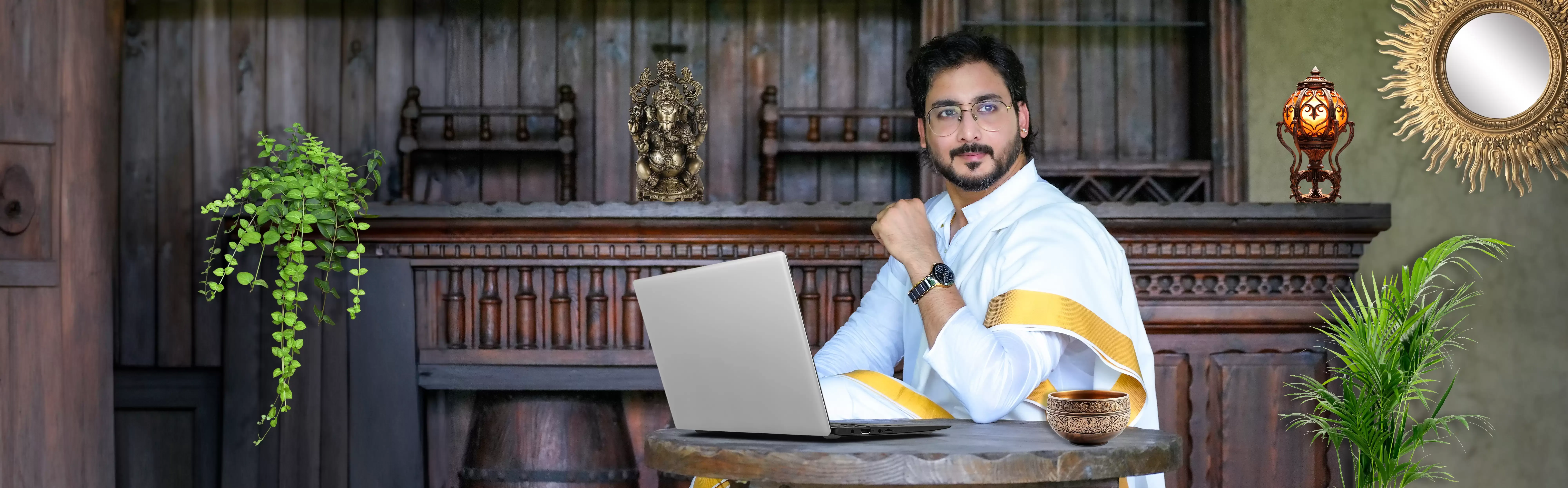
Introduction to Trataka Meditation and Inner Context
The Fragmentation of the Modern Mind
We live in an era where human attention has been commodified, fractured, and sold to the highest bidder. The modern individual wakes up to a barrage of notifications, navigates a day of endless multitasking, and goes to sleep with a mind that refuses to power down. This constant state of cognitive fragmentation is a profound spiritual crisis. When the mind is perpetually jumping from one stimulus to another, it loses its ability to hold a single thought, let alone connect with the deeper, silent layers of the soul. Anxiety, brain fog, and a pervasive sense of inner emptiness are the direct results of a consciousness that has forgotten how to rest. The ancient Rishis of Sanatan Dharma understood that a scattered mind is incapable of perceiving the subtle truths of existence. They prescribed specific, rigorous practices to cure this fragmentation, and among the most powerful of these is Trataka meditation. This practice is a direct antidote to the chaotic vibration of our times, offering a return to the natural, unforced stillness that is our birthright.
The Flame as a Mirror of Consciousness
When you sit before a candle and begin the practice of candle gazing, you are engaging in a profound dialogue between the microcosm of your individual mind and the macrocosm of the universal consciousness. The flame of a candle is unique; it is alive, constantly shifting, yet it remains anchored to its wick. As you gaze at the flame without blinking, you are training your physical eyes to remain perfectly still. But the eyes are not merely optical organs; they are the physical manifestation of the mind's movement. In yogic psychology, wherever the eyes move, the mind follows, and wherever the mind moves, the vital life force, or prana, follows. By arresting the movement of the eyes, you automatically arrest the movement of the mind. This is the secret that makes this practice so remarkably effective. It bypasses the intellectual struggle of trying to force a chaotic mind to be quiet and instead uses the physiological mechanism of sight to gently but firmly command the nervous system to settle. The flame becomes a mirror. As the flame stops flickering in your vision, the turbulent waves of your own consciousness begin to subside, revealing the clear, reflective surface of your true nature.
The Psychological Depth of Single-Pointed Focus
The psychological benefits of achieving this single-pointed focus, known as "ekagrata" in yogic terminology, are immense and far-reaching. When you practice consistently, you are essentially rewiring the neural pathways of your brain. You are moving from a state of high-beta brainwave activity, characterized by stress and anxiety, into alpha and eventually theta states, which are the domains of deep relaxation, creativity, and intuitive insight. This shift is a fundamental restructuring of how your brain processes information. You begin to develop a profound capacity for deep work, sustained attention, and emotional regulation. The reactive patterns that once dictated your emotional responses begin to loosen their grip, replaced by a spacious, observant awareness. You no longer react blindly to the triggers of daily life; instead, you respond from a place of centered clarity. This psychological stability is the necessary foundation for any serious spiritual pursuit, which is why this practice is heavily emphasized in the foundational teachings at Nabatara.
The Spiritual Thirst and the Call of the Lineage
Yet, the benefits of this practice extend far beyond mere psychological well-being or improved productivity. The modern seeker is not just looking for better focus; they are experiencing a deep, unquenchable spiritual thirst. They are searching for meaning, for a connection to something greater than the material world, for a direct experience of the divine. This thirst is the soul's way of calling you back to your source. When you feel this pull, it is time to turn to the unbroken lineage of spiritual masters who have preserved these technologies of consciousness for millennia. The wisdom of Trataka meditation flows directly from this ancient stream, transmitted through the Guru-Shishya parampara, the sacred teacher-disciple tradition. At Nabatara, this lineage is kept vibrantly alive. Under the guidance of Gaurav Tribedi, whose own deep immersion in these practices informs every aspect of our teachings, you are not just learning a technique; you are being initiated into a living tradition. We invite you to explore our occult science programs and step into a current of grace that has flowed for centuries.
The Vedic Foundations: Ancient Knowledge for Today
The Scriptural Roots of Steady Gazing
To truly appreciate the power of this practice, we must look to the ancient scriptures that first codified it. Trataka meditation is not a modern invention or a New Age adaptation; it is a rigorous, time-tested science rooted in the classical texts of Hatha Yoga. The Hatha Yoga Pradipika, one of the most authoritative texts on yogic sciences, explicitly details this practice in its second chapter. The text describes Trataka as the steady gazing at a specific point without winking, declaring it to be the ultimate remedy for all eye diseases and the destroyer of all mental afflictions. Similarly, the Gheranda Samhita categorizes this practice as one of the six essential purification techniques, or Shatkarmas, required to cleanse the physical and subtle bodies before attempting higher states of meditation. These ancient seers understood that the element of fire, represented by the candle flame, has a direct, purifying impact on the human physiology and the subtle energy channels, or nadis.
The Shatkarmas and the Purification of the Vessel
In the framework of Hatha Yoga, the body and mind are viewed as a sacred vessel that must be purified before it can hold the high voltage of spiritual awakening. The Shatkarmas are the six acts of purification designed to cleanse this vessel. Trataka meditation is the final and perhaps the most subtle of these six acts, focusing specifically on the purification of the mind and the subtle sensory organs. While the other purification techniques cleanse the digestive tract and the respiratory system, Trataka cleanses the optical nerves, the brain, and the very fabric of our thought processes. By purifying the eyes and the faculty of sight through steady gazing, the mind receives clear, unadulterated input. This clarity is essential for the awakening of higher intuition. At Nabatara, we emphasize that spiritual practices are about refining the body to its highest potential. In our Vedic astrology course, students learn that a clear mind is the primary instrument for interpreting the complex language of the stars. Without the mental clarity cultivated through practices like Trataka, the subtle nuances of astrological charts remain hidden.
The Guru-Shishya Parampara and the Transmission of Wisdom
While the scriptures provide the theoretical framework, the actual transmission of this practice requires the living breath of a realized master. This is the essence of the Guru-Shishya parampara, the unbroken chain of spiritual transmission that defines Sanatan Dharma. You cannot learn the deepest nuances of Trataka meditation from a book or a video. The practice involves subtle energetic shifts that can only be guided and corrected by a guru who has mastered the practice themselves. When a student sits before a flame under the watchful eye of a master, the guru monitors not just the physical posture but also the subtle energetic state of the student. They know when the student is forcing the gaze, when the mind is slipping into dullness, and when the inner light is beginning to manifest. This personalised guidance prevents the practitioner from falling into common pitfalls, such as straining the eyes or experiencing psychological imbalances. This living transmission is the heartbeat of Nabatara's educational philosophy.
Integrating Ancient Wisdom into Modern Curricula
At Nabatara Institute of Astrology, we have meticulously designed our curricula to ensure that this ancient wisdom is not just preserved but made accessible and applicable to the modern seeker. We understand that the contemporary student has a different lifestyle and different challenges than the ascetics of ancient India. Therefore, we have adapted the presentation of these teachings without compromising their core essence. In our Advanced Tantra Sadhana Course, for instance, Trataka meditation is not taught in isolation. It is integrated into a comprehensive framework of spiritual practices that include mantra repetition, pranayama, and ritual worship. This holistic approach ensures that the practitioner's entire being—physical, mental, and spiritual—is engaged in the process of transformation. The modern seeker needs a structured, supportive environment to sustain a rigorous daily practice, and our courses provide exactly that. By bridging the gap between the ancient ashram and the modern home, we ensure that the light of this wisdom continues to burn brightly in the world.
The Hidden Dimensions: Secrets Only the Sadhaka Knows
The Awakening of the Ajna Chakra
As the practitioner of Trataka meditation deepens their practice, they move beyond the physical act of staring at a flame and enter into the subtle, hidden dimensions of yogic science. The most profound of these dimensions is the activation of the Ajna Chakra, the energy center located at the space between the eyebrows, commonly known as the third eye. The Ajna Chakra is the seat of intuition, inner vision, and higher perception. It is the command center of the subtle body, where the dualities of existence merge into a unified state of awareness. When you gaze steadily at the flame, you are directing your vital energy, or prana, directly toward this center. The physical eyes are connected to the optic chiasm in the brain, which is in close proximity to the pineal and pituitary glands, the physical correlates of the Ajna Chakra. The steady, unbroken flow of attention stimulates these glands, balancing the endocrine system and awakening the dormant potentials of the brain. As the practice matures, the practitioner begins to experience subtle internal phenomena—"flashes of light, geometric patterns, or a profound sense of inner space.
The Inner Light and the Space of Consciousness
One of the most closely guarded secrets of this practice is the transition from external gazing to internal visualization, known as "antar trataka." After gazing at the external flame until the eyes water and can no longer remain open, the practitioner closes their eyes and focuses on the afterimage of the flame at the space between the eyebrows. Initially, this afterimage may be vague, flickering, or colored. But with consistent practice, this internal image stabilizes, becoming as bright and clear as the external flame. This internal flame is known as the Jyoti, the inner light. It is a manifestation of pure consciousness itself. When the practitioner can hold this inner light steadily in their mind's eye without any effort, they have entered the state of Dharana, or profound concentration. In this state, the boundaries of the individual ego begin to dissolve. The practitioner realizes that they are not the one looking at the light; they are the light itself. This realization is a profound spiritual milestone that shifts the identity from the limited, physical body to the infinite, luminous consciousness.
Trataka as a Supreme Astrological Remedy
In the esoteric traditions of Jyotish, or Vedic astrology, the mind is deeply influenced by the planetary forces, or Grahas, that govern our karmic blueprint. An afflicted moon can lead to emotional instability, anxiety, and a lack of mental peace. An afflicted Rahu can create illusions, phobias, and a deeply scattered mind. While external remedies, or "upay," such as wearing gemstones or performing specific rituals, are highly effective, the most powerful remedy is always an internal one. Trataka meditation acts as a supreme internal upay for pacifying the mind and balancing the planetary influences. The steady flame represents the pure, unafflicted energy of the Sun, the source of all light and clarity in the horoscope. By gazing at the flame, the practitioner internalizes this solar energy, strengthening their inner vitality, willpower, and clarity of purpose. Simultaneously, the practice cools and stabilises the lunar energy, bringing emotional balance. This is why Gaurav Tribedi often prescribes this practice to students whose charts indicate severe mental afflictions. To understand how this integrates with your personal chart, we encourage you to explore our numerology and astrological remedies.
The Alchemy of Tears and the Purification of Nadis
Another hidden dimension of this practice lies in the physiological and energetic alchemy that occurs when the eyes begin to water. In the initial stages of Trataka meditation, the eyes will inevitably water, and tears will flow. The uninitiated may view this as a sign of strain or a reason to stop the practice. But the experienced sadhaka knows that these tears are a profound purification. In yogic anatomy, the subtle energy channels, or nadis, are said to be clogged with impurities and stagnant energy. The heat generated by the steady gaze, combined with the cooling effect of the flowing tears, creates a powerful alchemical reaction within the head. This process is said to cleanse the Ida and Pingala nadis, the lunar and solar energy channels that run along the spine. As these channels are purified, the prana is forced to enter the central channel, the Sushumna nadi. When the prana enters the Sushumna, the mind naturally becomes thought-free, and the state of deep meditation arises spontaneously. To fully explore these transformative practices and experience this profound purification under expert guidance, seekers are encouraged to explore our comprehensive spiritual sadhana and tantra courses.
Walking with the Master: Gaurav Tribedi's Teachings and Nabatara's Global Mission
The Lineage of the Shankaracharya Parampara
The authenticity and power of any spiritual teaching are inextricably linked to the lineage from which it springs. At Nabatara Institute of Astrology, the teachings are deeply rooted in the pristine and unbroken tradition of the Sri Jagadguru Shankaracharya parampara. This is a lineage of supreme scholarly and spiritual achievement, dedicated to the preservation and propagation of Advaita Vedanta and the holistic sciences of Sanatan Dharma. To be a part of this lineage is to carry a profound responsibility to maintain the purity of the teachings, ensuring they are not diluted by commercial interests. Tantra Avishikta Gaurav Tribedi, the founder of Nabatara, is a devoted disciple of this sacred lineage. His spiritual authority does not come from self-proclamation but from decades of rigorous, austere sadhana performed under the direct guidance of his own guru. He has internalized the vast ocean of Vedic knowledge, Tantra, Jyotish, and yogic sciences and has been empowered to transmit this knowledge to the next generation. When you learn from Nabatara, you are tapping into the collective spiritual power and wisdom of a lineage that has guided humanity for centuries.
Twenty Years of Sadhana and the Transmission of Diksha
The journey of Gaurav Tribedi is one of profound dedication and relentless spiritual seeking. For over twenty years, he has immersed himself in the depths of spiritual sadhana, mastering the complex and powerful sciences of Tantra, mantra, and yogic meditation. This is not a journey that can be rushed or replicated through superficial study. It requires a complete surrender of the ego, a willingness to face the deepest shadows of the mind, and an unwavering commitment to the truth. Through this intense tapasya, or spiritual austerity, he has not only mastered the techniques but has also realised the underlying consciousness that gives them power. As a guru, his primary role is not merely to impart intellectual knowledge but to transmit spiritual energy, or shakti, to his students. This transmission, known as diksha, is the catalyst that awakens the dormant spiritual potential within the shishya, or disciple. When a student receives diksha from Guruji, they are connected directly to the lineage of masters, and their practice is infused with a grace that accelerates their spiritual evolution exponentially. To understand the depth of this spiritual journey and the profound impact of this lineage, you can discover the full spiritual journey and teachings of Gaurav Tribedi.
The Purity of Intent and the Section 8 Trust
In a world where spiritual teachings are often commodified, packaged, and sold for personal gain, the purity of intent of the teaching institution is of paramount importance. Nabatara Institute of Astrology and Nabatara Foundation operate as a Section 8 not-for-profit organisation registered under the Government of India. This legal structure is not merely a formality; it is a profound reflection of the organization's core values and mission. A Section 8 status mandates that all profits, donations, and revenues generated by the organization must be reinvested solely into the promotion of its objectives, which include the preservation of ancient Vedic traditions, the promotion of holistic growth, and the dissemination of spiritual knowledge. There are no private shareholders, no dividends, and no personal enrichment derived from the spiritual thirst of the seekers. This ensures that the teachings remain pure, accessible, and entirely focused on the spiritual upliftment of the students. When you approach Nabatara, you can do so with absolute trust, knowing that your interaction is with an institution driven by a selfless desire to serve humanity.
A Global Seat of Authentic Learning
While deeply rooted in the sacred soil of India, the wisdom preserved and transmitted by Nabatara is not confined by geographical boundaries. The spiritual thirst is a universal human condition, and the call for authentic, unadulterated Vedic knowledge is echoing across the globe. Over the years, Nabatara has evolved into a global seat of authentic learning, attracting sincere seekers from diverse cultural and geographical backgrounds. The shishyas of Gaurav Tribedi now span across more than fifteen countries, creating a vibrant, international community of practitioners dedicated to the path of spiritual awakening. This global reach is a testament to the universal applicability and profound efficacy of the teachings. Whether a student is sitting in an ashram in West Bengal or practicing in a quiet room in North America, the core principles of the practice remain the same. The institute utilizes a blend of traditional, in-person immersion and modern digital platforms to ensure that the teachings reach those who are genuinely ready to receive them. We invite you to join our global yoga and meditation programs and become part of this transformative community.
Integration, Real-Life Transformations, and Your Next Step
The Integration of Practice into Daily Life
The ultimate test of any spiritual practice is not how profound the experience is while sitting on the meditation cushion but how it transforms the quality of your daily life. The insights gained and the mental clarity cultivated through Trataka meditation must be seamlessly integrated into your everyday actions, relationships, and responses. This integration is where the true alchemy of the practice occurs. When you step away from the candle and return to the demands of your profession, your family, and your social obligations, you carry the stillness of the flame within you. The challenges of life do not disappear, but your relationship to them fundamentally changes. You begin to respond to conflicts with a calm, measured awareness rather than reactive anger. You approach your work with a deep, unbroken focus that yields exceptional results. You interact with your loved ones with a presence and empathy that was previously impossible when your mind was constantly wandering. At Nabatara, we emphasize that spiritual sadhana must result in a more compassionate, effective, and joyful engagement with life.
A Transformation Vignette: Finding Clarity in the Storm
The transformative power of this practice is best understood through the lived experiences of those who have walked this path. Consider the story of a seeker who came to Nabatara a few years ago; let us call him Rohan. Rohan was a highly successful corporate executive, but internally, he was crumbling. He suffered from severe insomnia, chronic anxiety, and a pervasive sense of meaninglessness that no amount of material success could fill. His mind was a storm of relentless, anxious thoughts, and he felt entirely disconnected from his inner self. When he was introduced to the teachings of Gaurav Tribedi and began the disciplined practice of candle gazing, he was initially skeptical. But he committed to the practice, attending the intensive sessions and diligently practicing daily at home. Within the first few months, the changes were subtle but profound. His sleep improved, and the frantic buzzing in his mind began to quiet down. As he continued, the internal light began to manifest during his closed-eye meditation, bringing waves of profound peace and intuitive clarity. He began to see the patterns in his life and his career with startling clarity, making a radical shift toward work that aligned with his deeper values. His story is a testament to the fact that when ancient wisdom is applied with sincerity and discipline, it can radically transform the human experience.
How long should I practice Trataka meditation daily for optimal results?
For a beginner, it is highly recommended to start with a duration of ten to fifteen minutes of external gazing per day. Consistency is far more important than duration when you are first training the mind and the optical nerves. As your eyes become accustomed to the practice and your concentration deepens, you can gradually extend the time to twenty or thirty minutes. The key is to practice daily without straining the eyes. If you feel significant discomfort, it is better to stop and rest than to force the gaze, which can create tension. Over time, as the practice becomes effortless, the duration will naturally expand, and the transition to internal meditation will occur more smoothly.
Can Trataka meditation cure eye problems or improve physical eyesight?
According to classical yogic texts like the Hatha Yoga Pradipika, this practice is indeed said to be highly beneficial for eye health and can help alleviate certain minor eye disorders. The steady gazing exercises the ciliary muscles of the eyes, improves blood circulation to the optical nerves, and stimulates the tear glands, which helps in cleansing and lubricating the eyes. However, it is crucial to understand that this is a spiritual and yogic practice, not a medical treatment. If you have a serious medical condition, such as glaucoma, severe myopia, or retinal issues, you must consult an ophthalmologist before beginning the practice. The primary goal of this sadhana is mental and spiritual purification, with physical eye benefits being a secondary, supportive outcome.
What should I do if my eyes start watering intensely during the practice?
The watering of the eyes is a completely natural and expected physiological response to keeping the eyes open without blinking for an extended period. In the context of yogic science, these tears are considered highly purifying, helping to cleanse the optical nerves and the subtle energy channels in the head. When your eyes begin to water heavily, or when you feel a strong urge to close them, this is the exact moment to gently close your eyes and transition to the internal practice. Focus your attention on the space between your eyebrows and observe the afterimage of the flame. Do not rub your eyes or force them to stay open beyond your comfortable limit. Allow the tears to flow naturally, as this release is an integral part of the purification process.
Is it necessary to have a guru to learn Trataka meditation safely?
While it is possible to learn the basic physical mechanics of the practice from a book or a reliable online source, having the guidance of a realized guru is highly recommended for experiencing the deeper, transformative dimensions of the sadhana. A guru provides essential corrections to your posture, gaze, and mental focus, preventing you from developing bad habits or straining your eyes. More importantly, the Guru transmits the subtle spiritual energy, or Shakti, that awakens the inner potential of the practice. They also guide you through the complex psychological and subtle experiences that arise as your consciousness expands, ensuring that you navigate the inner journey safely and effectively. For personalized guidance, you can book a personalized puja and spiritual consultation with our experts.
How does candle gazing connect to astrological remedies and planetary pacification?
In Vedic astrology, the mind and its fluctuations are deeply governed by the Moon, while illusions and mental anxieties are often linked to Rahu. The steady, pure light of the candle flame represents the unclouded energy of the Sun, which brings clarity, vitality, and spiritual illumination. By gazing at the flame and internalizing its light, the practitioner strengthens their inner solar energy and stabilizes the lunar energy, bringing emotional balance and mental peace. This practice acts as a powerful internal remedy, or "upay," that pacifies the negative influences of afflicting planets. It burns away the smoke of illusion created by Rahu and strengthens the willpower and clarity associated with a strong sun. To see how this aligns with your personal environment and chart, we recommend you book a personalized Vastu Shastra consultation.
When will I start seeing the internal light during closed-eye meditation?
The timeline for experiencing the internal light, or Jyoti, varies greatly from person to person and depends on the purity of the mind, the consistency of the practice, and the individual's karmic blueprint. For some highly focused practitioners, a faint afterimage may be visible immediately after closing the eyes. For others, it may take weeks or even months of daily, disciplined practice for the internal light to become stable and bright. It is important not to chase the experience or become frustrated if the light does not appear immediately. The practice itself is the goal. By maintaining a steady, patient, and surrendered attitude, the inner vision will naturally awaken in its own perfect time, revealing the luminous nature of your own consciousness.
The Invitation to Step Into the Light
The path of spiritual awakening is not for the faint of heart, nor is it for those who seek only superficial comforts. It is a path for the brave, for the sincere, and for those who recognize that the ultimate truth of existence lies within. The practice of Trataka meditation is a profound, time-tested key that can unlock the doors to inner peace, razor-sharp focus, and awakened intuition. But a key is only as useful as the hand that turns it. You must be willing to sit, to gaze, to endure the initial discomfort, and to surrender to the transformative fire of the practice. At Nabatara Institute of Astrology, we have dedicated our lives to preserving this sacred knowledge and making it accessible to those who are genuinely ready to receive it. Under the compassionate and authoritative guidance of Gaurav Tribedi, you will find not just a set of techniques but a living, breathing spiritual family dedicated to your highest good. We invite you to take the next step on your journey. Whether you are seeking to deepen your knowledge by exploring authoritative Vedic scriptural sources or you are ready to take action, our doors are open to you. Visit us at nabatara.com and enrol in our upcoming batch today. The flame is burning, the lineage is waiting, and your true self is calling you home.