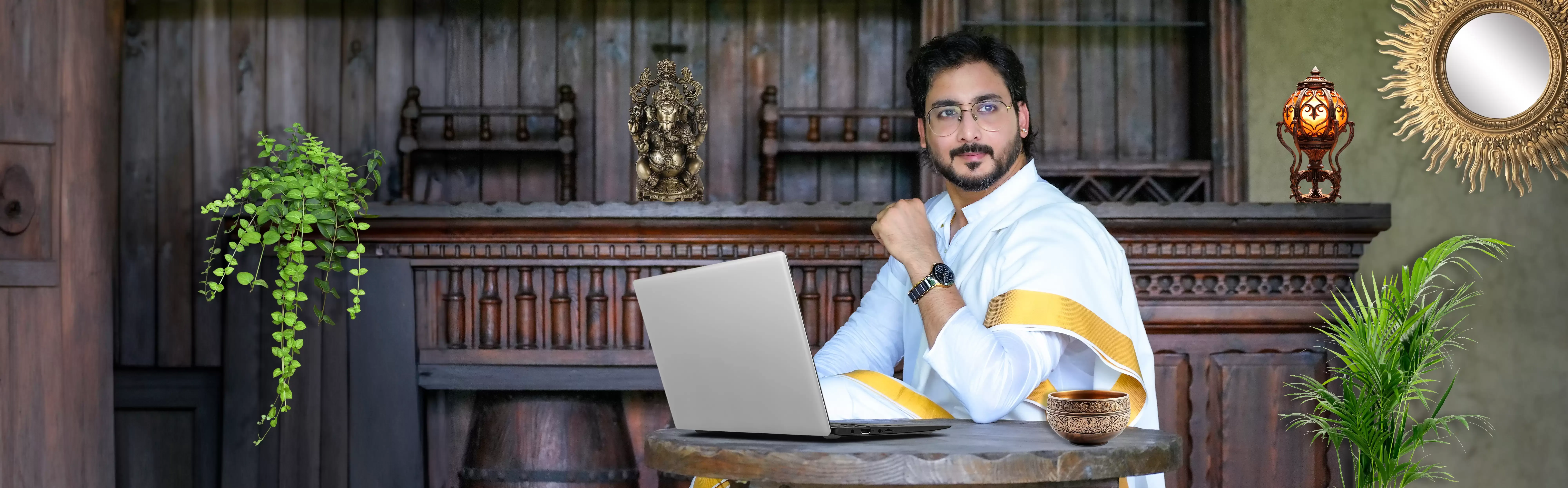
When the Grahas Whisper Your Name
The first time you saw a birth chart—perhaps your own—something shifted. Those nine Grahas placed across twelve houses, the curved lines of the rashi chakra... they looked like a secret map. And somewhere inside, a quiet voice whispered, "This is not just information." This is a calling. You are not alone. Every year, hundreds of sincere seekers write to us at Nabatara Institute saying the same thing: I have been studying astrology from books and YouTube for three years, but I feel hollow. I can calculate dashas, but I cannot see the soul in the chart. How do I turn this into a real career that honors the tradition? That question—raw, honest, and aching—is the seed of our discussion today. Because how to build a successful career in Vedic astrology in 2026 is not a technical problem. It is a spiritual question. And it can only be answered by someone who has walked the path of the rishis, not just the path of the market.
We are living in extraordinary times. More people than ever are turning to Jyotish because modern life has left them disconnected from their own inner sky. Anxiety, broken relationships, and career confusion—these are not random. They are the language of the Grahas trying to speak. And the world needs genuine astrologers who can translate that language with compassion, accuracy, and a living connection to the source. But here is the crisis that no one talks about: ninety percent of those calling themselves Vedic astrologers today have never received a proper diksha from a parampara master. They have memorized techniques but not purified their own vision. As a result, their readings cause more confusion than healing. This is why, at Nabatara, founded by Tantra Avishikta Gaurav Tribedi, a devoted disciple of the Sri Jagadguru Shankaracharya lineage, we do not simply teach astrology as mathematics. We initiate you into it as a sadhana—a spiritual discipline that transforms both the astrologer and the seeker.
Let me tell you about a young woman from Pune who came to us two years ago. She had completed three online certification courses from popular platforms. She knew the names of nakshatras, could cast a chart in five minutes, and had even started a small Instagram consultation page. But every time a client sat in front of her, she felt a knot in her stomach. She did not know how to handle a person crying over a failed marriage. She did not understand why the same planetary placement could bring wealth to one person and ruin to another. She was terrified of giving wrong predictions. That terror is not a sign of weakness—it is a sign of conscience. She had the heart of an astrologer but not the inner purification that allows the Grahas to speak through you. When she joined Nabatara Tantra & Sadhana Courses under Guruji Gaurav Tribedi's guidance, the first thing he told her was, "Stop calculating. Start listening. The chart is not a puzzle to solve. It is a living being asking for recognition.
Why 2026 Is the Year of the Jyotishi
This is the central truth that separates a career built on sand from one built on the bedrock of Sanatan Dharma. Vedic astrology is not a fortune-telling gimmick. It is one of the Vedangas—the limbs of the Vedas. Its purpose is not to predict your next promotion. Its purpose is to show you the karmic flow that your soul has chosen so you can navigate it with awareness instead of resistance. When you understand this, you stop feeling pressure to be "always right" and start feeling gratitude for being a channel. That shift alone changes everything. And that shift cannot come from a PDF or a recorded lecture. It must come from a living parampara—"a chain of masters who have passed the subtle transmission of this knowledge, breath by breath, for thousands of years. Gaurav Tribedi received this transmission directly from his Guru in the Shankaracharya lineage. And through Nabatara, a Section 8 nonprofit run entirely for the sake of preserving and spreading authentic wisdom, he offers that same transmission to serious shishyas who are ready to make astrology their dharma.
So why 2026? Because the planetary alignments of the coming years are creating a unique window. Saturn's transit through Aquarius, Jupiter's movement into Cancer, and the ongoing eclipse patterns are accelerating a global hunger for spiritual guidance. Many people who never believed in astrology are now knocking on doors. At the same time, artificial intelligence is flooding the internet with automated horoscopes"cold, soulless, and often harmful. The world does not need more algorithms. It needs human beings who have done their own inner work, who can sit with a suffering person and feel the Grahas moving inside their own pulse. That is the kind of career we are speaking about. Not a side hustle. A vocation. A tapasya. And yes, it can also provide a dignified living"but only when the foundation is authentic. In the following sections, we will walk you through everything: the scriptural roots, the hidden dimensions that only a sadhaka knows, the teachings of Gaurav Tribedi that have transformed shishyas from over fifteen countries, and the practical steps to integrate this into a life of service and sustainability. You have arrived at the right doorstep. Now let us open the door together.
The Vedic Foundations—What Parashara and the Gurus Actually Taught
To build a career that lasts, you must first understand what Vedic astrology actually is. Not the watered-down version you see on pop culture websites, but the full, living tradition known as Jyotish Shastra. The word "Jyotish" comes from "jyoti," "light." An astrologer is not a predictor. A Jyotishi is one who brings light into darkness. And that light has three distinct sources. First, mathematical precision—the ability to calculate planetary positions, dashas, and yogas correctly. Second, intuitive perception"the capacity to see the story behind the numbers. Third, spiritual grace—the blessing of one's ancestors, one's guru, and one's own sadhana. All three are equally necessary. Most commercial courses give you the first and pretend the other two do not exist. That is why their students fail. They have tools but no inner eyes.
The foundational scripture of Jyotish is the Brihat Parashara Hora Shastra, dictated by Sage Parashara to his disciple Maitreya thousands of years ago. In its verses, Parashara repeatedly emphasizes that astrology is not a secular art. It is a divine science that only bears fruit when the astrologer is pure in conduct, regular in mantra sadhana, and devoted to his or her Guru. One famous verse says, "Without the grace of the Guru, even the most learned astrologer will make mistakes that cause harm. That is not poetry; it is a practical warning. Because the Grahas are conscious forces. When you speak their language without proper diksha, you can attract their negative influences into your own life and the lives of your clients. This is why at Nabatara, our Jyotish Foundation Program is not just a course. It is a transmission. Before you learn how to read a chart, you learn how to sit in meditation with the nine Grahas, how to offer them respect, and how to purify your own mind so that you become a clean mirror. Only then do we open the mathematical texts.
Another essential source is the Tajika Neelakanthi for annual horoscopes and the Jataka Tattva for deeper psychological insights. But the crown jewel remains Parashara's system of Vimshottari Dasha, which maps out the timing of life events with breathtaking accuracy. A serious career astrologer must not only compute dashas but also feel their rhythm. For example, when a client is running Mercury Dasha, you need to know not just that Mercury rules communication and business, but also that Mercury is a Graha that becomes extremely sharp or extremely scattered depending on the nakshatra and the astrologer's own state of awareness. A distracted astrologer will see only surface patterns. A sadhaka will see the exact karmic knot that needs loosening. This is the difference Nabatara makes. We teach from the original Sanskrit commentaries, line by line, but we also teach the inner hearing, "the shruti," that allows you to know when a prediction is correct because your own pulse confirms it.
How Nabatara Preserves the Unbroken Guru-Shishya Transmission
Let me give you a concrete example from our training. One of the most common questions in consultations is about marriage timing. A beginner astrologer looks at the 7th house, its lord, and the Dasha period. If Venus or Jupiter is involved, they predict marriage. But then the client returns two years later, still unmarried, frustrated, and angry. What went wrong? The beginner did not check the condition of the upachaya houses, the ashtakavarga bindus, or the karma linked to the 7th lord from the Moon and from the Navamsa. More importantly, they did not ask, "Is this soul meant to marry in this lifetime?" Some charts show a strong 7th house but also strong indications of sannyasa or karmic isolation. A real astrologer must have the courage to say, "Marriage may not be the path for you. Let us find your true dharma instead. That honesty, born from deep study and deeper compassion, is what builds a loyal, grateful client base. And that honesty cannot be faked. It comes only from training in an unbroken Guru-Shishya lineage.
Nabatara offers several structured pathways. For those completely new, the Jyotish Foundation Program covers Graha basics, rashi lordships, bhava interpretation, and the essential Yogas of wealth, health, relationships, and spirituality. For intermediate students, the Advanced Predictive Techniques course dives into Ashtakavarga, Jaimini Karakas, and Tajika annual charts. And for those called to the highest level, Nabatara Tantra & Sadhana Courses integrate Jyotish with mantra initiation, yantra worship, and remedial upay—the practical methods to pacify afflicted grahas. Every course is taught by shishyas who have completed years of personal sadhana under Gaurav Tribedi's direct supervision. There are no shortcuts. But there is a clear, ancient path.
Now, you might ask, "Can I learn all this online?" The answer is yes and no. The foundational knowledge—the mathematical rules, the planetary characteristics, the dasha calculations—can absolutely be transmitted through well-structured online classes. Nabatara has been doing this successfully since 2018, with shishyas from the United States, Brazil, Germany, Australia, Singapore, and across India. Our online platform includes live lectures, recorded sessions, practice chart discussions, and personal mentorship calls. However, the diksha—the spiritual activation that makes you a true Jyotishi—requires an in-person element or at least a direct mantra transmission from the guru. Gaurav Tribedi offers this through special initiation retreats at the Nabatara ashram in West Bengal. Once you receive that, even your online consultations will carry the parampara's grace. Without it, you will always feel like you are missing the last piece of the puzzle. That is not a sales pitch; it is a statement of fact that every senior astrologer will confirm.
As you build your career, the scriptural foundations will serve as your anchor. When a client asks, Why is this happening to me? You will not answer with your opinion. You will answer with Parashara's verses, with examples from the Ramayana and Mahabharata that illustrate similar planetary patterns. You will become a living bridge between ancient wisdom and modern suffering. And people will trust you because they can feel the weight of tradition behind your words. That is the kind of career that no algorithm can replace. That is the career we are building at Nabatara, together with serious seekers like you.
The Hidden Dimensions—Secrets Only the Sadhaka Knows
If you have been studying astrology for a while, you may have noticed something strange. Two people with almost identical charts—same lagna, same Graha placements, same dashas—can have completely different lives. One rises to fame and fortune. The other struggles quietly with the same challenges. Why? This is the mystery that separates mechanical astrology from the living tradition. The answer lies in three hidden dimensions: the prarabdha karma that each soul brings, the ancestral blessings or pitru dosha that modify planetary effects, and the level of spiritual practice of the individual themselves. A sadhaka astrologer learns to see these dimensions. A textbook astrologer misses them entirely.
Karma, Ancestors, and the Unseen Graha Modifiers
Let us take the first hidden dimension: prarabdha karma. Parashara teaches that your birth chart is a photograph of the karma you have already set in motion from past lifetimes. But here is the secret: the photograph can be developed differently depending on the quality of the film. The film is your own consciousness. If you have been doing mantra sadhana, meditation, and service, your consciousness becomes more refined, and even a difficult planetary transit like Saturn return or Rahu Dasha will manifest as a period of intense spiritual growth rather than catastrophe. If your consciousness is dull or arrogant, the same transit will hit you like a storm. When you sit for a consultation, a client's prarabdha is fixed, but their response to it is not. A great astrologer does not just describe the storm. They prescribe the inner practices that will allow the client to dance in the rain. This is why Nabatara's training includes daily meditation, Graha mantras, and the study of the Bhagavad Gita—because you cannot guide others through their karma if you are still fighting yours.
The second hidden dimension is ancestral influence. In the Vedas, the "pitris"—our departed ancestors—are considered co-authors of our destiny. If there are unresolved debts or curses in the family line, they will show up in your chart as certain combinations: for example, the 9th house and its lord afflicted, or the presence of Ketu with a malefic in the 5th house. Many mainstream astrologers see these combinations and say, "Perform a Shanti puja," without ever checking whether the client has actually honored their ancestors through regular tarpanam and feeding of Brahmins. At Nabatara, we teach you to ask the deeper questions: When did your family stop doing annual rituals? Was there a suicide or an accidental death three generations ago? Is there a woman in your lineage who was denied her rightful inheritance? These are not therapy questions; they are Jyotish questions. The Grahas record everything. Once you uncover the ancestral wound, the remedy becomes clear. And as an astrologer, you will be able to offer not just a puja recommendation but a full ancestral healing process, which creates profound shifts in your clients' lives. Those clients become your lifelong shishyas. They send their friends and family. Your career grows organically, from the heart.
Kundalini and the Living Grahas: The Tantric Core of Jyotish
The third hidden dimension is the most powerful and the most hidden: the Kundalini state of the astrologer themselves. This is where we enter the tantric core of Jyotish. According to the Tantraloka by Abhinavagupta, the Grahas are not separate from the chakras. Surya (Sun) corresponds to the Manipura chakra, Chandra (Moon) to the Swadhisthana, Mangala (Mars) to the Muladhara, Budha (Mercury) to the Vishuddhi, Guru (Jupiter) to the Ajna, Shukra (Venus) to the Anahata, Shani (Saturn) to the Sahasrara, and the nodes Rahu and Ketu to the two side channels, Ida and Pingala. When your Kundalini is asleep, you see the Grahas as distant objects. When it begins to rise, you feel them inside your own body. A client asks about Shani, and you feel a pressure at the crown of your head. A question about Venus arises, and your heart center expands. This is not imagination—"this is the direct perception that only comes after years of sadhana under a living guru. Gaurav Tribedi has spent over twenty years in precisely this sadhana. He teaches his advanced shishyas how to feel each Graha in their subtle body before interpreting it in a chart. The result is readings that leave clients breathless with recognition. How did you know that? they ask. And the honest answer is because I felt it.
Most commercial astrology courses will never mention Kundalini. They are afraid of it, or they do not understand it. But without this dimension, you are practicing astrology with one arm tied behind your back. You will always wonder why your predictions miss the mark occasionally, why some clients never come back, and why you feel exhausted after a few consultations. The exhaustion comes because you are using your personal prana to read the chart instead of channeling the universal prana through a purified vehicle. At Nabatara, we teach specific breathing techniques and bija mantras for each Graha that build your capacity to receive information without depletion. For example, the mantra Om Sham Shanaishcharaye Namah chanted 108 times before a consultation not only pacifies Saturn in the client's chart but also creates a protective shield around you. After two years of consistent practice, you can sit for six hours of back-to-back readings and feel more energized than when you started. That is the secret of the sadhaka astrologer.
So when you think about how to build a successful career in Vedic astrology in 2026, do not think only about marketing strategies or pricing models. Think first about how deep you are willing to go inside yourself. The external success is a natural byproduct of internal clarity. The Grahas reward those who honor them, who serve them, and who do not use them for cheap entertainment or ego gratification. If you approach this path with humility, if you seek a true guru, and if you commit to daily sadhana, then doors will open that you cannot even imagine right now. That is not a promise"it is a law of the spiritual universe. And it has been verified by every genuine Jyotishi from Parashara to the present day.
Walking with the Master—Gaurav Tribedi's Teachings and Nabatara's Global Mission
Now we arrive at the heart of the matter. You have understood the foundations. You have glimpsed the hidden dimensions. But the bridge between knowing and being is a living master. In the Shankaracharya parampara, it is said, "Guru bin gati nahi"—without the Guru, there is no progress. This is not a dogma. It is a practical observation. Try to learn swimming from a book. You can memorize every stroke and every breathing technique. But the moment you enter deep water, panic takes over. You need someone who has already swum those waters, who can hold you when you sink, and who knows exactly when to push you and when to let you float. Similarly, in Jyotish, you will make mistakes that cost people their peace of mind. A guru like Gaurav Tribedi catches those mistakes before they reach the client. He sees the blind spots in your own chart that color your interpretations. He gives you personal mantras to clear those blind spots. This is why no serious astrologer in history has ever emerged from a correspondence course alone. Always, always, the great ones sat at the feet of a master.
From Seeker to Tantra Avishikta: "A Lineage of Living Light"
Gaurav Tribedi's journey is itself a living testimony to the power of the parampara. Born into a family with no particular astrological background, he felt from childhood an inexplicable pull towards the stars. By his teenage years, he had memorized the planetary positions for decades ahead. But his readings were inconsistent—"brilliant one day, confusing the next. At twenty, he met his guru, a sannyasi in the Sri Jagadguru Shankaracharya lineage, who looked at his chart and said, "You have the eyes of a Jyotishi but not the heart. Your heart is blocked by past-life guilt. Come, sit with me. I will remove the block. For the next twelve years, Gaurav Tribedi underwent intense sadhana: twelve hours of meditation daily, recitation of the complete Aditya Hridayam every morning, ceremonial worship of the nine Grahas in a fire ritual that took seven days to complete, and pilgrimage to all 51 Shakti Peethas. In 2012, his guru gave him the title Tantra Avishikta"—one who has been initiated into the inner secrets of tantra. From that moment, his readings became effortless. He could look at a chart and see not just the current Dasha but the exact sequence of events from three lifetimes ago that led to this moment. He began teaching, and within five years, hundreds of students from across India were seeking his guidance. Out of that natural growth, the Nabatara Institute was born.
About Gaurav Tribedi—"Full Journey" will give you the complete story, including photographs from his initiation and videos of his lectures. But let me share what his shishyas say about him. A doctor from London wrote to us: Before meeting Guruji, I was using astrology to avoid my own pain. I would hide behind charts. Guruji looked at me and said, Stop interpreting other people's karma. Interpret your own first. That sentence changed everything. I went into therapy and started a daily mantra practice, and only then did my consultations begin to heal others. A software engineer from Bangalore shared, I had studied Jyotish from six different teachers. But every time I predicted something negative, I would feel sick to my stomach. Guruji explained that I was carrying the negative energy of my predictions because I had no protection. He initiated me into a simple three-minute Nyasa before each reading. The sickness stopped. My confidence grew. Now I have a full-time practice with a waiting list. These are not isolated miracles. This is the parampara at work.
The Nabatara Method—Sadhana, Service, and Skill
The Nabatara method is unique in three ways. First, we do not separate astrology from sadhana. In every class, we begin with a collective meditation and a short Graha mantra. Second, we require our shishyas to keep a journal of their own life events correlated with their own chart—self-analysis is the foundation of helping others. Third, we emphasize the practical application of upayâ—remedies like gemstones, yantras, donations, fasting, and specific actions—that actually work because they have been tested in the master's own life and in the lives of thousands of previous shishyas. Many other institutes teach remedies as an afterthought. At Nabatara, remedies are half the curriculum. Because what good is a diagnosis without a prescription?
Our shishyas now come from over fifteen countries. The Institute operates as a Section 8 nonprofit—meaning every rupee from course fees goes directly into preserving the Guru-Shishya tradition, maintaining our small ashram, and offering free or subsidized training to economically disadvantaged seekers from rural West Bengal and Odisha. There is no profit motive. There is only the mission: to keep the flame of authentic Jyotish alive for the next generation. When you join a course at Nabatara, you are not just buying an education. You are becoming part of a lineage that stretches back to the rishis. You are receiving blessings that have been accumulated and passed down through thousands of initiations. That cannot be measured in money. It can only be received with gratitude.
Gaurav Tribedi often says, "The career is not the goal. The sadhana is the goal. When your sadhana is pure, the career comes looking for you. He is right. In 2026, the opportunities for Vedic astrologers will be wider than ever. You can offer one-on-one consultations both locally and globally via Zoom. You can create a YouTube channel or a podcast explaining planetary transits in simple, compassionate language and build a following that supports you through membership platforms. You can write books or e-courses. You can teach at yoga studios, wellness retreats, and corporate mindfulness programs. You can become a researcher, documenting case studies that demonstrate the validity of Jyotish in fields like psychology and medicine. You can even collaborate with developers to create ethical, non-automated astrological software. All of these are real careers that real Nabatara shishyas are already pursuing. But each of them will tell you the same thing: none of it would have been possible without the Guru's grace and the solid foundation of authentic training.
So if you feel that inner pull—that quiet whisper that says, "This is your path"—do not ignore it. Do not settle for shallow courses or self-teaching that leaves you anxious. Give yourself the gift of walking with a master. Give yourself the gift of Nabatara.
Walking the Path: Integration, Real-Life Transformations, and Your Next Step
We have covered a vast territory together. From the sacred call of the Jyotishi to the scriptural foundations, from the hidden dimensions of karma and Kundalini to the living grace of Gaurav Tribedi's parampara. Now comes the most important part: what do you actually do from Monday morning? Integration is everything. You can read ten thousand words and still take no action. The difference between a seeker and a sadhaka is the step into practice. So let me offer you a simple, practical summary, followed by answers to the questions that are likely in your mind right now, and finally, a clear invitation to begin.
The path to a successful career in Vedic astrology in 2026 has five pillars. First, find authentic training that includes not only technique but also spiritual discipline. Second, receive direct diksha from a qualified guru in a recognized parampara. Third, practice on your own chart and on the charts of close friends for at least six months before charging any fee. Fourth, develop a daily sadhana that keeps your perception clean—even fifteen minutes of mantra and meditation can transform your readings. Fifth, treat astrology as a service, not a business. When you serve, abundance follows naturally. These five pillars cannot be skipped or shortened. But each one is achievable if you commit.
Frequently Asked Questions by Serious Aspirants
What is the minimum qualification to enroll in Nabatara's astrology courses?
No previous astrological knowledge is required, but a sincere interest in spirituality and a willingness to follow the Guru's instructions are essential. You need a steady internet connection for live classes, about five to seven hours per week for study and practice, and an open heart. Our oldest shishya is sixty-eight years old; our youngest is eighteen. The only disqualification is arrogance—if you think you already know everything, you will learn nothing. Come as an empty cup, and we will fill it.
How long does it take to become a confident professional astrologer through Nabatara?
Most shishyas complete the foundational and advanced courses within eighteen to twenty-four months. After that, they spend another six months doing supervised practice readings under senior mentors. By the end of year two, they are usually ready to take on paying clients with confidence. However, some students move faster "if they already have a background in meditation or Sanskrit," and some take longer. The parampara does not rush. Quality over speed. Remember that the world will trust you only as much as your training deserves.
Can I really earn a full-time living as a Vedic astrologer in 2026?
Yes, absolutely, if you approach it professionally. Many Nabatara shishyas charge between two thousand and five thousand rupees per consultation (or between fifty and one hundred dollars internationally). With an average of fifteen to twenty consultations per week—perfectly sustainable without burnout—the income is more than respectable. Additionally, income from recorded courses, group mentoring, and digital products can easily double that. But we always caution: do not start with the money goal. Start with the service goal. Help enough people, and the money will follow. That is not a cliché; it is a tested principle.
What is the difference between Nabatara's training and a university degree in Jyotish?
Several universities in India offer diploma and degree courses in astrology. They are excellent for theoretical knowledge, Sanskrit slokas, and historical context. However, they rarely include the tantric practices"mantra initiation, meditation techniques, and energy protection"that are essential for becoming a healer rather than just a calculator. Nabatara fills that gap completely. Many of our shishyas have actually completed university degrees and then come to us because they felt something missing. The ideal path is to do both: the academic degree for credentials and Nabatara for the living transmission.
Do I need to learn Sanskrit to become a professional astrologer?
Not at the beginning. We teach you the essential terms and mantras in Devanagari script, but we also provide transliterations and translations. Over time, many shishyas choose to learn Sanskrit because it opens the original commentaries and gives a much deeper understanding. However, it is not a prerequisite for starting or even for building a successful practice. What is a prerequisite is a clean pronunciation of the bija mantras, and that is what we train you in personally, word by word.
How do I handle difficult predictions or a client who becomes emotional during a reading?
This is exactly where the parampara training shows its value. In our courses, we devote entire modules to ethical communication, trauma-informed listening, and knowing when to refer a client to a therapist or a doctor. A Vedic astrologer is not a replacement for mental health care. You are a guide to karmic patterns. When a client cries, you do not panic. You sit with them, offer water, suggest a simple remedy like lighting a lamp or chanting a mantra together, and remind them that every Graha's difficult period ends. More importantly, your own sadhana gives you the emotional stability to hold space without drowning in their pain. That is a skill that develops with practice and grace.
A Glimpse of Transformation: From Banker to Beloved Jyotishi
Let me share a brief transformation vignette—real, though the name is changed for privacy. Rajesh, a forty-two-year-old banker from Kolkata, had been studying astrology from books for seven years. He could recite the longitude of every planet for any given date. But his family laughed at him when he said he wanted to become an astrologer. You have no degree in it, they said. Who will trust you? Frustrated and doubting himself, he joined Nabatara's Jyotish Foundation Program. Within three months, under Gaurav Tribedi's direct mentorship, he learned not only how to read a chart but also how to perform a simple Graha shanti ritual for himself. His own anxiety—which had been diagnosed as clinical—dropped by half. He began offering free readings to colleagues at his bank. Word spread. Within a year, he was asked to resign from banking because his astrology practice was earning him triple his salary. Today, Rajesh runs a full-time consultation practice, teaches a small batch of students in his local language, and donates ten percent of his income to Nabatara's scholarship fund. His story is not unique. It is the natural result of combining authentic knowledge with sincere practice.
Your Next Step: A Clear and Heartfelt Invitation
So here is your next step. You have read this far. Something in you has resonated. That resonance is not accidental—it is your own Grahas guiding you towards the right source. You can continue browsing, continue doubting, and continue waiting for the perfect time. Or you can act now. The world is crying for genuine Jyotishis—men and women who can sit with suffering and turn it into understanding, who can take a person's confusion and reveal the karmic thread that makes sense of it all. That person could be you. But only if you step onto the path.
Visit nabatara.com today. Explore our upcoming batch for the Jyotish Foundation Program—seats are limited because we keep class sizes small to ensure personal attention. You will find a simple contact form, and one of our senior shishyas will reach out within twenty-four hours to answer any remaining questions. You can also schedule a fifteen-minute clarity call with a mentor. There is no pressure, no hard selling. Only a genuine invitation to see if this is your dharma. If it is, we will walk together. If it is not, we will bless you and point you to other authentic resources. Either way, you will leave with more clarity than you came with.
The stars have been waiting for you. The Guru has been waiting for you. Your future shishyas—the people whose lives you will change—are also waiting, though they do not know your name yet. Do not make them wait too long. Take the step. Start building your sacred career in Vedic astrology in 2026. And let Nabatara be the ground beneath your feet.