

Discover Which Deity Is Worshipped First
D iscover the profound truth behind Vedic ritual order and sacred worship. Ancient scriptures reveal Agni as the divine messenger who carries our prayers upward. Later traditions honor Ganesha as the remover of obstacles. Learn how this sacred sequence transforms your spiritual practice and inner peace today.
Published Date: 06 May 2026
Frequently Asked Questions
Why we are India's Best Astrology & Tantra Sadhna Institute
At Nabatara, we are committed to providing the best possible education and training in astrology, numerology, and related fields. Our team of experienced professionals is dedicated to helping you achieve your goals and improve your life.

Agni, the Vedic fire deity, is traditionally invoked first in a Vedic yajna or fire sacrifice. He occupies a central position because he receives the offerings made into the sacred fire and is regarded in Vedic tradition as the divine messenger who carries them to other deities. The Rig Veda begins with a hymn dedicated to Agni, highlighting his importance in Vedic worship. He is also described as the priest of the gods and the intermediary between human beings and the divine. However, it is important to distinguish a traditional Vedic yajna from the forms of puja commonly performed in Hindu homes and temples today. In many later Puranic and Tantric worship traditions, Lord Ganesha is invoked first because he is revered as Vighnaharta, the remover of obstacles. Therefore, the answer depends on the ritual tradition being followed. For a traditional Vedic fire sacrifice, Agni has the primary opening role, while Ganesha commonly receives the first invocation in many contemporary Hindu pujas.
Agni is invoked first in a traditional Vedic yajna because he serves as the sacred medium through which offerings are presented to the deities. In Vedic understanding, Agni is more than the physical element of fire. He represents divine presence, transformation, and communication between the human and celestial worlds. When ghee, grains, or other prescribed offerings are placed into the sacrificial fire, Agni is understood to receive them and convey them to their intended divine recipients. This intermediary function explains his importance in Vedic ritual procedures. The opening hymn of the Rig Veda, known as Rig Veda 1.1, is addressed to Agni and describes his role as the priest and divine messenger. Invoking Agni therefore establishes the sacrificial fire as the central focus of the ceremony. His position also reflects the importance of correct preparation, sacred intention, and ritual discipline. Within the Vedic tradition, beginning with Agni, it acknowledges the principle that the fire is essential to the structure and spiritual symbolism of a yajna.
Lord Ganesha is commonly worshipped before other deities in many contemporary Hindu pujas, while Agni has the primary opening role in traditional Vedic fire sacrifices. These practices belong to related but distinct ritual contexts. Ganesha is known as Vighnaharta, meaning the remover of obstacles, and is honored before important undertakings, ceremonies, and devotional worship. His invocation expresses the devotee's wish for an auspicious and unobstructed beginning. Agni, on the other hand, is central to Vedic yajna because the sacred fire receives offerings and serves as the intermediary through which they are presented to the gods. Consequently, saying that Ganesha must always be worshipped first in every Vedic ritual oversimplifies the historical and textual differences between Hindu worship traditions. Similarly, saying that Agni must always receive the first worship in every modern puja overlooks established Puranic and Tantric practices. Understanding the ritual's specific tradition, purpose, and prescribed procedure is the best way to determine which deity is invoked first.
Vedic yajna and Puranic puja are two forms of Hindu religious practice that differ in their textual foundations, ritual structures, and methods of worship. A Vedic yajna traditionally centers on a consecrated fire, prescribed mantras, ritual offerings, and the participation of trained priests following particular Vedic procedures. Agni plays an essential role because offerings are placed into the fire and presented to the intended deities through him. Puranic puja, by contrast, commonly involves worship of a particular deity through practices such as invocation, offerings of flowers, incense, food, lamps, and devotional prayers. Lord Ganesha is frequently invoked at the beginning of these ceremonies as the remover of obstacles. Some contemporary Hindu rituals combine elements from different traditions, so their procedures may overlap. The distinction matters when discussing which deity is worshipped first. A Vedic fire sacrifice and a household puja should not automatically be treated as identical ceremonies. Understanding their respective traditions helps devotees appreciate the significance of Agni, Ganesha, and the different forms of Hindu worship.
Agni is one of the most important deities in the Rig Veda, where he represents sacred fire, divine communication, and the transformative power associated with Vedic sacrifice. His significance is immediately apparent because the first hymn of the Rig Veda, Rig Veda 1.1, is dedicated to him. The hymn describes Agni as the priest of the sacrifice, the divine messenger, and the one who brings the gods to the ritual. Agni has several interconnected roles in Vedic understanding. He is the visible sacrificial fire, the recipient of offerings and the intermediary through whom offerings reach other deities. He is also associated with household life, illumination, and the continuity of sacred practices. The Rig Vedic hymns praise Agni for his presence among human beings and his connection with the divine realm. His importance is therefore not limited to the physical act of lighting a fire. Within Vedic philosophy and ritual, Agni represents the relationship between human devotion, sacred offerings, and divine participation.
Agni represents fire, transformation, illumination, and the sacred relationship between human beings and the divine in Hindu spiritual traditions. His physical form is the flame, but his religious significance extends beyond ordinary combustion. In Vedic literature, Agni is understood as a deity who receives sacrificial offerings and conveys them to other gods. This makes him an essential participant in yajna and other fire-based ceremonies. Agni also has symbolic associations with purification because fire transforms the materials placed within it. In spiritual interpretations, this transformative quality is sometimes compared with the process of developing wisdom, discipline, and inner clarity. The expression "inner Agni" is used in certain philosophical and spiritual discussions to describe an individual's inner strength, awareness, or transformative potential. These interpretations should be understood within their traditional religious context rather than as scientific descriptions of energy. Agni's symbolism also appears in Hindu marriage ceremonies, where sacred fire serves as a witness to important vows. His many associations explain why he occupies such a respected position in Vedic and later Hindu traditions.
The Rig Veda begins with a hymn to Agni because of his foundational importance in Vedic worship and sacrificial tradition. The opening verse, Rig Veda 1.1.1, addresses Agni as the priest of the sacrifice, the divine officiant, and the one who carries offerings to the gods. This opening is significant because the sacrificial fire forms a central part of the religious world represented in many Rig Vedic hymns. Agni connects the human participants in a yajna with the deities receiving the offerings. He is therefore both a deity worthy of worship in his own right and the intermediary who facilitates the ritual. The opening hymn also establishes the importance of sacred speech, correct invocation, and the relationship between worshippers and divine powers. However, the Rig Veda should not be understood as a simple manual prescribing one identical procedure for every Hindu ceremony. It contains hymns with different purposes and contexts. Its opening invocation highlights Agni's exceptional position in Vedic religion without establishing that every later Hindu puja must begin with fire worship.
Agni is associated with physical fire, but in Hindu religious traditions he is understood as more than the ordinary element used for cooking, heating, or illumination. In Vedic literature, Agni is a divine personality who manifests through fire and performs important roles in sacrificial worship. The visible flame provides the ritual setting in which prescribed offerings are made, while Agni represents the sacred presence associated with that fire. This distinction helps explain why fire is treated with particular reverence during a yajna or homa. Agni is traditionally described as the recipient of offerings and the messenger who carries them to other deities. Fire also has symbolic meanings connected with transformation, purification, and illumination. These meanings appear in different Hindu ceremonies, including marriage rituals and devotional fire offerings. However, the theological understanding of Agni varies across scriptures, philosophical schools, and religious traditions. It is therefore useful to distinguish the physical properties of fire, which can be studied scientifically, from Agni's divine identity, which belongs to Hindu religious belief and traditional interpretation.
Yajna is a Vedic ritual of sacred offering and worship, traditionally performed through a consecrated fire and accompanied by prescribed mantras and ceremonial procedures. The word is commonly translated as "sacrifice," "worship," or "ritual offering," although its meaning includes a broader sense of religious participation and giving. In a traditional fire yajna, materials such as ghee, grains, and other prescribed substances are offered into the fire according to the relevant ritual instructions. Agni plays a central role because he receives these offerings and is understood to convey them to the deities being honored. Yajna is not simply the act of burning materials. It involves ritual preparation, sacred recitation, specific responsibilities, and an understanding of the relationship between human beings, the natural world, and divine powers. Different yajnas have different purposes and procedures, and some are considerably more elaborate than others. In Hindu philosophical interpretation, yajna is also associated with selflessness, discipline, and the spirit of offering. Understanding these dimensions helps explain why Agni is so important in Vedic sacrificial worship.
The deity associated with the first offering in a Vedic fire ritual depends on the particular sacrifice and its prescribed ritual tradition. Agni is central to the opening of Vedic fire worship because he is the sacred fire and intermediary through whom offerings are presented. However, identifying the first deity invoked is not always the same as identifying the deity to whom the first specific oblation is dedicated. Different Vedic and Grihya ritual procedures prescribe different sequences. For example, a passage in the Gobhila Grihya Sutra, traditionally cited as 1.4.4, describes a first silent oblation dedicated to Prajapati, followed by another associated with Agni Svishtakrit. This illustrates why the question requires more precision than simply naming one deity for every Vedic ceremony. The offerings, mantras, and order of worship depend on the specific yajna, or domestic ritual, being performed. Anyone studying a particular Vedic ceremony should consult its relevant Shrauta or Grihya Sutra and qualified traditional guidance rather than applying one general sequence to all rituals.
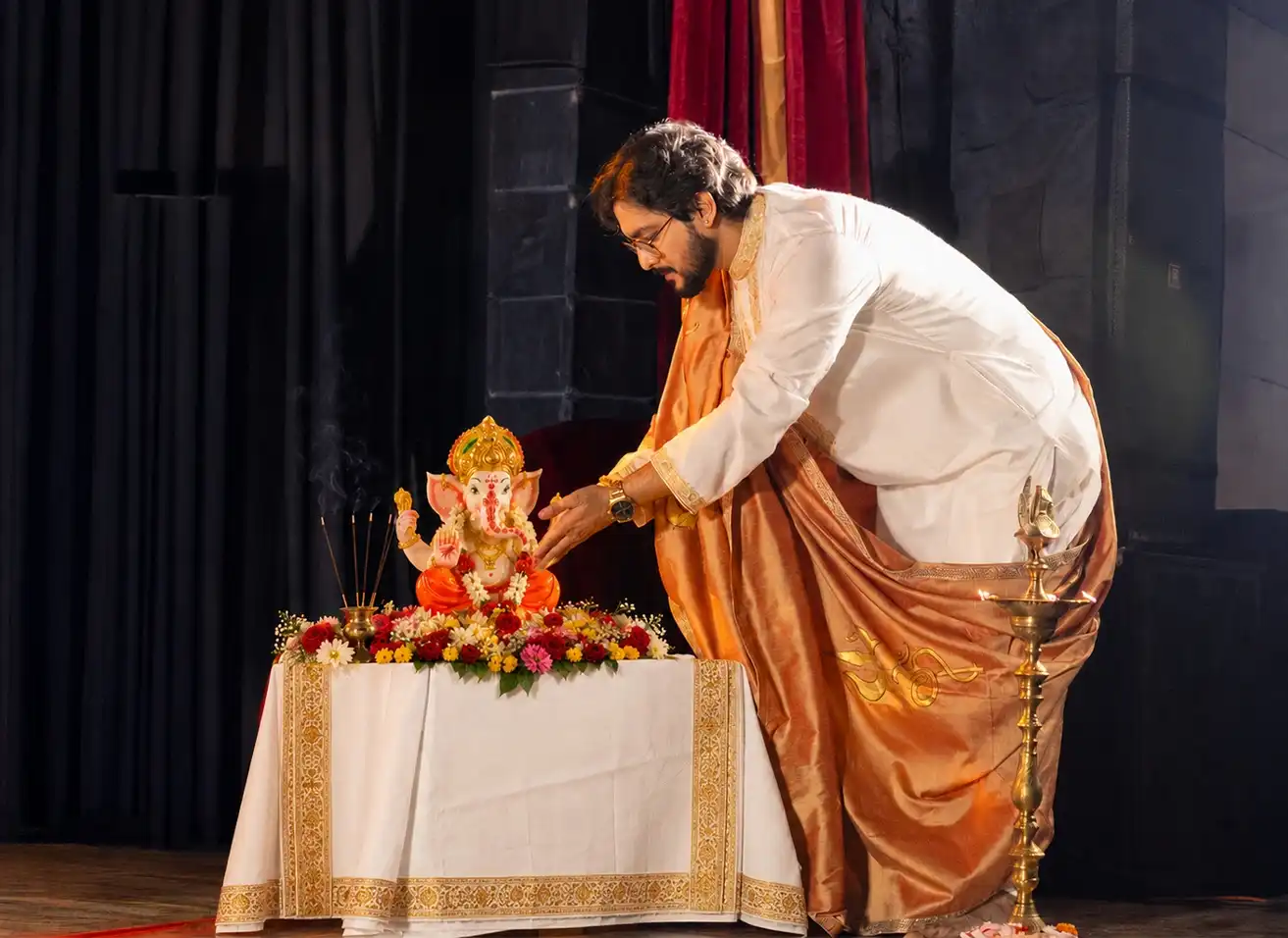
Lord Ganesha is known as Vighnaharta, meaning the remover of obstacles, and is widely invoked at the beginning of Hindu ceremonies and important undertakings. Devotees traditionally seek his blessings before beginning activities such as weddings, religious festivals, journeys, educational pursuits, and new business ventures. His elephant head, association with wisdom, and reputation for overcoming difficulties make him an important symbol of auspicious beginnings. In many Puranic and Tantric forms of worship, Ganesha receives an initial invocation before the principal deity of the ceremony. This practice expresses devotion and the traditional belief that his blessings help remove obstacles from the undertaking. Ganesha's position should nevertheless be understood in the context of the relevant ritual tradition. He is not automatically the first recipient in every ancient Vedic sacrificial procedure, where Agni has a distinct and fundamental role. Recognizing this difference helps explain why both Agni and Ganesha can be described as first in different forms of Hindu worship without creating a genuine contradiction between their respective religious traditions.
A Hindu household can include reverence for Agni in its daily worship, but the appropriate procedure depends on the family's religious tradition, the type of puja, and the ritual being performed. Many households begin their daily puja by lighting a diya, or oil lamp, as an expression of devotion, illumination, and auspiciousness. Some families also offer prayers to Lord Ganesha before worshipping their chosen deity. Lighting a lamp, however, is not automatically equivalent to performing a formal Vedic yajna or invoking Agni through its complete prescribed procedure. A traditional homa involves specific materials, mantras, preparation, and ritual responsibilities that may differ from ordinary household worship. Families may follow regional customs, family traditions, or instructions received from a knowledgeable priest or teacher. There is no need to assume that one household's sequence invalidates another's practice simply because their customs differ. Anyone wishing to introduce a formal fire ritual should first understand its requirements and seek appropriate guidance. Ordinary devotional worship can remain simple, respectful, and consistent with one's established family tradition.
Agni, homa, and Havana are related terms in Hindu ritual practice, but they do not refer to exactly the same thing. Agni is the Vedic deity associated with sacred fire and the divine intermediary in sacrificial worship. Homa refers to a fire-based ritual in which prescribed substances are offered into a consecrated fire while appropriate mantras are recited. Havana is another commonly used term for a fire offering ceremony and is often used interchangeably with homa in contemporary Hindu practice. The particular materials, mantras, deities, and sequence depend on the purpose and tradition of the ceremony. Agni is commonly invoked or honored in these practices because of his central relationship with sacred fire and offerings. Some ceremonies focus on a particular deity, with Agni serving as the medium through which offerings are made. Other rituals follow specific Vedic procedures with their own prescribed invocations. These terms are frequently used together, but understanding their individual meanings helps readers distinguish the deity, the ritual action, and the ceremonial process when studying Hindu fire worship.
One well-known traditional mantra used to address Agni is Om Agnaye Namah, which can be translated as salutations to Agni. It is a devotional expression acknowledging Agni as the sacred fire deity. Another important source of Agni mantras is the opening hymn of the Rig Veda, beginning with the words Agnim Ile Purohitam. This verse praises Agni as the priest of the sacrifice and the divine messenger. The appropriate mantra depends on whether someone is performing simple devotional worship, studying Vedic recitation, or participating in a formal homa. These contexts should not be treated as interchangeable because traditional Vedic chanting has particular pronunciation, accent, and procedural requirements. Beginners can learn the meaning and basic devotional use of a simple mantra without assuming that it qualifies them to conduct an elaborate Vedic sacrifice. Anyone wishing to study formal Vedic recitation should learn from a suitably knowledgeable teacher. Mantra chanting is a religious and contemplative practice; claims that a particular repetition guarantees wealth, protection, healing, or other outcomes should be approached critically rather than accepted as established facts.
Beginners can learn the correct order of Vedic rituals by first understanding the difference between Vedic yajna and household puja and later Puranic or Tantric worship practices. A useful starting point is studying the Rig Veda's opening hymn to Agni and learning why the sacred fire has such an important role in Vedic sacrifice. Students can then explore the relevant Grihya Sutras and Shrauta Sutras to understand how different ceremonies prescribe their invocations, offerings, and ritual sequences. It is equally important to recognize that the first deity invoked and the recipient of the first specific offering may not always be the same. Guidance from a knowledgeable teacher can help students understand Sanskrit terminology, mantra pronunciation, ceremonial preparation, and the differences between textual traditions. Nabatara Institute provides educational content and learning opportunities in traditional spiritual subjects, including related areas of ancient spiritual practice. Anyone interested in formal Vedic ritual studies should establish the specific tradition and level of instruction they wish to follow before choosing a course or teacher. Careful study is more valuable than memorising a single ritual sequence and applying it universally.